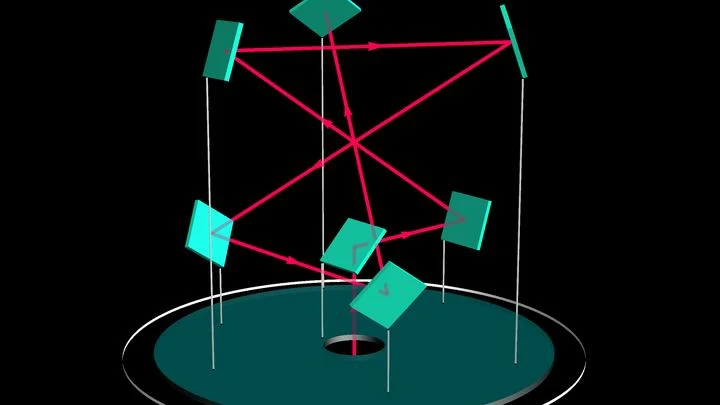
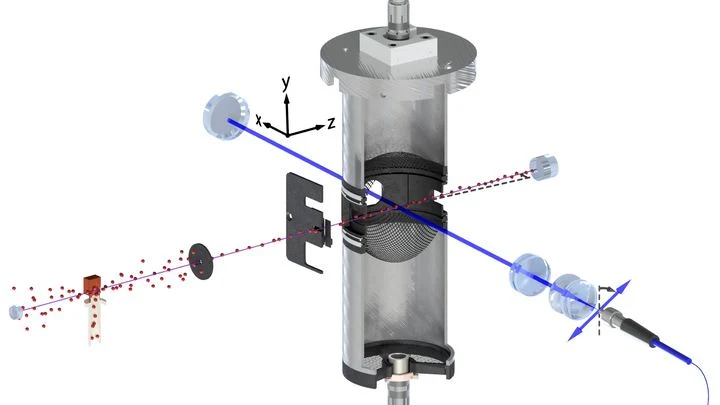
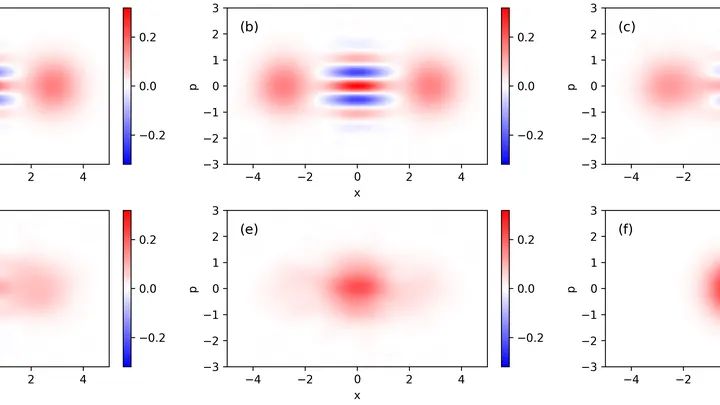
In the 1970s, Vladimir Braginsky, analyzing the limits of measurement precision in macroscopic quantum systems, introduced the concept of the standard quantum limit. It stems from the Heisenberg uncertainty principle, but applies to continuous measurements. If you illuminate a mirror with a laser to track its position, quantum fluctuations in the photon number create radiation pressure that randomly displaces the mirror. The total coordinate error has a minimum, known as the SQL. Interestingly, this limit can be circumvented using quantum non-demolition measurements and squeezed states of light.
History
Vladimir Braginsky in 1967 first pointed out the quantum sensitivity limit in gravitational wave antennas. Further development of the SQL theory is associated with the work of Carlton Caves, who formalized the concept of the standard quantum limit in the 1980s. Experimental surpassing of the SQL was achieved at LIGO in collaboration with Caroline McKenzie and others, where using squeezed states of light improved sensitivity by 3 dB. Key contributions to understanding and overcoming the SQL were also made by Yu. I. Vorontsov and Kip Thorne.
How it works
SQL limits the precision of interferometric measurements, such as gravitational wave detectors, atomic force microscopes, and optical traps. For free masses, the limit depends on the measurement time: Δx SQL ~ √(ħτ/m). For a harmonic oscillator, there is a resonant regime where the SQL is reached when measuring amplitude. Overcoming the SQL is possible using quantum non-demolition measurements (measuring only one quadrature without disturbing the other) or squeezed states. Modern LIGO interferometers already operate below the SQL for certain frequency bands.
In practice
LIGO and Virgo gravitational wave detectors constantly hit this limit, requiring sophisticated quantum tricks to overcome it and detect tiny fluctuations of space-time.
Fun fact
LIGO gravitational wave observatories already operate in a regime where sensitivity is limited by quantum effects rather than classical noise.
A superconducting quantum interferometer is a device that senses magnetic fields billions of times weaker than the needle of an ordinary compass. Inside it, there is a narrow bridge where superconductivity briefly breaks.
In 1996, physicists asked: how much noise can a quantum channel withstand before it stops transmitting information? A phone call where every third word is replaced by random noise is still understandable. Up to what level of interference can the listener still grasp the meaning?
A laser beam passes through a glass cell filled with cesium vapor. The atoms in the vapor dart around chaotically, like a crowd at a train station: each one enters the beam, spends a moment there, and flies back out. Their internal state, something like the orientation of a tiny magnet, changes under the influence of light. If all atoms were identical and stationary, the signal would be steady.
A camera looks at two distant sparks. They're so close together that they merge into a single fuzzy blob. It seems impossible to tell them apart — the classic limit of optical microscopy has been reached.
But quantum mechanics hints that the light field still holds a secret about where each spark sits.
A camera looks at two distant sparks. They're so close together that they merge into a single fuzzy blob. It seems impossible to tell them apart — the classic limit of optical microscopy has been reached.
But quantum mechanics hints that the light field still holds a secret about where each spark sits.
Light escaping a massive body loses energy: its waves stretch, and its color shifts toward the red. This is gravitational redshift, known since the work of Einstein.
The quantum vacuum is not empty: it is permeated by entanglement linking distant regions. But when physicists tried to compute this entanglement, it turned out to be infinite. The culprit: particles with very low energy that can smear out over arbitrarily large volumes. They are like waves with no shores to contain them.
The cosmic dawn is hidden behind a dense veil of time. To see beyond it, you need to catch the radio signal from clouds of neutral hydrogen — the so-called global 21 cm signal. But it is so faint that the receiver's own noise drowns it out.
Imagine photographing a statue in dim light. You face a dilemma: take one bright shot or a series of dim frames from different angles. In the first case, quality is limited by photon noise, the graininess that arises from a lack of photons, while in the second, details overlap, making it harder to reconstruct the 3D structure.
A laser is like a tuning fork that rings at a single note. But even in complete silence, its sound trembles slightly. Previously, it was thought that this tremor, random kicks from spontaneous emission of light by atoms inside the laser, was the main limit to precision.
The quantum world loves balance. When a massive particle is forced to split, to go down two paths at once, something must give way in response. That "something" turns out to be the very apparatus that split the particle.
Photographing hummingbird wings with an ordinary camera gives a blurry smudge. For a sharp picture, you take many rapid shots from different angles and piece them together: that's how a quantum 'snapshot' is made. In the lab, scientists 'feel' the vibrations of a tiny mirror with a laser beam.
A laser beam in a multi-kilometer tunnel trembles as a gravitational wave passes, but the tremor is barely perceptible, on the scale of fractions of a proton's diameter. To hear this cosmic whisper, physicists squeeze every last bit of performance out of light.
Light or sound can be confined in a tiny region of a crystal, like a pearl in a shell. Usually, two methods are used. The first is like a heavy ball in a pit: a particle with large mass simply cannot roll out. The second is a perfect cage of mirrors, where waves cancel each other everywhere except in the trap itself.
Quantum electrodynamics, or QED, describes how light interacts with charged particles — for example, electrons. It is one of the most precise theories in history: its predictions match experiment to the eleventh decimal place.
A laser isn't just about light. If you make a particle oscillate like a pendulum and those oscillations sustain themselves, you get a phonon laser. Sounds complicated, but the idea is simple: instead of light waves, the device emits orderly waves of mechanical vibrations — phonons.
Atomic nuclei are rarely perfect spheres. More often, they resemble a slightly squashed ball — the electric charge inside is unevenly distributed, and protons may shift a bit, creating a tiny 'pear-shaped' bulge.
Any measuring device is spoiled by quantum noise — the chaotic jitters of elementary particles. To tame it, physicists used a trick on calcium fluoride molecules, much like squeezing a balloon: press in one spot, and it bulges in another.
Imagine a library where instead of books, you have every conceivable combination of a few dozen quantum particles. The number of combinations grows like a snowball: add one particle, and the volume doubles. For fifty particles, there are more shelves than atoms in the visible universe.
A quantum computer measures a molecule's energy much like an old tape measure that only has markings every meter. If the actual length of a table is 2.37 meters, the tape shows “two and a bit,” and you can't do better. Physicists call this resolution: the step of the grid, finer than which you cannot go.
The authors of the new work turn this flaw into an advantage.
Even at absolute rest, atoms emit a faint noise — unavoidable quantum jitter. In the debates between Einstein and Bohr, this noise, like an unceasing whisper, blurs the interference fringes from an atomic slit. Overcoming this limit was considered impossible.
In a water supply system, water sometimes flows not as a continuous stream but in separate identical portions, as if the tap opens and closes, letting through exactly one drop each time. This is roughly how electric current behaves in superconducting contacts called Josephson junctions.
Four tiny puddles, and in them ripple droplets of a superfluid. These droplets are atoms cooled to near absolute zero and paired up like little magnets. When the whole setup rotates, the fluid flows between the puddles. Simply counting how many droplets end up in each reveals the angle and angular velocity.
Strike a bell, and it responds with its own note. Likewise, a black hole disturbed by the fall of a star or another black hole begins to 'ring,' emitting gravitational waves. But instead of sound, it's the trembling of space itself, and instead of a single note, a whole set of decaying frequencies. These are called quasinormal modes.
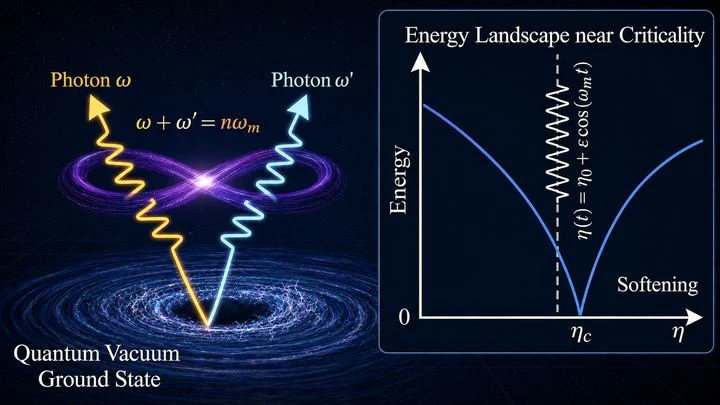
The quantum vacuum is not emptiness, but a tautly stretched string, where particles constantly appear and vanish. Abruptly changing conditions, like shifting the mirrors of a microcavity, causes the 'string' to emit real photons.
If space is a canvas, then brushstrokes cannot be infinitely thin. There's a tiniest segment, shorter than which there's no point in measuring. This quantum 'graininess' alters the geometry itself: the motion of galaxies and the growth of large-scale structures bear its mark.
Atomic clocks are pendulums that tick at the frequency of light. Inside a trap, an aluminum ion hangs, and a laser probes it like a tuning fork. If the laser's frequency matches the atom's natural frequency, the atom responds. The clock's rate is checked against this response.
A quantum computer is a finicky instrument. Each measurement of its state is like photographing a fast-moving object: the shorter the exposure, the higher the chance of getting a blurry shot. But if you skillfully process a series of such snapshots, you can reconstruct a clear picture.
That's exactly what the researchers did.
A quantum dot is like a tiny lamp that turns on and off at the command of a laser, emitting exactly one photon at a time. But this light has a quirk: the photons don't interact with each other; they fly independently, like random drops from a faucet.
Imagine reality as an undeveloped photograph: until the moment of measurement, it exists only as a cloud of probabilities — a superposition of all possible states. Only the act of observation, like developing film, forces a particle to acquire definite properties.
A quantum dot the size of a virus, squeezed between mirrors, gives birth to two photons in a short flash of light. These photons fly out as a pair, and their polarizations, the directions of wave oscillation, are linked such that knowing one instantly tells you the other.
A laser beam is like a taut string: even in complete silence, it trembles almost imperceptibly. This trembling is quantum noise, and it gets in the way of ultra-precise measurements. Physicists have long sought ways to calm the string, and one of them is "squeezing" light: reducing the trembling in one direction while allowing it to increase in another.
The hydrogen atom is like a tiny clock, ticking with a precision engineers can only dream of. When an electron jumps between orbits, it absorbs or emits light at a strictly defined frequency: that's the 'tick.' In the new work, physicists caught one such transition, between the 2S and 6P states, and measured its frequency with an…
Light can be more than just a stream of particles; it can be a wave with a specific shape over time. Sometimes this shape changes so rapidly that capturing it is like photographing a bullet in flight. Scientists have devised a way to measure such fleeting quantum states of light.
For this, they use a device called a balanced homodyne detector.
A laser beam usually quivers slightly, like a plucked string. In optical clocks, that quiver turns into timing errors. Engineers swapped the shaky light for steady light, and rubidium vapor clocks started ticking five times more evenly.
A quantum sensor is like a telegraph line transmitting a hypersensitive message. The slightest disturbance distorts the signal. It used to be thought that accurate measurement required an error-free 'telegraphist' — a perfect error-correction system. But in practice, all elements are noisy. The new approach allows for errors at every step: in sending, verification, and reception.
Building ultrasensitive sensors for light measurements and spectroscopy starts with tiny chambers where light ricochets like an echo in a canyon. Previously, engineers chased the quality factor — the duration of this echo: the longer it rings, the more noticeable the slightest changes.
A crowd of thirty-one quantum sensors whispers within a diamond slab. Previously, this whisper was drowned out by the roar of floodlights: the random photon bursts used to read out the spin states masked the ensemble's own quantum noise. Now physicists have learned to switch off the floodlights and listen to the crowd itself.
A century ago, quantum mechanics gave the world a neat picture: a particle rotating around a point can only have certain discrete amounts of angular momentum, integer multiples of Planck's constant. This rule seemed as solid as the law of gravity, and it followed from simple algebraic arguments.
A quantum state under continuous measurement is not a frozen picture but a random dance. Each measurement outcome nudges the state one way or another, and to predict the future you have to track the entire trajectory.