A linear relationship is like an ideal rubber band: elongation is strictly proportional to force. In reality, things are more complex: a bridge swaying in the wind can suddenly resonate and collapse; heart muscle can sometimes lapse into fibrillation. Nonlinear dynamics studies systems where the superposition principle breaks down—the effect is not the sum of independent causes. Here, feedback loops give rise to astonishing effects: self-organization, bifurcations (branching of states), and chaos.
History
Henri Poincaré in the late 19th century laid the foundations of the qualitative theory of differential equations, first realizing the complexity of behavior in celestial mechanics. In the 20th century, the work of Alexander Lyapunov, Andrey Kolmogorov, Vladimir Arnold, and Jürgen Moser (KAM theory) explained the conditions for the preservation of ordered motion in perturbed systems. Computer experiments by Lorenz, Feigenbaum, and others in the 1960s–1980s revealed universal scenarios for the transition to chaos and sparked an explosive growth of interest in nonlinear dynamics.
How it works
The state of a nonlinear system is defined by a set of variables, and the rate of their change is given by nonlinear functions of these variables. Analysis often begins with finding equilibrium points and studying their stability according to Lyapunov. When a control parameter is varied, an equilibrium point may lose stability, and the system undergoes a bifurcation, switching to a new regime—for example, from a steady state to periodic oscillations (Andronov–Hopf bifurcation). With further parameter changes, a cascade of period-doubling bifurcations often leads to chaos—irregular, aperiodic motion with high sensitivity to initial conditions, characterized by positive Lyapunov exponents. Many phenomena, such as turbulence in fluids, are described by nonlinear partial differential equations (e.g., the Navier–Stokes equations), where the nonlinear term (v·∇)v is responsible for energy transfer between scales.
In practice
Navigation systems account for nonlinear effects to achieve precise positioning, while engineers combat nonlinear vibrations in bridges and aircraft.
Fun fact
The soliton—a solitary wave traveling down a channel without changing shape—was discovered in 1834 when engineer John Scott Russell spotted one on a canal and chased it on horseback for several kilometers. Solitons behave like particles and obey nonlinear equations.
An orchestra without a conductor: each musician tunes to a neighbor, and out of that comes a well-coordinated melody. In the world of microscopic magnets, the role of that orchestra is played by a tiny neodymium sphere levitating above a superconducting film.
The interpreter in the meeting room hears the shift in tone before it is spoken aloud. They catch subtle changes in breathing, pauses, and intonations, and already know that in a few minutes the conversation will turn heated.
Imagine a large orchestra without a conductor. Each musician hears everyone else and adjusts to the collective hum. If every instrument amplifies its neighbors, the sound builds to a screech; if some occasionally dampen it, the orchestra may fall into silence or break into cacophony.
A superconducting detector usually works like an honest ruler: absorb a photon, get a pulse whose amplitude is strictly proportional to the energy. This mode is convenient, but it has a ceiling: a weak signal easily gets lost in the amplifier noise.
Now imagine a swing.
A superconducting detector usually works like an honest ruler: absorb a photon, get a pulse whose amplitude is strictly proportional to the energy. This mode is convenient, but it has a ceiling: a weak signal easily gets lost in the amplifier noise.
Now imagine a swing.
A sponge slowly watered from a watering can gets soaked all the way through. But if you dump the same bucket of water on it all at once, the middle gets wet while the edges stay almost dry. That's roughly how a material with nonlinear absorption behaves: the more intense the flux, the more it gets stuck at the point of impact.
Inside a piece of aluminum, atoms are arranged in neat rows, like bricks in a wall. But sometimes a row ends before reaching the edge, and a "step" appears in the crystal, which physicists call a dislocation. These defects determine how strong, ductile, and how a metal behaves under load.
A forest does not live in a static world. Between winter and summer, day and night, conditions shift, and each fluctuation is like a rhythm that all its inhabitants must keep pace with. Yet until now, ecologists have mostly studied how communities of living beings persist in an unchanging environment, like testing a bridge's strength only in calm weather.
Two daughter cells receiving equal shares from the mother: that's the familiar picture of division. But what if one gets almost everything and the other just crumbs? Stochastic modeling shows that sometimes unequal division is more advantageous.
Each cell stores a protective reserve that helps it weather hardships. During division, this reserve is distributed between daughters.
Holding in mind the exact position of a pen as it's slowly moved is a routine task for the brain. For artificial neural networks, it's nearly impossible. Standard recurrent networks like GRU and LSTM tend to break continuous motion into rigid steps: the pen doesn't glide smoothly but jumps from point to point.
A neural network predicts the future of a system — say, how plasma will swirl in a magnetic field or how a face in a video will change. Errors are inevitable, and the further it looks ahead, the more they accumulate. Checking against the correct answer during operation is impossible: it simply doesn't exist.
One hundred milliseconds. In that time, after a lightning strike or a short circuit, the power system either returns to normal operation or loses stability. A new-generation Neural Network Oscillations learns to sense this moment, like an experienced tightrope walker anticipating a gust of wind.
A cloud of waves collapses under its own gravity. While it's loose, everything goes by the book: the field oscillates gently in nearly flat space, and approximate formulas work perfectly. But add just a bit more energy, and the picture changes.
Physicists used a numerical model to catch the moment when simple calculations stop describing reality.
$$10^{-35}$$ seconds. A tiny instant during which the Universe manages to expand by a factor of $$10^{26}$$. Immediately after, it goes through thousands of rapid transformations — like a ball bouncing along a chain of tunnels. This cascade is the essence of chain inflation, first proposed by Alan Guth.
A solid under a microscope is not a monolith at all. In glass, polymer, or solidified resin, atoms are arranged randomly, and as a result, the material's properties vary from point to point. On large scales, we are used to describing them with smooth fields, like temperature or pressure in a room. But when you zoom down to a few atomic layers, that smoothness disappears.
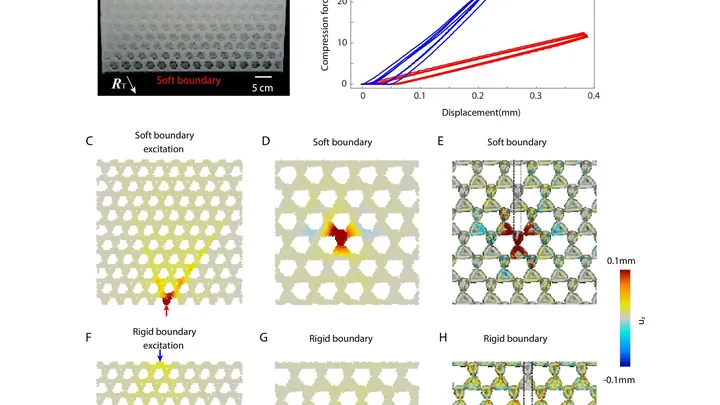
Bending a sheet of paper is easy. But compressing it by pushing from the edge is a different story: the paper will crumple but barely transmit the force further. That's how ordinary elasticity works — deformation depends on where and how you press. The new three-dimensional lattice pushes this contrast to the limit.
A stable system behaves like a ball in a bowl: give it a push, and it rolls back to the bottom. The spread of possible trajectories, uncertainty, shrinks over time. But the speed depends on the slope of the bowl's walls. In complex systems, this 'bowl' has sections of varying steepness.
A person in a boat turns by shifting their body weight. An unmanned vessel uses the same trick: a sliding weight inside the hull does the steering. Its movement is controlled by a neural network, anticipating the chaos of waves and gusts of wind. The propeller pushes the boat forward, while the weight shifts balance — like moving from one foot to the other.
Complex machinery, from drones to surgical robots, sometimes behaves like a wild mustang: full of disorder and whims, where the slightest touch triggers a storm. Instead of rote memorization of formulas, the new method observes the system like a horse breaker.
A Tesla coil crackles, and a beam of light begins to rotate around it. The medium it passes through is still stable, but the field grows, and the rotation intensifies. This is not a trick but the behavior of special materials that couple electricity and magnetism. For such coupling, there is a fundamental limit — the Tellegen limit.
2 is the threshold beyond which a well-behaved sequence risks losing its structure.
Instead of the usual uniform scale, picture a rubber ruler with uneven elasticity. That's exactly how Orlicz spaces work: Banach spaces of sequences where each scale has its own stiffness, described by a convex Young function (a kind of spring).
A sheet of rubber is squeezed from two sides. At first glance, it's just deformation. But inside, deep within the material, a hidden order awakens. This is not just wrinkles on the surface. It's the birth of special zones where vibrations become trapped, as if in a cage.
Previously, it was thought that such effects require intricate lattices and periodic structures.
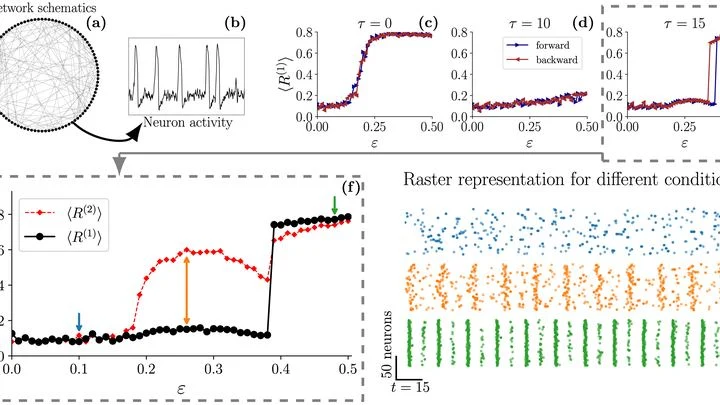
A neuron sends a signal to its neighbor. The neighbor doesn't respond immediately — the impulse travels along the process at a finite speed, like a letter delayed in transit. Usually, such a delay is considered a nuisance, but in this new work, it becomes the conductor.
When two excitable neurons are connected with a delay, a rhythm spontaneously emerges between them.
Air flowing over a wing or turbine blade behaves like a string: it starts smooth and layered: that's the laminar regime. But as speed increases or external ripples appear, the string breaks into chaotic vibration — turbulence. Predicting the exact moment of breakdown is crucial: it affects drag, heating, and noise.
A handful of sand falls onto a table: each grain rolls down until it rests in a hollow. That's how a potential works: the table's surface tells the grains where to go. But in a river with whirlpools, there's no single basin everything flows into. Water swirls, returns, and meanders. For such systems, the usual map of 'pits and hills' doesn't apply.
A stone falls into a pond, and ripples spread evenly in all directions. But some media behave as if the wave knows which way to turn, like water that only swirls clockwise. This asymmetry comes from odd viscosity and odd elasticity — properties of media with broken mirror symmetry.
When the conductor leaves the orchestra, the musicians keep playing from memory for a while. But without a unified rhythm, each one starts to speed up or slow down on their own, and the harmonious symphony turns into disjointed noise. According to new research, the brain and heart behave much the same way in the last hours of a person's life.
A busy intersection without traffic lights. Cars drive, brake, and change lanes, and from the outside, it looks like complete chaos. But if you watch for a while, you can notice a rhythm: the flow thickens and thins. In physics, this rhythm of disorder is called entropy: it shows how far a system is from calm equilibrium, like water in a boiling kettle.
The room is quiet, just footsteps and an internal count: “one-two, one-two.” After a minute, the gait stiffens, legs move like pistons. Forget the count and just walk — the body relaxes, the step becomes smooth. The difference between these two states is not just a feeling. It's written in numbers, and those numbers tell the story of how the brain controls movement.
Imagine a long corridor with many doors that open and close in a strict rhythm. If you send sound down it, the echo from each door will distort the melody, and a crooked wall at the end will throw off the entire rhythm. It would seem that understanding what's happening deep inside is now impossible.
But there's a trick.
An ordinary thread sewn into fabric can listen to the body. It feels the chest rising with each breath, a finger bending, and the pulse beating at the wrist. All this — without stiff patches or wires, just as part of your clothing.
The sensor is made from a flexible thread that changes resistance when stretched or pressed. It is woven into fabric in a triangular pattern, like a fine mesh.
When you pull on a piece of metal, it changes shape and simultaneously becomes stronger. The secret lies in tiny defects in the crystal lattice called dislocations. They are like wrinkles in a rug: moving a wrinkle shifts the rug more easily than dragging the whole rug.
Toss a handful of sand on the floor: there are few large grains, many medium ones, and even more tiny ones. This skew, where small events are common and large ones are rare, is described by a power law. It shows up in city sizes, earthquake magnitudes, and citation counts of scientific papers.
A neural network learning something new is like a traveler in mountainous terrain. Each piece of learned knowledge is a depression in the landscape into which the traveler rolls and gets stuck. To escape and reach a new basin, energy is needed. But as the traveler gains experience, the walls of their pit become steeper, and each subsequent climb requires more effort.
Lymphatic vessels are one-way streets. Through them, fluid flows only forward thanks to tiny flap valves. These valves open in just one direction, creating asymmetry, directionality, without which the flow would stop.
In the lab, scientists modeled a vessel and sent compression waves along it, like a parade of gentle nudges.
Water in a river flows around rocks, air bends around an airplane wing: these motions are described by equations that are hard to solve even on a powerful computer. Neural networks can approximate such solutions, but they often err when data is collected at only a few points or is noisy.
A ball drops to the floor, squashes for an instant, and flies back up. How much energy it returns depends on the material: rubber bounces back to nearly the same height, while a lump of clay just splats and stays put.
A flat sheet with slits in a flow of water or air behaves like self-adjusting blinds. The pressure opens the gaps, and each strip of material tilts, turning into a miniature wing. Thus, even a sheet placed perpendicular to the flow generates not only drag but also significant lateral lift.
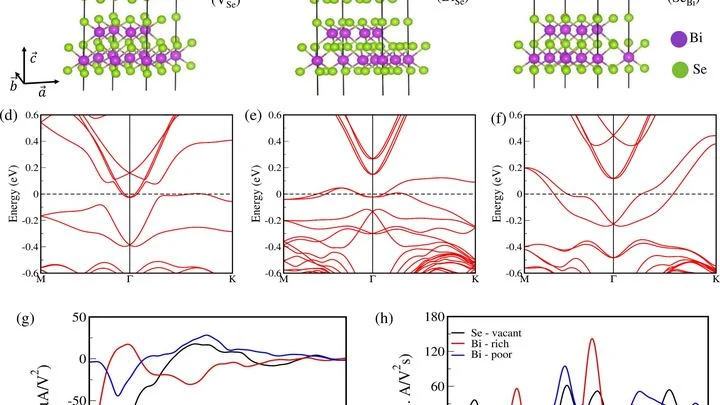
The crystal bismuth selenide (Bi₂Se₃) is symmetric by itself, like a neatly stacked sandwich: flip it over, and nothing changes. But twist one layer slightly relative to the other, and the symmetry breaks. The material begins to 'feel' which side the light comes from and responds with an electric current.
A Network That Decides When to Stop
A crowd grows: each new person joins the group with a probability that depends on how large the group already is. If the group is small, joining is easy; if it is huge, people start to hesitate, and growth slows down. This mechanism, called feedback, changes the entire behavior of the network.