Quantum van der Pol Oscillators: A Dance Without a Soloist ✛
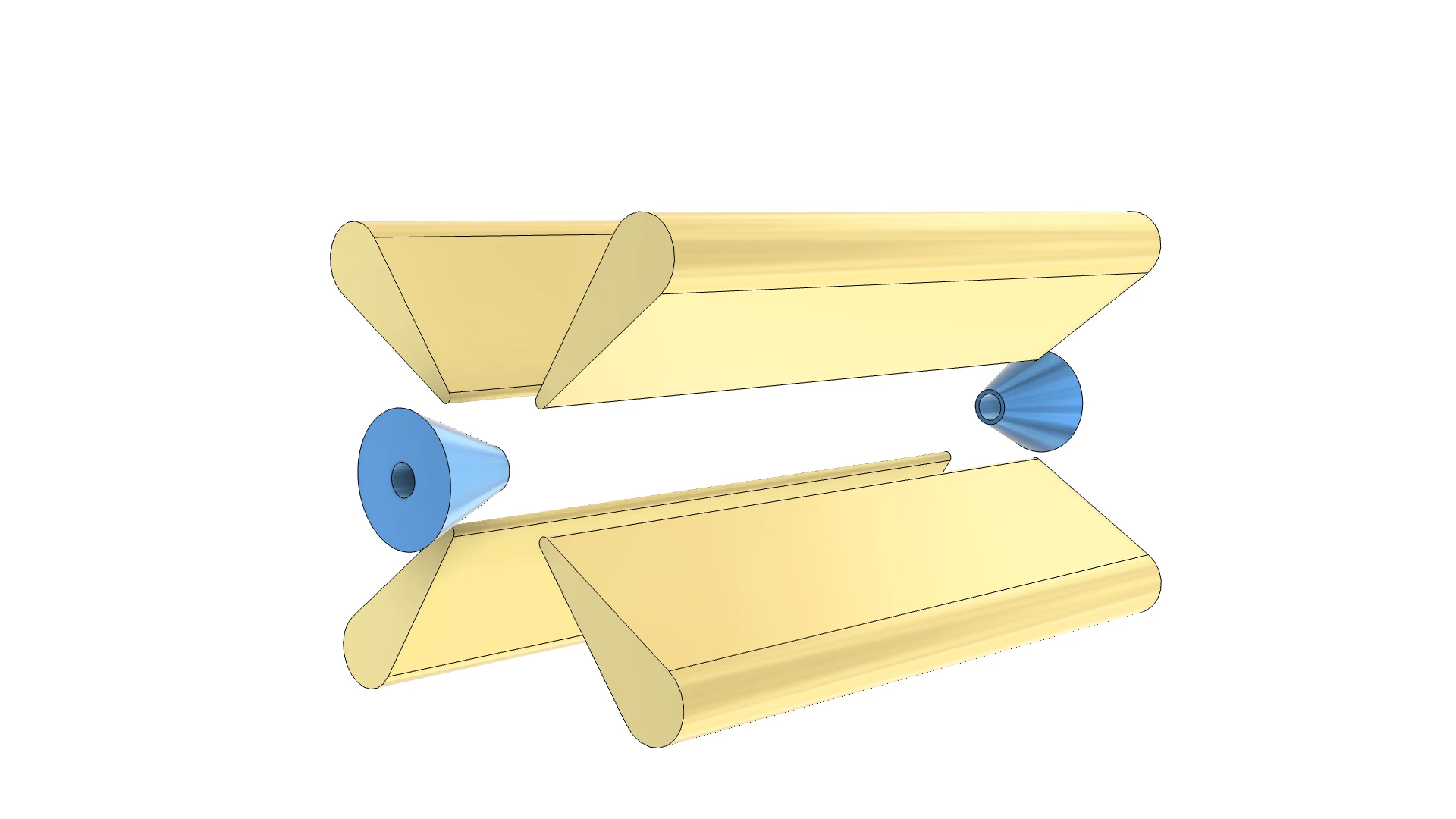
Two pendulums on the same wall, swinging out of step, will be in sync within an hour. Christiaan Huygens noticed this synchronization back in 1665, watching the clocks in his workshop. Today, researchers repeat his observation in the lab, but with a twist: the pendulums are not wooden but quantum.
In an ion trap, where two calcium ions of different isotopes hang in vacuum, physicists made two crystal modes oscillate: one in-phase, the other out-of-phase. Each mode is a van der Pol oscillator, that is, a self-oscillating system with nonlinear damping. Using laser pulses on the sidebands of the 729 nm transition, they imparted negative damping and nonlinear losses, creating a limit cycle: a closed trajectory that the system tends toward. Then, by exciting common red sidebands, they coupled the oscillators through collective dissipation, meaning shared damping. And here is the result: the relative phase between the modes became stable, and its value was set by the coupling phase. With zero phase, the oscillators swung in unison; with π, they moved in antiphase; and with π/2, they circled in quadrature space.
This dance without a soloist is a metaphor for the entire work. No one sets the rhythm from outside; order emerges from mutual energy exchange through a shared environment. In the classical world, this is how fireflies in a forest or neurons in the brain synchronize. In the quantum limit, where noise and measurement backaction erase phase, such an effect had eluded experimentalists. Now that two quantum oscillators have synchronized for the first time through mutual dissipative coupling, the path opens to networks of many limit cycles. One could explore quantum chimera states, where part of the system is synchronized and part is chaotic, or topologically protected synchronization that is robust to defects. For quantum metrology, such synchronized networks promise sensors with improved sensitivity, and for quantum computing, new ways to control bosonic codes through engineered dissipation.
Huygens, seeing his pendulums, could not have known that three and a half centuries later his discovery would be repeated at the level of single quanta. But the dance without a soloist continues: now in a trap, where two ions, linked by shared damping, behave as a single ensemble, even though each individually remains quantum chaos.
Synchronization was first described by Christiaan Huygens in 1665, when he noticed that two pendulum clocks hanging from a common beam would swing in opposite phases.
In the series 'Altered Carbon', synchronization of consciousness through a shared network resembles quantum synchronization, where oscillator phases align through a common dissipative medium.