In experimental physics, a cycle is a single complete pass through a repeated sequence of operations. In the context of quantum optics and ion trapping, a cycle typically involves preparing, manipulating, and measuring a quantum system — for example, delivering photons to ions to drive a transition, then reading out the resulting state. The cycle is the fundamental unit of repetition in an experiment, and its duration and fidelity directly determine the overall data quality and the number of measurements that can be accumulated.
How it works
A cycle begins with initialization: the system (e.g., a trapped ion) is prepared in a known state, often via optical pumping. Then a sequence of operations — such as laser pulses, microwave drives, or photon deliveries — is applied according to the experimentalprotocol. Finally, a measurement is performed, and the outcome is recorded. The entire sequence is then repeated many times, with each repetition constituting a new cycle. The results from many cycles are aggregated to build statistics and extract the desired physical quantity.
In practice
Cycles are the backbone of quantum information experiments, where thousands to millions of repeated cycles are needed to perform quantum error correction, generate entanglement, or run quantum algorithms on trapped-ion or photonic platforms.
Fun fact
In some trapped-ion experiments, a single cycle can take just a few microseconds, yet millions of cycles are needed to produce a single high-fidelity entangled state.
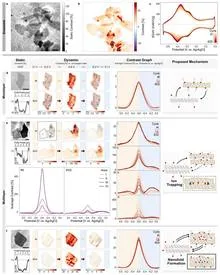
A stack of pages that has been flipped through many times remembers it: some sheets lie flat, others stick up, and creases remain here and there. Layered materials behave much the same way when ions enter them.
In the world of atoms and particles, everything tends toward rest: particles lose energy, just as a swing slows down due to energy loss (friction). But many devices — from hydrogen masers to atomic clocks — live by repetitive cycles.
In the mountains, there is a saddle — a point where the trail from one valley crosses over into another. Standing exactly on it, you take a step and are already descending the new slope. In chemistry, such a place is called the transition state: a brief moment when atoms are frozen on the threshold of transformation.
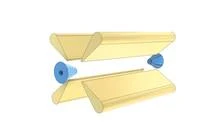
An optical tweezer is a laser beam that holds an atom in place, much like fingers holding a pea. Arrays of these tweezers form the basis of future quantum computers. But there's a catch: not every tweezer catches an atom. Typically, only half of the traps get filled, and for molecules, even fewer. Empty spots break the whole setup.
A quantum computer is like an orchestra where every musician must play with precision down to a billionth of a second. If one instrument goes out of tune, the whole symphony collapses. So scientists spent a year watching 27 qubits — the simplest cells of quantum memory.
Salt in a glass of water is a crowd of charged particles. When there's plenty of water, each particle floats on its own, wrapped in a thick fur coat of water molecules. But as you keep adding salt, the water runs out for everyone, and the particles start seeking each other out. First, they stick together in pairs, then in larger clumps.
Two pendulums on the same wall, swinging out of step, will be in sync within an hour. Christiaan Huygens noticed this synchronization back in 1665, watching the clocks in his workshop. Today, researchers repeat his observation in the lab, but with a twist: the pendulums are not wooden but quantum.
Light is a finicky guest. It flies into a cavity but doesn't stay: part of the pulse inevitably reflects and carries away quantum information. Classical single-pass capture schemes hit this limit no matter how much you improve control. Reflection was considered a loss, but the authors of a new study suggest looking at it differently.