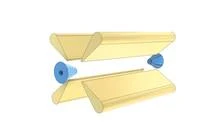
An optical clock is a timekeeping device that uses the oscillation of light at optical frequencies (hundreds of terahertz) to define the second. Because optical transitions occur at much higher frequencies than microwave transitions used in traditional atomic clocks, they can be divided into more 'ticks' per second, allowing for far greater precision. Optical clocks are so accurate that they would not lose or gain a second over the age of the universe.
History
The concept was proposed in the 1980s, but practical optical clocks emerged in the 2000s after the invention of the optical frequency comb (2000 Nobel Prize in Physics). The first optical clocks achieved accuracy surpassing microwave clocks in the 2010s.
How it works
A cloud of atoms (e.g., strontium or ytterbium) is laser-cooled and trapped in an optical lattice. A laser is locked to an atomic transition, and the frequency of this laser is counted using an optical frequency comb. The clock's output is the number of optical cycles per second, which can be compared to other clocks via optical fiber links.
In practice
Used in geodesy to measure gravitational potential differences, in fundamental physics tests (e.g., variation of constants), and as future candidates for redefining the SI second.
Fun fact
Optical clocks are so precise that they can detect a change in altitude of just a few centimeters, due to gravitational time dilation.
A laser pulse hits a thin film of MoS₂, and inside it a cloud of electrons with excess energy starts to boil. These hot carriers are like runners who took off at high speed but, on the way to the finish line, are bound to lose all their momentum through collisions with the crystal lattice.
A conductor raises the baton, and the orchestra produces not just sound but a complex score: each note sounds at its own moment, at its own pitch, with the right volume. Light can also be a score, if you control its spectrum and timing. Previously, this required bulky setups that could not be reconfigured after assembly.
An orchestra of a hundred musicians plays without a conductor. Every instrument is tuned perfectly, but one violin goes slightly off, and the harmony falls apart.
A theater spotlight keeps the actor in its beam no matter where they step. The terahertz radar we are about to describe does the same with a short light pulse reflected off a moving object.
Terahertz waves sit between microwaves and infrared light.
The two states of a strontium atom are like twins running down the same track, but one is slightly higher than the other. Usually, the light used to manipulate atoms pushes one twin harder and the other more weakly. Here, they chose a wavelength of 813 nanometers—'magic'—where both get the same kick.
The quantum world does not forgive forgetfulness. Throw a stone into a pond — the ripples spread and vanish, the information about the impact dissipates without a trace. In quantum mechanics, everything is different: the evolution of a system is reversible, and the past is never completely erased.
The ticking of atomic clocks is like the beat of a metronome, but instead of a pendulum, it's the oscillation of electrons in an atom. Two such clocks — one using an ytterbium ion, the other using strontium atoms — were made to tick side by side, and their rhythms were compared.
The world's most precise stopwatch still runs with one eye on an old pendulum. Hydrogen masers — the best radio-frequency flywheels (devices that keep the rhythm between comparisons with a reference)—accumulate error because noise between ticks leaks into the final signal.
General relativity, which describes the structure of the universe, does not forbid closed timelike curves. But Stephen Hawking put forward the 'chronology protection' conjecture: quantum effects should destroy such curves, making time travel to the past impossible.
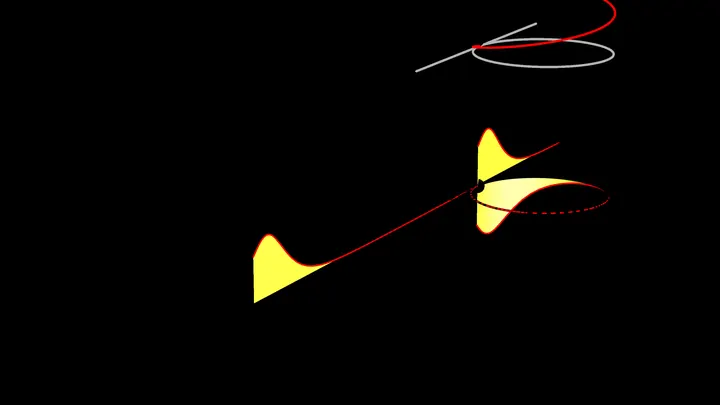
Light waves are never perfectly smooth — they are constantly jittered by quantum ripples. These almost invisible nudges were studied by Nobel laureate Roy Glauber, who laid the foundations of quantum optics. Now physicists have learned to freeze these ripples.
Ordinary atomic clocks are like a tuning fork that must be kept in perfect silence and stillness. The slightest movement, and the note goes flat. The same goes for atoms: their thermal motion shifts the frequency of radiation, so ultra-precise clocks require almost complete immobilization of the particles.
A pendulum that swings on its own, without any winding — in the quantum world, such 'pendulums' are called time crystals. In them, rhythmic motion arises spontaneously and does not decay. But until now, controlling this rhythm was nearly impossible: any intervention threatened to destroy the fragile order.
A pendulum that swings almost half a quadrillion times per second. This isn't mechanics: it's the pulse of light trapped by ytterbium atoms. Instead of gears, there's an optical lattice — a standing wave that holds atoms at its nodes like peas in a pod.
A pebble tossed into a pond sends ripples spreading in all directions. Now imagine the pond itself suddenly turning into jelly — instantly, faster than the wave can complete a single crest. Some ripples would keep spreading but change their spacing, while others would unexpectedly turn around and run back toward the point of impact, as if time were flowing backward for them.
A pendulum swings with such precision that, had it been counting seconds since the Big Bang, it would have drifted by only half a second by today. That is the stability of the new portable ultraviolet laser — the heart of aluminum atomic clocks.
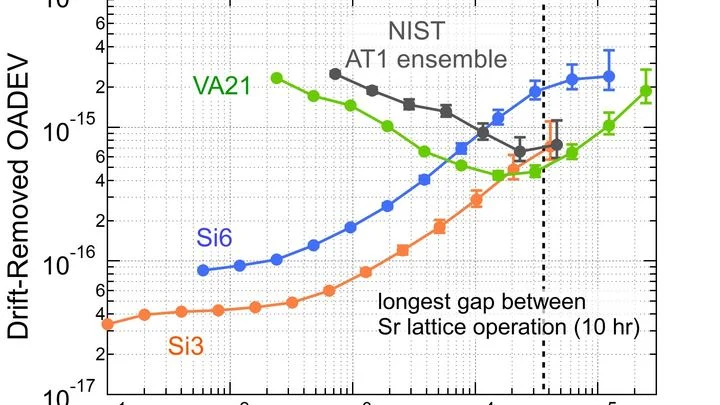
In the basements of four European institutes stood seven devices: each can be compared to a tuning fork of unimaginable precision. But instead of sound, they emit 'ticks' made of light: oscillations of a laser locked to a specific frequency by atoms of strontium, ytterbium, or mercury.
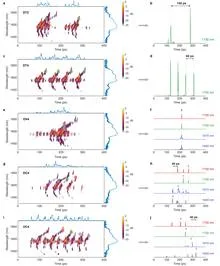
In giant accelerators, particles zip through detectors in billionths of a second, and telling one from another requires a stopwatch of incredible precision. The new µRWELL-PICOSEC detector acts as such a stopwatch: it captures the moment a particle passes with a precision of 48 picoseconds: that's 48 trillionths of a second.
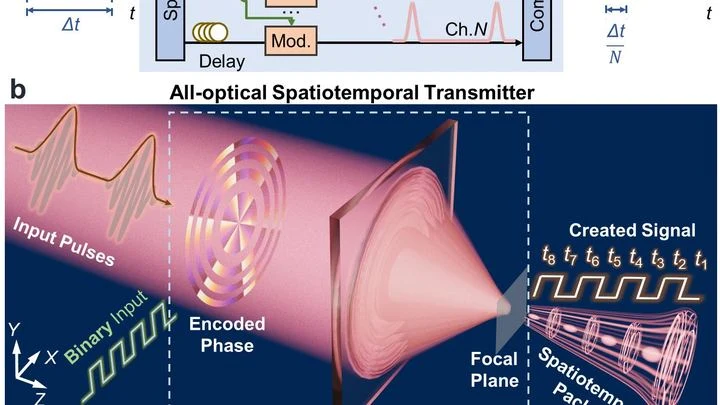
Light can carry information faster than any electronics. But usually, between a computer and a laser sits a digital-to-analog converter — a device that turns zeros and ones into electrical signals. It's the bottleneck.
The new transmitter does away with this middleman.
Atomic clocks are pendulums that tick at the frequency of light. Inside a trap, an aluminum ion hangs, and a laser probes it like a tuning fork. If the laser's frequency matches the atom's natural frequency, the atom responds. The clock's rate is checked against this response.
A superconductor is a material that, when cooled sufficiently, conducts electricity without losses, like water flowing through a perfectly smooth pipe. But if you hit it with a brief flash of light, it quickly loses this property.
A beam of light passing through a transparent plate usually keeps its color. But if you stack the plate from thin alternating layers, it becomes a grating that reflects and transmits waves selectively. This has long been used in lasers and optical filters. Now such gratings have been made to vibrate, and light started changing color.
A tiny particle floats in a laser beam like a speck of dust in a flashlight's glow. Water molecules constantly jostle it — randomly, from all sides. Usually these bumps are a nuisance: the particle twitches, and precise measurements turn into a lottery. But physicists have figured out how to turn the interference into an advantage.
If you shake a box of sand long enough, patterns appear on its surface — patterns that weren't there when the box was still. It's the same here: physicists took a cloud of cold atoms, trapped them in an optical lattice, and began shaking it periodically. This gave rise to a new state in the atoms, like a new pattern in the sand that doesn't exist without the shaking.
Two clocks in different rooms need to tick in unison. Usually, this is done by sending bright pulses or pairs of photons that arrive one right after the other. But the signal can be so weak that photons barely make it through. In this work, clocks were synchronized with light a billion times dimmer than usual.
Ordinary atomic clocks tick when an electron jumps between energy levels. But external fields and jolts can disrupt this rhythm. Highly charged ions, atoms stripped of many electrons, barely notice such disturbances: their electrons sit deep and tight. That makes them ultra-stable 'pendulums.'
The Cf17+ ion is a curium atom that has lost 17 electrons.
An ordinary comb parts hair into even strands. A laser 'comb' does the same to light: it emits not one color but thousands, spaced at exactly equal frequency steps. Such a tool has already helped measure time to billionths of a second and peer inside atoms.
Since Vera Rubin first convincingly showed that galaxies are surrounded by invisible matter, the quest to understand the nature of dark matter has remained one of physics' greatest challenges.
A laser beam passes through a glass cell containing rubidium vapor, and by how the atoms absorb light, you can determine their temperature. This is like measuring the speed of cars by the blur in a photograph: the faster the atoms move, the wider the absorption line becomes.
Inside a tiny mirrored cavity, smaller than the thickness of a hair, light is trapped and bounces off the walls many times. If you place a material that can absorb and emit light inside, the light particles (photons) start to 'dress' in excitations of the material — this is how polariton modes are born.
Heat an ordinary quartz watch by ten degrees, and it will start losing seconds each day. Atomic clocks are more precise, but they take up an entire cabinet. Diamond with a tiny defect, a nitrogen vacancy, promises atomic-clock accuracy in the volume of a grain of sand.
Two pendulums on the same wall, swinging out of step, will be in sync within an hour. Christiaan Huygens noticed this synchronization back in 1665, watching the clocks in his workshop. Today, researchers repeat his observation in the lab, but with a twist: the pendulums are not wooden but quantum.
A thin film of thorium dioxide, just 10 nanometers thick, is deposited on a steel disk. A laser pulse strikes it, but instead of the expected glow, the detector catches a stream of electrons.
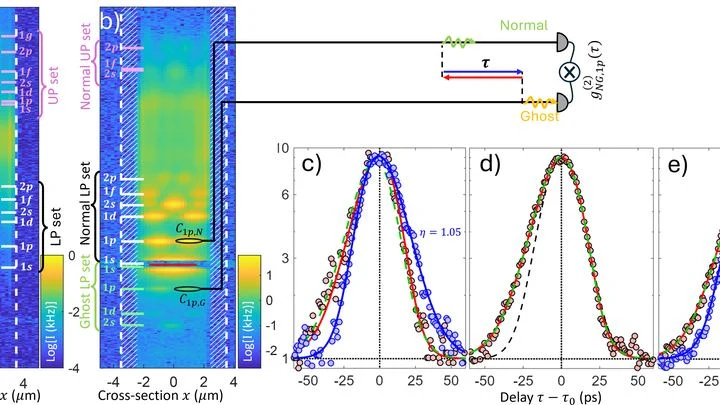
A ruler made of light: that's one way to describe a new method for measuring tiny time delays. In 1987, Chong Ki Hong, Zhe-Yu Ou, and Leonard Mandel noticed that when two indistinguishable photons hit a beam splitter simultaneously, they always exit together from the same port.