Hidden quantum entanglement is a subtle form of quantum correlation that exists in a mixed quantum state but cannot be detected by standard measurements of entanglement. In everyday quantum mechanics, entanglement is usually revealed by measuring correlations between subsystems — for example, checking whether two particles always have opposite spins. However, when a quantum system interacts with its environment, it becomes mixed, and some entanglement can become 'hidden' in the sense that it is not accessible through simple local measurements. This concept is crucial for understanding the boundary between classical and quantum behavior, especially in complex systems like many-particle solids or biological molecules.
The key idea is that entanglement can be distributed across many degrees of freedom, and when you only look at a few of them, the visible entanglement may vanish even though the overall state still contains quantum correlations. Hidden entanglement is often quantified using measures that require optimization over all possible ways of splitting the system, such as entanglement of formation or relative entropy of entanglement. These measures can reveal that a mixed state is entangled even when simpler criteria (like the Peres-Horodecki criterion) fail. In practice, hidden entanglement is detected by performing measurements on multiple copies of the system or by using sophisticated tomographic techniques.
In practice
Hidden entanglement is relevant for quantum computing and quantum communication, where mixed states are unavoidable due to noise. Understanding hidden entanglement helps in designing error-correction protocols and in characterizing the quantum resources available in realistic devices.
Fun fact
In some quantum phase transitions, hidden entanglement can signal a change in the system's order even when all visible correlations remain unchanged.
Take two thin sheets of a semiconductor. One is saturated with free electrons, like a packed café where every table is taken. The other, by contrast, is full of empty spots—'holes' eager to be filled. When these sheets are brought close together, a spark of attraction jumps between them: electrons and holes begin to feel each other across the thin gap.
Imagine an orchestra where every musician plays their own part without listening to the others. Suddenly, without any visible command, neighboring musicians begin to sync perfectly, yet there is still no overall melody.
Two entangled photons fly apart in opposite directions but continue to behave as a single whole: measuring one instantly determines the state of the other. That's quantum entanglement. But sometimes it resembles a seasoned spy — leaving no traces detectable by ordinary checks.
An infinite chain of atoms spaced at equal intervals. Shift the entire chain by one step, and the picture doesn't change. That's translational symmetry: the world looks the same wherever you look. You'd think such a simple rule would give rise to simple states, like a crystal lattice assembled from identical building blocks.
But the authors counted those blocks anew.
In particle physics, it has long been taken for granted that the forces of nature (electromagnetism, the weak and strong interactions) obey a strict symmetry called gauge symmetry. It's like a set of rules by which particles exchange force carriers. But where do the rules themselves come from?
Two particles flying apart in opposite directions behave as a single whole: measuring one instantly determines the state of the other. Such quantum entanglement has long been known for light particles, but now it has been observed for the first time in heavy Z bosons — the carriers of the weak force.
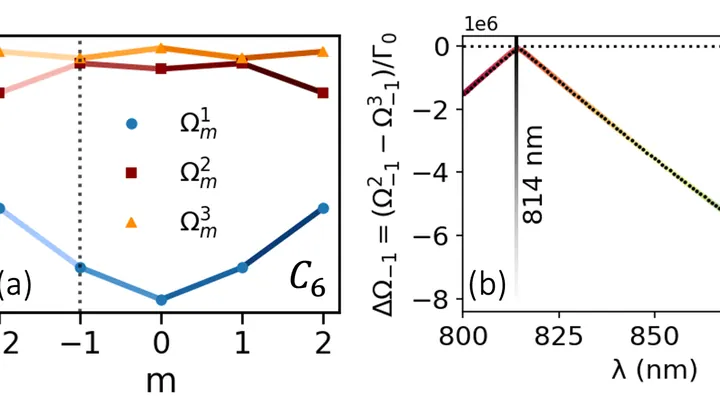
In the depths of murky ponds, purple bacteria lurk. Their secret to surviving in near-total darkness is rings of light-catching molecules, arranged like a round dance: each dancer passes energy to a neighbor. But if the round dance has fewer than seven participants, the dance breaks down — energy scatters, and disorder takes over.
Two pendulums on the same wall, swinging out of step, will be in sync within an hour. Christiaan Huygens noticed this synchronization back in 1665, watching the clocks in his workshop. Today, researchers repeat his observation in the lab, but with a twist: the pendulums are not wooden but quantum.
In 1976, Gerard 't Hooft noticed that the vacuum of a gauge theory is not as simple as it seems: it possesses a topological structure that manifests itself in a nonzero topological susceptibility.