Coupling, in quantum physics, refers to the interaction strength between quantum systems. It determines how energy, information, or entanglement flows between particles, atoms, or artificial quantum devices. Tunable coupling is a key resource for quantum technologies, allowing researchers to control when and how strongly systems interact, which is essential for building quantum processors and simulators.
History
The concept of coupling in quantum mechanics dates back to the early 20th century, with the development of perturbation theory by Schrödinger and others. Tunable coupling in artificial quantum systems became a major focus in the 2000s with the rise of superconducting qubits and other solid-state quantum devices.
How it works
In a quantum system, coupling arises from physical interactions such as electromagnetic forces between charges or spins. The coupling strength can often be tuned by external parameters, such as a magnetic field, which changes the energy levels of the systems and thus their resonance conditions. When two systems are coupled, they exchange energy coherently, leading to phenomena like Rabi oscillations or entanglement. By adjusting the coupling, researchers can turn interactions on or off, enabling precise control of quantum operations.
In some quantum experiments, coupling can be tuned so precisely that researchers can teleport energy from one end of a chain of particles to the other without any physical movement of the particles themselves.
Imagine a ladder whose rungs are tiny magnets. If neighboring magnets point in opposite directions, the ladder is "calm." But if you make them all point the same way, the whole structure becomes magnetized and "stubborn."
Scientists built such a ladder from germanium atoms — a semiconductor used to make transistors.
Drop by drop from a faucet, or a steady stream without a single splash. That's roughly what the two regimes of current in a superconducting contact look like. Only here, the role of water is played by Cooper pairs — bound electrons that move without resistance.
A polar molecule is like a tiny dumbbell with opposite charges at its ends. Normally, such particles quickly stick together or fly apart when they meet — electric forces are too strong. But the authors of the work found a way to turn this aggressiveness into a controlled game.
Imagine a quantum phase transition as an intricate dance. Electrons whirl in strict order, each step representing their spatial arrangement, and the rhythm their dynamics. For decades, physicists could only see a blur of motion, unable to tell if the figures were changing or the music speeding up.
A quantum computer relies on two forces: entanglement (particles behaving as a single whole) and "magic"—a measure of how far a state is from familiar classical physics. But how these two resources relate as a many-particle system evolves in time has remained a puzzle.
The authors approached the problem through time.
A magnetic field holds a tiny particle in mid-air, like an invisible dance partner. A special tuning of the field creates a trap with two "positions." In the ordinary world, a dancer occupies only one, but in the quantum world — both at once. Physicists have learned to achieve this for dust grains weighing trillionths of a gram.
Quantum tunneling — the ability of particles to pass through barriers forbidden by classical physics — powers stars with thermonuclear fusion, ignites primordial nucleosynthesis, and gives us flash memory.
Quantum entanglement often behaves like a synchronized dance visible from only one angle. Change the way you observe it, and the particles appear disconnected. This limits secure communications. Now physicists have created a pair of photons whose 'dance' is flawless from all perspectives.
The old question of Maxwell’s demon, can an intelligent being circumvent the second law of thermodynamics and pump heat from cold to hot, gains new resonance in the quantum world.
Neutrinos are the true ghosts of the microcosm. Nearly massless and chargeless, they pass through planets as if through empty space. But inside each neutrino hides not one particle but three — three 'flavors' (electron, muon, and tau) that constantly morph into one another. This dance is called oscillation.
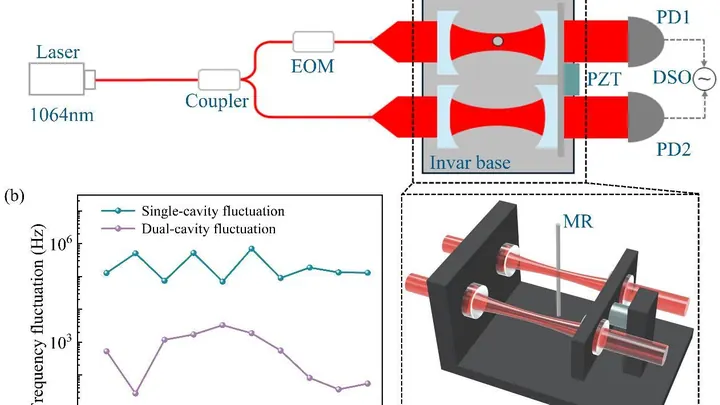
A guitar string is stretched between two mirrors. A beam of light bounces back and forth between them, and the string shudders at every touch. Sometimes the light loses energy — the string takes it and dissipates it as heat, like a fading sound. Other times, the string shifts the pitch of the light itself, changing its color but barely dimming it.
Three dancers move as one: each feels all the others, and the overall harmony cannot be reduced to individual interactions. This is roughly how three particles behave, born from an electron and positron collision at the speed of light. They are a top quark, its antiparticle, and a Z boson.
Neutrinos are nearly elusive particles that permeate everything around us. In a dense cloud, such as during a star explosion, they begin to collectively change their type, or 'flavor.' This process is like a crowd of people synchronously changing the color of their clothes, but not all at once — rather in waves.
Light is a stream of photons. In a special waveguide, resembling a narrow corridor, a 'gatekeeper' atom usually lets them through one at a time. This phenomenon is the domain of single-particle spectroscopy.
Two simultaneous interpreters sit in the same booth. The first translates from English into Russian but swallows half the words. The second goes from Russian into French, and also loses half. If you put them together, you'd expect a mess: the losses would add up, and only a quarter of the meaning would reach the listener. But what if they start correcting each other?
A driver turns the steering wheel to make the car turn. The quantum world also has its own "steering wheels"—external parameters that are slowly varied to shuttle particles from one place to another.
Two tiny spinning tops fly apart after a collision. Their rotation is not predetermined: it becomes definite only at the moment of measurement. This is quantum entanglement: the state of one top instantly responds to the state of the other, no matter how far apart they are.
Three craftsmen work in the same workshop. The first tries to figure out whether tiny hourglasses are built into nature's own machinery. The second attaches a laser pointer to a microscope to see details invisible to the naked eye. The third, conversely, takes living threads and carefully weaves them into fragile quantum circuits.
Two mailboxes at opposite ends of a city. Drop a letter in one, and an identical one instantly appears in the other. That's roughly how quantum entanglement works: two particles behave as a single unit, even when separated by a great distance. But until recently, this connection could only be maintained within a single room or across a lab bench.
In the first moments of the universe's existence, space was filled with hot plasma, where particles emerged and disappeared like bubbles in a boiling pot. The traces of these processes, stretched to gigantic sizes by expansion, are preserved in the cosmic microwave background — ancient light that has reached us across billions of years.
Inside every proton and neutron, invisible work is underway: gluons, the particles that carry the strong force, glue quarks together into a single whole. You can think of this field as rubber bands that keep quarks from flying apart.
In ping-pong, two paddles connected by an invisible thread feel each other's movements, guessing the ball's trajectory. Researchers gave a computer a similar thread — quantum entanglement. Into an ordinary trial-and-error learning program, they embedded a quantum circuit of eight qubits — particles that can spin like a coin on its edge.
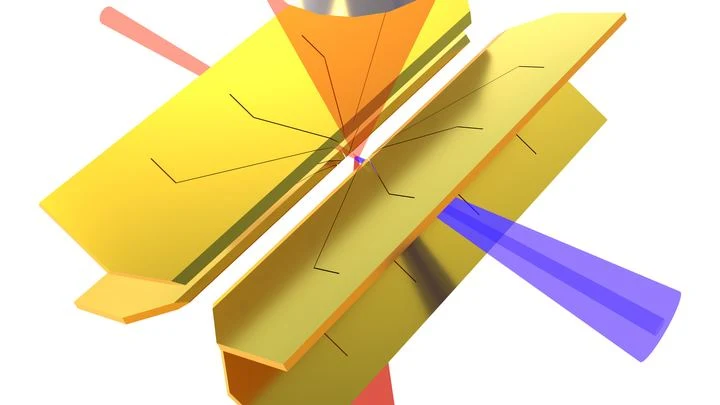
An ion quantum computer is like a chandelier with a dozen pendants: pull one, and they all start swinging. Each ion is a qubit, but when there are many, their collective vibrations crowd the stage. Any operation on one pair disturbs the neighbors, and the computation goes awry.
Inside every cell, there is a scaffold of filaments, like construction scaffolding that gives the cell its shape and allows it to move. These filaments are connected by crosslinking proteins: some simply hold them together like ropes, while others act as tiny motors that crawl along the filaments and pull them toward each other.
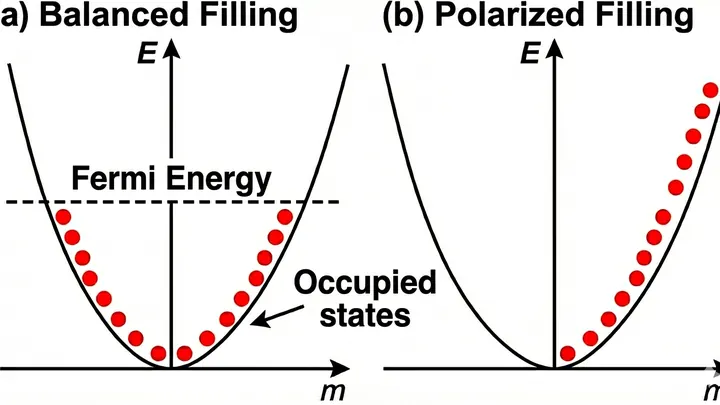
Electrons in a conductor behave like a crowd on an escalator: each one moves on its own, but together they create a flow. If you make them circle around a ring, their angular momentum (a measure of rotation) can couple to a magnetic field, like gears in a clock.
At the Large Hadron Collider, by accelerating particles to nearly light speeds, top quarks are created — the heaviest building blocks of the Standard Model. They live for vanishingly small fractions of a second but manage to exhibit complex quantum connections.
If light could be bottled, scientists would have the perfect assembly line: one bottle — exactly one photon, no stray drops. Such single particles of light are needed for quantum computers and secure communication: they carry information that cannot be eavesdropped on unnoticed.
Qubits in a quantum computer are like musicians in an orchestra: each must hear the others, or the music falls apart. But if you wire the musicians together permanently, they start getting in each other's way: that's how unwanted interactions arise in superconducting chips, spoiling computations.
Quantum sensors are like an orchestra where musicians play in unison: their entangled states let them pick up signals that ordinary instruments can't. But as soon as you start accumulating the signal, the nonlinear interaction, like a conductor who suddenly starts beating time erratically, ruins the music.
In a diamond crystal, a tiny defect sometimes occurs: a nitrogen atom takes the place of a carbon atom, and nearby a lattice site is empty. Electrons in this spot behave like a spinning top that can rotate in different directions. These 'spinning tops' are ready-made cells for future quantum computers and ultra-sensitive sensors.
In the quantum world, a collision between particles doesn't destroy their individuality but ties them into an inseparable knot: internal states and motions become intertwined like threads in an intricate tapestry.
In the quantum world, particles can walk through walls: this is quantum tunneling. If you place a detector right in the path of such a 'ghostly' passage, the moment of detection acts like a starting pistol: the particle gets a sharp kick and flies out of the barrier with excess energy, turning into a tiny engine.
Regular quantum communication is like a postal service that sends letters strictly one at a time. If the route is long, you have to wait an indecently long time for a reply. Physicists sped up the process by dispatching ten 'postal trucks' — light pulses — into a single optical fiber, but in different time windows.
Two pendulums on the same wall, swinging out of step, will be in sync within an hour. Christiaan Huygens noticed this synchronization back in 1665, watching the clocks in his workshop. Today, researchers repeat his observation in the lab, but with a twist: the pendulums are not wooden but quantum.
In September 2024, the concert hall in Linz had more than just an orchestra on stage. Next to the musicians, a setup was generating pairs of entangled photons: a laser with a wavelength of 405 nm passed through a nonlinear crystal and split into two photons at 810 nm, which flew off to two measurement stations, Alice and Bob.
In 1963, a Tanzanian schoolboy named Erasto Mpemba noticed that hot ice cream freezes faster than cold. That paradox, named after him, long remained a subject of debate in classical thermodynamics. Now the quantum world offers its own version: a state with more strongly broken symmetry can recover it faster than a less broken one.
In 1867, James Clerk Maxwell imagined a demon that sorts gas molecules and thereby violates the second law of thermodynamics. The demon needs to know the speeds of the particles. In the quantum world, a similar task arises: keep entanglement from growing like an avalanche, but you cannot observe the entire system.
Inside a cryostat cooled to tens of millikelvins live superconducting qubits. There aren't many of them: tens, at most hundreds. Crosstalk and thermal noise prevent packing more. But cracking RSA-2048 requires anywhere from ten thousand to ten million physical qubits.
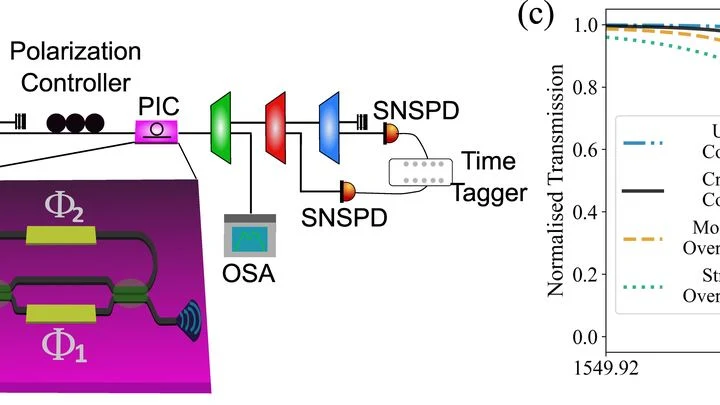
Quantum computing promises a revolution, but its real power will only unfold in a network. The best “brains” — superconducting qubits — communicate at microwave frequencies. The ideal “couriers” — optical photons — fly at hundreds of terahertz. A direct hookup is impossible.