Quantum chaos is the study of how systems that are chaotic in classical mechanics behave when governed by the rules of quantum mechanics. While classical chaos is characterized by extreme sensitivity to initial conditions — the famous 'butterfly effect' — quantum systems evolve linearly and deterministically, seemingly smoothing out that sensitivity. Yet chaos leaves fingerprints in quantum systems: in the statistical properties of their energy levels, in the structure of their wave functions, and in the way quantum information spreads and becomes entangled.
History
The field emerged in the 1970s–80s, with key contributions from Martin Gutzwiller (periodic orbit theory) and Orest Bohigas, Marie-Joya Giannoni, and Charles Schmit, who conjectured in 1984 that quantum spectra of classically chaotic systems follow random matrix statistics.
How it works
In a chaotic classical system, nearby trajectories diverge exponentially. In quantum mechanics, the wave function spreads out, but the system's energy spectrum and eigenstates still 'remember' the classical chaos. A key signature is level repulsion: energy levels of a chaotic quantum system avoid crossing, leading to a specific statistical distribution (Wigner-Dyson). Another signature is the entanglement spectrum — the distribution of eigenvalues of the reduced density matrix — which shows universal features in chaotic systems. Recent research also explores how internal noise can drive a quantum system from ordered behavior into chaos, and how chaos can be blocked or suppressed in certain quantum settings.
In practice
Quantumchaos theory is used to understand the stability of quantum computers, the thermalization of isolated quantum systems, and the information scrambling in black holes.
Fun fact
A black hole's emitted light can reveal whether the underlying quantum dynamics are chaotic, because the spectrum of Hawking radiation carries the imprint of level statistics.
The quantum world is often compared to a musical instrument. Each system, whether an atom or a chain of particles, sounds at its own frequencies, which physicists call energy levels. In chaotic systems, like an orchestra without a conductor, these frequencies usually fill the entire available range without gaps.
Musicians in an orchestra each play their own part, not hearing the others. In a perfect crystal of tungsten disulfide on graphene, excitons, bound electron-hole pairs, behave the same way: they barely mix due to a hidden symmetry called the valley. The energy levels of such a system resemble notes sorted into separate folders — the chaos is incomplete.
A string sounds perfectly pure until a draft touches it. That's roughly how a superradiant laser works: a beam of atoms, pre-charged with energy, flies through a room made of two mirrors — an optical resonator (a trap where light bounces back and forth).
A light beam approaches a black hole not head-on, but at a glancing angle. If the angle is just right, the light neither falls in nor escapes: it starts looping around, like a figure skater circling the rim of a funnel. This narrow track is the photon ring. It acts like a lens, repeatedly reflecting the image of everything that falls into the hole.
Every isolated quantum system inevitably moves toward thermal equilibrium — a state where all details of the past are erased. It’s like an orchestra: instead of a symphony, it starts playing white noise — random but statistically predictable notes.
When hot soup cools, clumps form on the surface — similarly, as the early universe cooled, it gave birth to threadlike clumps of energy: cosmic strings. Some of them are like a stretched rubber band: as long as it's intact, it's stable. But if you nick the band, it snaps.
Gravitational wave detectors work like sensitive microphones, picking up the trembling of space from distant cosmic catastrophes. When two black holes merge into one, the newborn object rings like a bell, and that ringing is a unique 'voice' of gravity.
A figure skater glides across the ice, gradually approaching the center of the rink. A slight twist of the torso, and the smooth spiral breaks, the trajectory becomes unpredictable. Something similar happens when a small black hole with its own rotation (spin) falls toward a giant black hole.
A chemical reaction resembles passing through a turnstile: a crowd creates chaos and gets stuck, while an orderly line moves. In the quantum world, however, when the jostling subsides, the barrier can become ghostly — a particle passes through it as if the turnstile has vanished.
In a pot of boiling water, steam bubbles rise and pop. In the quantum world of a superfluid, bubbles behave differently: they can collide and give birth to vortices — tiny swirling flows, like whirlpools in a river.
Scientists modeled such a liquid using a holographic approach.
A thin stream of water on a shower glass gathers into winding rivulets that quiver and shift before your eyes. Such a liquid film flowing down a vertical surface is a classic example of chaos in nature: it all flows downward, sure, but the surface lives its own unpredictable life.
The quantum world is full of surprises: even simply observing a particle changes its behavior. In a new study, physicists showed that continuously measuring energy can make quantum chaos more pronounced. They used a quantity that indicates how long a quantum state remains similar to itself under repeated measurements.
In 2019, the Event Horizon Telescope gave humanity the first image of a black hole's shadow. Since then, astrophysicists have dreamed of more: seeing how matter moves in the very funnel of spacetime. One of the mysteries is chaos.
Five superconducting qubits on a chip: the stage for a performance of quantum chaos. Four qubits form the system, and the fifth acts as the environment, introducing dissipation. After a short evolution, the environment is discarded, leaving the system with an open quantum map, an operator that transforms the system's state.
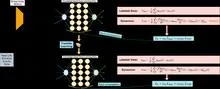
Imagine a translator who learns the grammar of a chaotic language from textbook examples and then becomes fluent in real speech, complete with accents and noise. That is how the new KDL method works: first, a neural network is trained on synthetic data generated by the Liénard equation, then it is transferred to real time series where extreme events are rare and unpredictable.