The harmonic oscillator is the basic model for almost all of physics. It appears in mechanics (pendulum, spring), acoustics (strings, air columns), optics (light as an oscillating electric field), and quantum theory (vibrations of atomic bonds). The reason for this universality is simple: near a stable equilibrium, the potential energy curve of any system resembles a parabola — and that is the 'signature' of an oscillator. The restoring force grows in direct proportion to the displacement, giving rise to sinusoidal motion.
History
In 1602, Galileo described the pendulum, initiating the quantitative study of oscillations. Euler and Bernoulli later formulated the linear oscillator equation. In 1900, Max Planck used the quantization of oscillator energy to derive the blackbody spectrum — this step began the quantum era. Erwin Schrödinger solved the quantum harmonic oscillator in 1926, and the algebraic method with creation and annihilation operators was proposed by Paul Dirac. Ludwig Boltzmann applied the classical oscillator to molecular heat capacity, linking atomic motion to temperature.
How it works
Near the stable equilibrium point x₀, the potential V(x) is expanded in a Taylor series: V(x) ≈ V(x₀) + ½k(x−x₀)², where k = V''(x₀). The force F = −kV'(x) = −k(x−x₀) is linear, and the oscillation frequency ω = √(k/m). In the quantum case, position and momentum become operators; the Schrödinger equation yields eigenfunctions expressed via Hermite polynomials. The equidistant energy spectrum is the reason why fields in physics can be represented as a set of independent oscillators for each mode.
In practice
A quartz crystal in a wristwatch vibrates exactly 32,768 times per second, setting the pace for the hands. The same law gives lasers their pure color and keeps bridges steady when wind blows over them.
Fun fact
Surgeons use a harmonic scalpel vibrating 55,500 times per second. It cuts soft tissue and simultaneously seals blood vessels — coagulation without excess heat.
A laser pulse slams into a crystal of Ca0.4Sr0.6CuO2, and inside the chains of copper and oxygen atoms a dance begins that lasts less than one millionth of a nanosecond. In an ordinary conductor, electrons run freely through the material, but here strong Coulomb repulsion pins them in place like passengers in a packed bus.
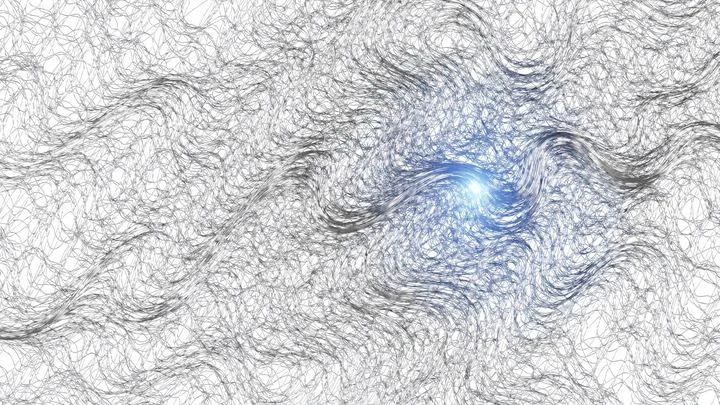
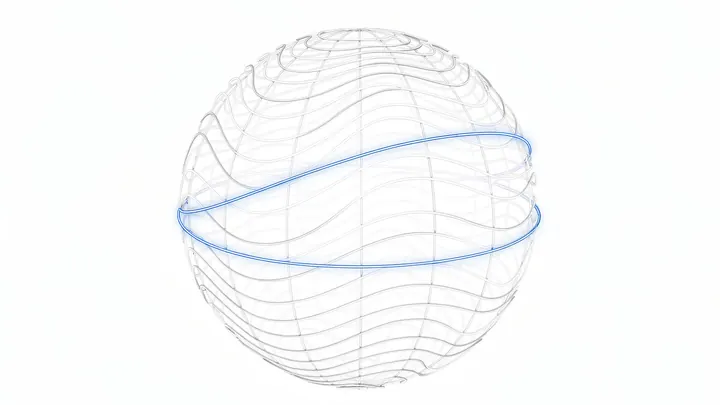
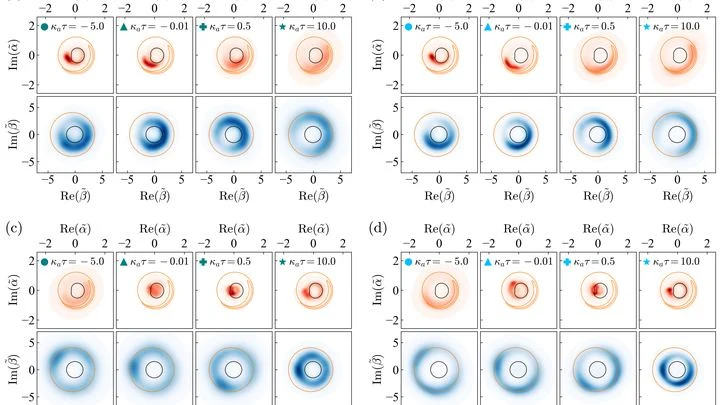
Water confined between two cylinders flows in smooth layers when the inner one rotates. But once the speed crosses a certain threshold, the layers crumple into toroidal rolls, like a stack of bagels. Physicists call these Taylor vortices: the flow loses stability and a regular pattern emerges.
A million orbits: the same score. Nine dark matter halos: nine orchestras without a conductor. All musicians play from the same notes, but in each hall the music sounds different: sometimes in tune, sometimes out of sync. Likewise, satellite galaxies falling into a host halo follow orbits that depend not only on mass but also on the shape of the invisible stage.
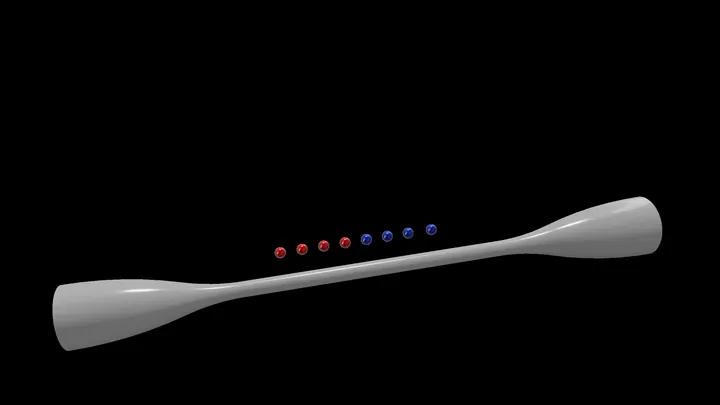
The mirror races along at nearly forty thousand kilometers per second. Light that strikes it bounces back, but changed, like a ball volleyed by a racket in mid-swing. That's exactly the kind of mirror scientists have built inside an ultra-thin glass thread filled with hydrogen.
First, a powerful laser pulse is sent down the fiber.
A quantum detector is like a sensitive pendulum suspended in empty space. If a sharp gravitational wave passes by, you might expect the pendulum to swing. But the calculation shows otherwise: the wave doesn't swing it: it damps any existing oscillations.
A light field, like a neat waffle iron, presses a regular pattern of bright and dark regions into space. Atoms get stuck in the brightest spots as if in tiny dimples: that's an optical lattice. It's a favorite tool for physicists who want to study quantum behavior of matter in its pure form.
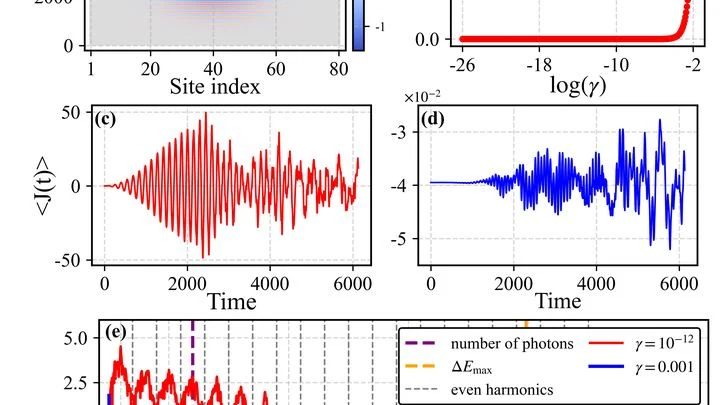
A guitar string plucked exactly at its middle produces only odd overtones. The same prohibition holds in symmetric crystals: when light knocks out electrons, their re-emitted radiation contains only odd harmonics. But physicists have found a way to bypass this rule — without shifting a single atom.
The secret is electric current.
A guitar string plucked exactly at its middle produces only odd overtones. The same prohibition holds in symmetric crystals: when light knocks out electrons, their re-emitted radiation contains only odd harmonics. But physicists have found a way to bypass this rule — without shifting a single atom.
The secret is electric current.
A car with a single suspension setting for all wheels — smooth on asphalt, but bumpy on dirt roads. That's roughly how modern computer models of fluids and gases work: all disturbances, from large whirlpools to fine ripples, are calmed with one common "brake." Stochastic modeling of flows has long been seeking a more refined tool.
The robot juggler catches and throws balls in precise rhythm with a human, like two пульсара sending pulses in unison. Juggling three balls is a classic cascade, governed by a steady beat, like the uniform rotation of a cosmic lighthouse. Break the rhythm and the pattern crumbles.
For over a century, astronomers puzzled over the capricious behavior of RR Lyrae stars: their brightness periodically waxed and waned with unpredictable amplitude, like a lighthouse with a faulty mechanism. The Blazhko effect, discovered in 1907, taunted scientists for decades.
In 1984, the world of crystallography was turned upside down: sharp diffraction peaks with fivefold symmetry were discovered in an alloy of aluminum and manganese – as if nature had mocked the strict theorems forbidding repeating patterns from having axes of order 5, 8, 10, or 12.
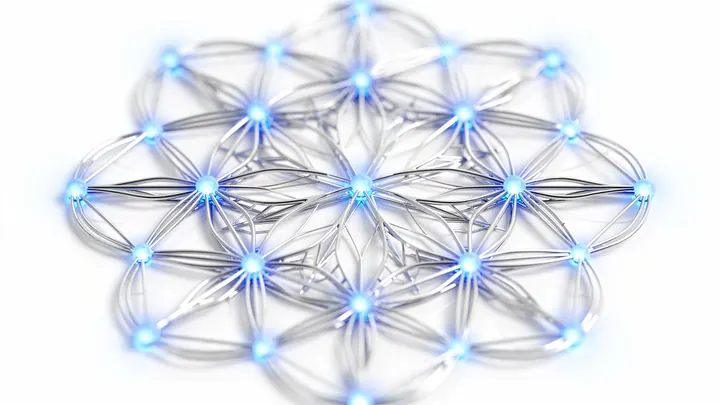
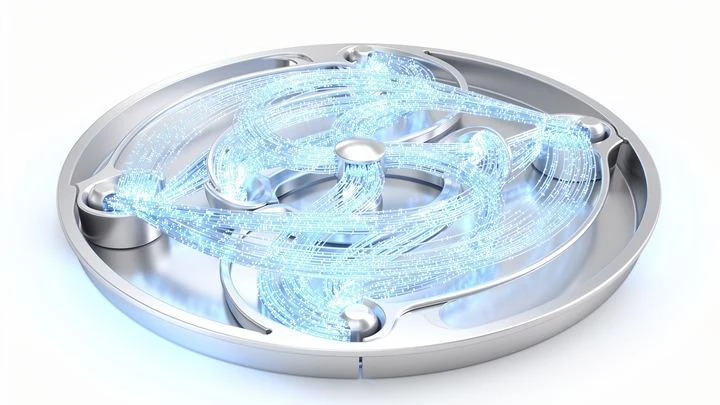
Light running through a waveguide sometimes gets trapped. In special structures, flat bands, it freezes in place: the wave doesn't spread but sits in a few neighboring channels, like a squeezed spring. A flat band is an energy range where the speed of light drops to zero.
An orchestra of billions of cesium atoms struck a single note, and it sounded for 17 hours without fading. That’s no exaggeration: Chinese physicists created a continuous time crystal with a record-breaking lifespan. A time crystal is a system that breaks time symmetry, spontaneously pulsating in an unchanging rhythm.
Crystals fascinate us with their perfect spatial order: atoms frozen at lattice points, like beads on an invisible string. But what if the same symmetry unfolds in time? Time crystals are systems that, without any external cue, start repeating their states cyclically — clocks wound by nature itself. Inside this tireless rhythm, disorder seems to have no place.
Two synchronized swimmers dive into the sea. One hits calm water, the other a whirlpool. Their movements, perfectly coordinated at the start, diverge. Something similar happens to two quantum particles when one moves in flat space and the other in curved space.
An orchestra without a conductor, where musicians hear each other through a shared wall. That's roughly how the new type of laser works: a few atoms (emitters) sit along a waveguide — a thin track for light on a chip. Light from each atom runs along this track and affects its neighbors.
The cosmic microwave background is the first light that pierced the dense fog of the early universe. Its spectrum, like a frozen score of a cosmic symphony, preserves the tiniest density fluctuations from which galaxies grew.
In the new model, each active particle has an internal rhythm: it spins either left or right. Chirality is key: some twirl clockwise, others counterclockwise. But when such a particle bumps into an obstacle or a neighbor, it flips its spin, like a figure skater who, after touching the board, explodes into a reverse pirouette.
A thousand particles enter a gradient dance. Each feels an attraction to regions of high probability and repulsion from neighbors — so they don't bunch up.
In a world striving for chaos, rhythm sometimes arises. The Belousov–Zhabotinsky reaction has amazed for decades: in a test tube, color waves run on their own, as if a living organism breathing matter. Something similar lurks in crystals where iron atoms balance between two magnetic states — high-spin and low-spin.
Two dead suns circle in an eternal dance. Their orbit is a perfect metronome, keeping time with the accuracy of atomic clocks. But even dead stars can tremble.
A pendulum that swings on its own, without any winding — in the quantum world, such 'pendulums' are called time crystals. In them, rhythmic motion arises spontaneously and does not decay. But until now, controlling this rhythm was nearly impossible: any intervention threatened to destroy the fragile order.
A string sounds perfectly pure until a draft touches it. That's roughly how a superradiant laser works: a beam of atoms, pre-charged with energy, flies through a room made of two mirrors — an optical resonator (a trap where light bounces back and forth).
You can think of a political system as a vast galaxy — a gravitationally bound system of stars, gas, and dust. In this analogy, parties are the stars, radiating the light of public activity, while their supporters are dark matter, the invisible substance that emits no electromagnetic radiation but whose mass holds the whole structure…
Electrons in a crystal are like cars on city streets: some race down avenues, others get stuck in traffic jams. In certain lattices, motion freezes entirely — velocity stops depending on energy, and electrons become "flat." This isn't a traffic jam but a special rhythm of the network where waves cancel each other out.
Inflation is the ultra-fast expansion of the universe in its first moments. It was driven by a field resembling a ball rolling down a hill. But there could have been a second, almost imperceptible ball nearby. The authors of this work considered exactly that scenario: a light spectator field (the axion), frozen at the top of its potential.
The most precise modern clocks count time by the oscillations of electrons in atoms. But their rhythm can be thrown off, like a mechanical watch's spring gets jolted by shaking. Physicists found a more reliable pendulum: the atomic nucleus.
Even Jocelyn Bell Burnell, who first detected the strict periodicity of radio signals, noticed that some pulses would suddenly vanish. Today we know: variability is not a whim, but the voice of intricate electrodynamics.
An orchestra without a conductor: each musician hears only their neighbor and is slightly late or early. In ordinary atomic clocks, the picture is similar — atoms oscillate, but their rhythm is disrupted by thermal jitter, limiting timekeeping accuracy.
However, a group of physicists has managed to turn this flaw into a feature.
The familiar metronomes placed on a movable platform eventually start to swing in sync. In the quantum world, this trick long eluded scientists. But now physicists have synchronized even the most exotic state — a Fock state, where the number of light particles is precisely defined, like in a counter.
Time crystals are quantum phases of matter that spontaneously oscillate, like a tuning fork with an infinitely decaying echo. If an ordinary spatial crystal repeats an atomic pattern in space, breaking translational symmetry, a time crystal exhibits periodicity in time, breaking time translation symmetry.
A time crystal resembles an eternal clock: its atoms spontaneously perform rhythmic movements. In ordinary clocks, a pendulum is driven by a spring or battery, but here the motion arises without an energy supply — the system simply returns to its initial state at regular intervals. This idea was proposed by Frank Wilczek in 2012.
A swing can rock strongly or barely move. Usually, if left alone, it stays in its chosen mode. But in the microworld, things are different: a tiny membrane, oscillating under the action of a laser beam, can spontaneously jump from one amplitude to another.
Two quantum particles are linked by an invisible thread: one loses energy, the other gains it, but the total remains unchanged. If you watch only the first, its oscillations don't fade — the rhythm is steady, like that of a cosmic pulsar, even though it seems that entropy and chaos are increasing.
The atom is like a conductor, and the light in the resonator is the orchestra. Their energy exchange, known as the Jaynes–Cummings interaction (part of the Standard Model), lets the atom use “baton” strokes to change the rhythm and timbre of the oscillations.
The pendulum of an old clock swings because a spring mechanism gives it a regular nudge. Now imagine a pendulum that decides on its own when to swing, and does so with a steady rhythm, just because the room is warm and there's a slight draft. That's exactly how time crystals behave, born in clumps of light and matter inside a semiconductor chip.
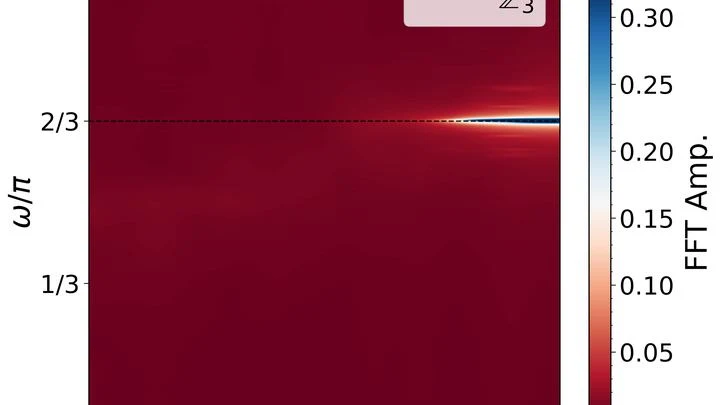
An ordinary pendulum swings at the same frequency as the push it receives. But in the quantum world, you can create a system that responds to a push two, three, or more times slower, as if it has its own rhythm. Such systems are called discrete time crystals.
A pendulum swings with such precision that, had it been counting seconds since the Big Bang, it would have drifted by only half a second by today. That is the stability of the new portable ultraviolet laser — the heart of aluminum atomic clocks.
In the basements of four European institutes stood seven devices: each can be compared to a tuning fork of unimaginable precision. But instead of sound, they emit 'ticks' made of light: oscillations of a laser locked to a specific frequency by atoms of strontium, ytterbium, or mercury.