Tiny Flares on the Sun express
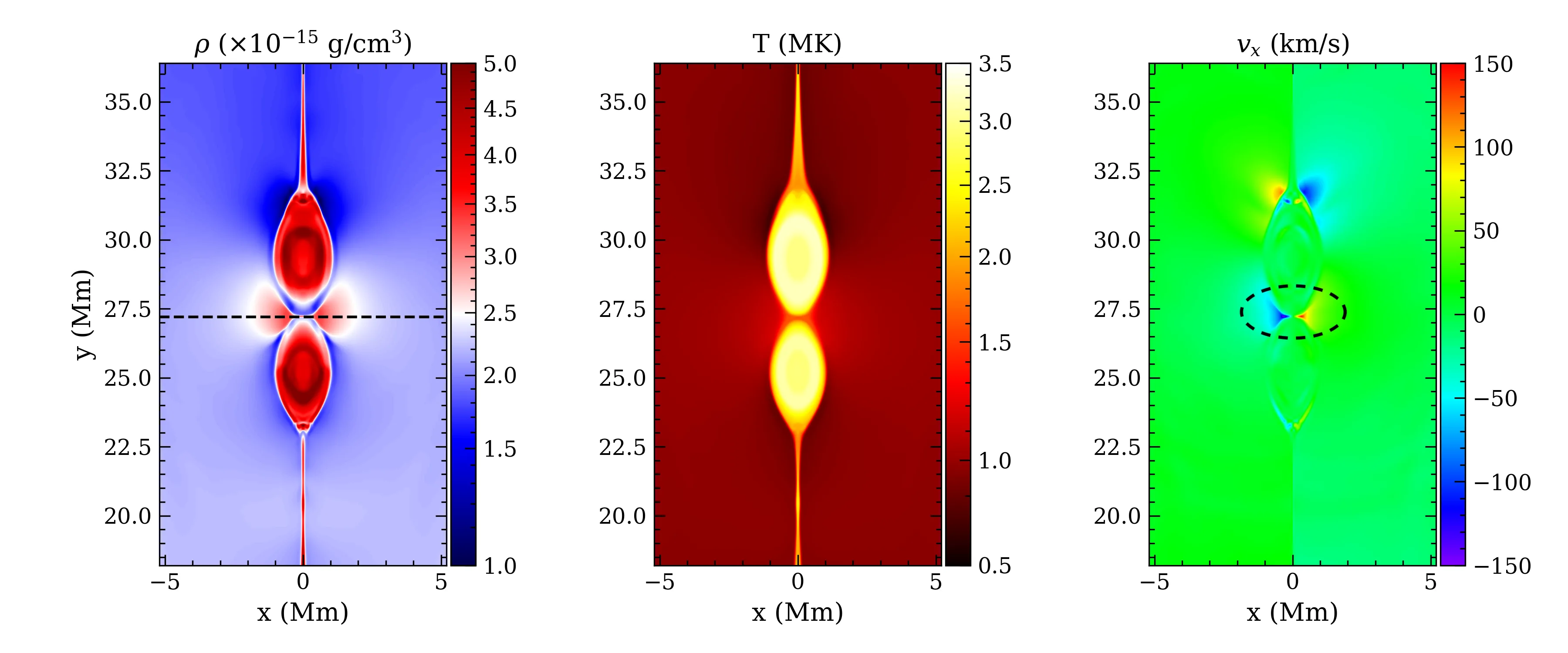
The Sun constantly produces brief plasma ejections — nanojets. They are about the size of a small city, travel at hundreds of kilometers per second, and vanish in less than half a minute. Each such flare is like a tiny explosion that hurls hot gas upward.
Astrophysicists suspect that these nanojets heat the solar corona to millions of degrees, even though the Sun's surface is hundreds of times cooler. But they are hard to observe directly: they are too small and too fast. So scientists built a computer model in which two magnetic ropes inside a solar loop merge and give birth to a nanojet, like two twisted rubber bands that, when untangled, snap upward.
The model showed what such a flare should look like in ultraviolet light, which modern telescopes capture. It turned out that nanojet signatures can be identified by brightness, Doppler shift (the change in light color due to motion), and spectral line broadening. This means that future instruments, such as the MUSE mission, will be able to spot nanojets and test whether they really heat the corona.
Thus, the computer model becomes a bridge between theory and observations: astronomers now know exactly what to look for in the data to catch these elusive nanojets.
Original abstract
as written by the authors arXiv:2601.03354
Detection and characterization of small-scale energetic events such as nanoflares and nanojets remain challenging owing to their short lifetimes, small spatial extent, and relatively low energy release, despite their potential role in coronal heating. Recent observations have identified nanojets as small-scale (length $$\lesssim 6.6$$~Mm, width $$\lesssim 1$$~Mm), fast ($$\sim$$~few 100 km s$$^{-1}$$), and short-lived ($$\lesssim 30$$~s) ejections associated with nanoflare-scale energies, providing evidence of magnetic reconnection at small spatial scales. However, the lack of synthetic diagnostics has limited the connection between magnetohydrodynamic (MHD) models and observations. In this Letter, we present synthetic observations of the coalescence of two flux ropes, leading to nanojet-like signatures from a numerical model obtained with the \texttt{MPI-AMRVAC} code. We report synthetic observables in Extreme-ultraviolet lines compatible with existing instruments such as SDO/AIA, and upcoming MUSE mission, and compare the synthetic observables with an existing observation of nanojets. The synthetic diagnostics of the emissivity maps, Doppler velocity, thermal, and non-thermal line broadening produce key observational properties, suggesting a plausible 3D scenario for nanojet generation where tiny flux ropes reconnect within loops. Our results provide predictions for the detectability of nanojets with current and future spectroscopic facilities, and establish a bridge between MHD modeling and observations.
In 30 seconds, a nanojet releases enough energy to power an ordinary light bulb for a billion years, but by solar standards, it's a tiny flash.