The Doppler shift is the change in frequency (and wavelength) of a wave when the source and observer are in relative motion. It applies to all types of waves, including sound, light, and radio waves. For light, a source moving away appears redshifted (lower frequency), while one moving toward appears blueshifted (higher frequency). This effect is fundamental in astronomy, where it reveals the motion of stars, galaxies, and even the expansion of the universe.
History
The effect was proposed by Christian Doppler in 1842 for sound waves and later generalized to light. It was first experimentally verified for sound by Buys Ballot in 1845, and for light by Hippolyte Fizeau, who applied it to spectral lines.
How it works
When a wave source moves toward an observer, each successive wave crest is emitted from a position closer to the observer, so the crests arrive more frequently — increasing the observed frequency. Conversely, if the source moves away, the crests arrive less frequently, decreasing the frequency. The magnitude of the shift depends on the relative velocity along the line of sight and the wave speed. For light, the relativistic Doppler formula accounts for time dilation at high speeds.
In practice
Doppler shift is used in radar and lidar for speed measurement, in weather radar to detect wind and storm motion, in medical ultrasound to measure blood flow, and in astronomy to detect exoplanets via stellar wobble and to measure galaxy recession velocities.
Fun fact
The Doppler shift is why the siren of an ambulance sounds higher-pitched as it approaches and lower-pitched as it recedes — the same effect that lets astronomers measure the expansion of the universe.
Picture a guitar string stretched between two frets. When you pluck it, a standing wave forms: some points on the string oscillate strongly, while others, the nodes, remain almost still. The chromosphere, a layer of the solar atmosphere sandwiched between the photosphere and the corona, behaves in much the same way.
A spotlight with an adjustable beam width sweeps along the shore. Its light is the long ocean waves that are born in the surf zone and spread in both directions: toward the beach and out to the open sea. Previously, this spotlight was considered a point source, but the actual breaking zone, where short waves break, has a finite width, and it changes as the wave front advances and retreats.
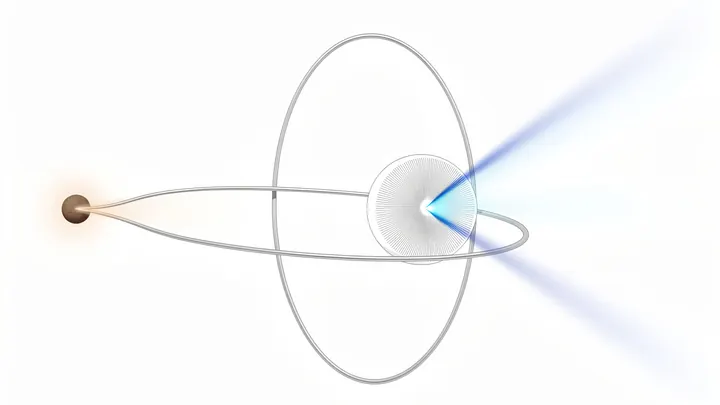
The mirror races along at nearly forty thousand kilometers per second. Light that strikes it bounces back, but changed, like a ball volleyed by a racket in mid-swing. That's exactly the kind of mirror scientists have built inside an ultra-thin glass thread filled with hydrogen.
First, a powerful laser pulse is sent down the fiber.
Long-period radio transients (LPTs) are a mysterious class discovered only recently. Their pulses last minutes or hours, and their nature was completely unknown. ASKAP J1745-5051, caught by the Australian telescope ASKAP, became the first to get a full explanation.
An ordinary photometry detector can't tell a left photon from a right one. But let it start moving, and everything changes.
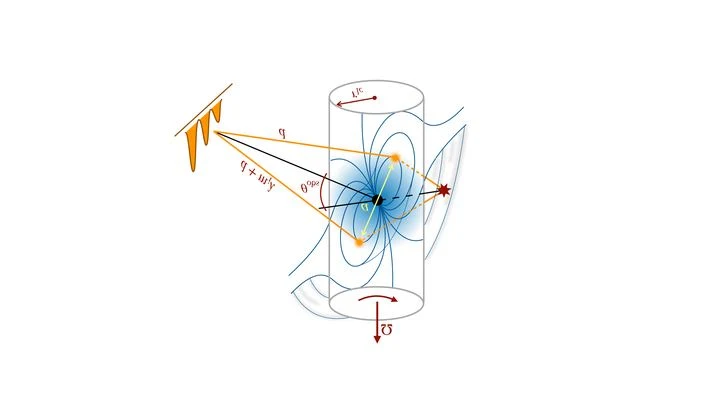
Imagine a rower moving between two flutists playing the same note. His ear is perfectly tuned to that note and ignores all others. As he moves, the pitch from the flutist ahead sounds higher, and from the one behind sounds lower.
If you look at a map of distant galaxies, it is not perfectly uniform: on one side of the sky there are slightly more, on the other — slightly fewer. This lopsidedness has been noticed in several sky surveys, and it does not look like a random fluke. Usually, it is explained by the fact that our Galaxy itself is flying somewhere, making distant objects appear shifted.
A radio telescope picks up a signal from the Crab Nebula, and instead of a smooth line, the screen shows bright and dark bands, like on a zebra's hide. This is the emission from the pulsar, a rapidly spinning neutron star left over from a supernova explosion.
An ordinary comb parts hair into even strands. A laser 'comb' does the same to light: it emits not one color but thousands, spaced at exactly equal frequency steps. Such a tool has already helped measure time to billionths of a second and peer inside atoms.