A nanowire is a structure with a diameter on the order of nanometers (typically 1–100 nm) and a length that is much larger, often micrometers or more. At this scale, quantum effects become significant, and the electrical, optical, and mechanical properties can differ dramatically from bulk materials. Nanowires are used as building blocks for nanoscale devices, including transistors, sensors, and energy-harvesting components. In the context of the provided titles, nanowires appear as petals of nanoflowers—complex three-dimensional structures that self-assemble from nanoscale components, offering high surface area and unique properties.
History
The concept of nanowires emerged from early studies of filamentary growth in the 1960s, but the term and systematic research gained momentum in the 1990s with the work of Charles Lieber and others, who demonstrated controlled synthesis of semiconductor nanowires.
How it works
Nanowires are typically grown using techniques like vapor-liquid-solid (VLS) growth, where a metal catalyst droplet absorbs precursor material and precipitates a crystalline wire, or via template-assisted electrodeposition, where material is deposited into nanopores. Their small diameter confines electrons and phonons, leading to quantized energy levels and reduced thermal conductivity. The high surface-to-volume ratio makes them extremely sensitive to surface interactions, which is exploited in chemical and biological sensors.
A nanowire made of gold can be so thin that it becomes transparent to electrons, behaving as a one-dimensional conductor where resistance is quantized in discrete steps.
A thin silver thread nearly as long as a hair's width, and inside it, pristine quantum laws hold sway. Physicists built a conductor where electrons can only move forward or backward, like on a perfectly straight single-lane road with no shoulders. On such a road, any pothole or pebble would normally destroy the fragile quantum state.
A solid under a microscope is not a monolith at all. In glass, polymer, or solidified resin, atoms are arranged randomly, and as a result, the material's properties vary from point to point. On large scales, we are used to describing them with smooth fields, like temperature or pressure in a room. But when you zoom down to a few atomic layers, that smoothness disappears.
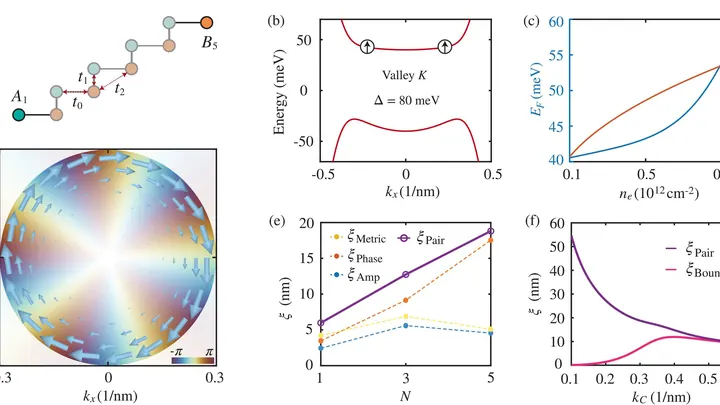
In a superconductor, electrons pair up like dancers holding hands. Usually, the distance between them, the pair size, depends on how fast they move and how strongly they are bound. But sometimes the dance floor almost disappears, and there's nowhere to move. This happens in materials with flat electronic bands: electrons nearly freeze, and the usual rules stop working.
An ordinary crystal is like an apartment building: electrons move through shared hallways and staircases, influencing each other through the walls. Now, imagine removing all the walls, leaving just a single line of apartments. How would the residents behave?
Hydrogen has nothing to do with it, but the collective behavior of electrons takes center stage.
Table salt makes food taste better in the kitchen, but in the lab it helps grow crystals just a few atoms thick. Scientists took tin selenide and, with the help of salt, grew ultra-thin flakes from it, so thin they're called two-dimensional. The salt acted as a separator: it kept the flakes from clumping together and made them lie flat on the substrate, like pancakes on a griddle.
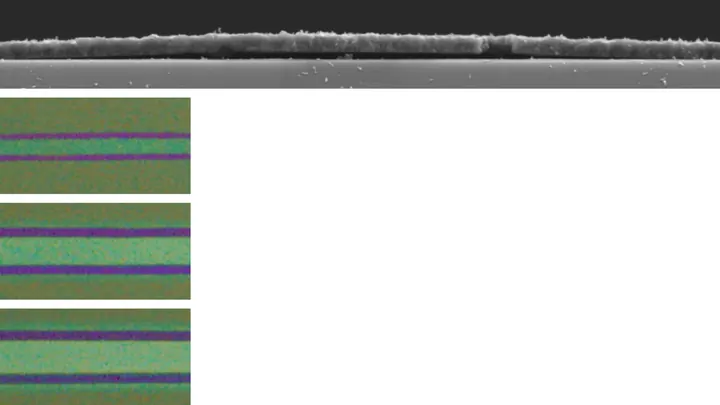
Conventional photolithography, used to make chips, hits a fundamental limit: light cannot draw features smaller than its wavelength. Here, they took a different route. First, they made sparse vertical ridges of oxide, then deposited layers of aluminum oxide, each one atom thick, onto them.
In a narrow gap between two plates, water from humid air collects on its own: this is capillary condensation. If the gap is only a few nanometers wide, water no longer behaves like a continuous liquid: every molecule counts.
Niobium is a metal that, when cooled to a few degrees above absolute zero, conducts electricity without resistance. In labs, it is deposited as thin strips onto a substrate, like frosting on a cake. But during deposition, oxygen from the special mask seeps into the metal, and it spoils the superconducting properties.
Light usually travels straight, like a flashlight beam. But it can be twisted, like water in a funnel, creating a vortex in the beam. Such twisted light can carry more data: different vortices don't interfere with each other, just like different radio channels. The challenge was to make a source of such light small enough for a chip.
River water flows smoothly until it hits a narrow spot. There the current speeds up, and around a bend it may swirl into a vortex. Similar funnels, but just molecule-sized, can gather particles in one place all by themselves — no pump or motor needed.
A laser beam passes through glass and touches a thin diamond film. At the point of contact, the film turns into a narrow strip that lifts slightly. We place a second strip next to it, and between them remains an empty corridor. That's the channel: its width can be fifty times its height, like a sheet of paper lying on a table.
A tiny vanadium oxide particle behaves like a window with adjustable transparency: in one state it lets infrared light through, and in another it starts absorbing it. The switch doesn't happen abruptly but smoothly, like turning a dimmer knob to adjust a lamp's brightness.
A graphene ribbon nine atoms wide is like a track where electrons race, as water rushes down a narrow trough. Gamma radiation is a stream of particles with enormous energy, capable of punching through metal and plastic.
Conventional blood sugar sensors rely on enzymes — proteins that recognize glucose. But enzymes are finicky: they spoil from heat, moisture, and time, like cut flowers wilting without water.
Here, instead of enzymes, a non-living material does the job: nickel oxide, grown as tiny flowers on a sheet of graphite paper.
The needle tip that you drag across a surface to feel its bumps has now grown an ultrasensitive "nose" for magnetic fields. Scientists have assembled a tiny superconducting loop on the end of a cantilever (a thin, flexible beam like the one in an atomic force microscope) that catches the slightest fluctuations in magnetic flux.
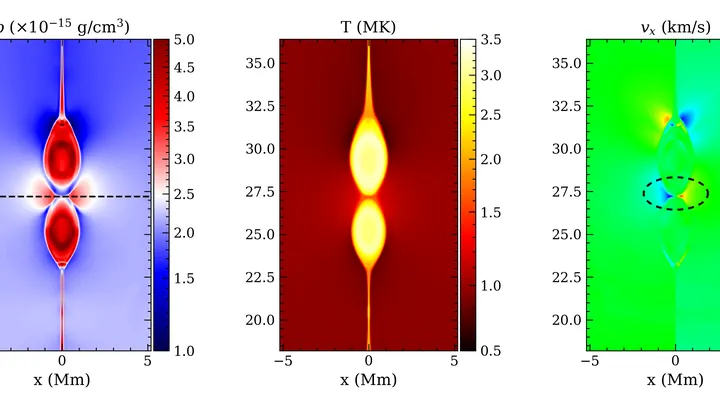
The Sun constantly produces brief plasma ejections — nanojets. They are about the size of a small city, travel at hundreds of kilometers per second, and vanish in less than half a minute. Each such flare is like a tiny explosion that hurls hot gas upward.