Supernova jets are narrow, collimated streams of plasma and high-energy particles ejected at near-light speeds during certain types of supernova explosions. Unlike the roughly spherical debris of a typical core-collapse supernova, these jets emerge along the rotation axis of the collapsing star, punching through the stellar envelope and carving out bipolar structures in the surrounding remnant. They are thought to be responsible for the elongated shapes seen in many supernova remnants and for the production of the most energetic cosmic rays.
History
The idea that supernovae could produce jets dates back to the 1970s, but it gained strong observational support in the 1990s with the discovery of the 'jet supernova' SN 1998bw, which was associated with a gamma-ray burst. Since then, several supernovae with clear jet signatures have been identified, including those with asymmetric remnants like Cassiopeia A.
How it works
When a massive star's core collapses, it forms a proto-neutron star or black hole. If the core is rapidly rotating and possesses a strong magnetic field, the infalling matter can be channeled into two opposite directions by magnetic forces, creating a pair of jets. These jets are powered by the rotational energy of the collapsed core, which is extracted via magnetic braking and the winding of field lines. As the jets plow through the stellar material, they heat and accelerate gas, producing intense X-ray and gamma-ray emission, and eventually break out of the star, shaping the supernova remnant into a bipolar or jet-like morphology.
In practice
Supernova jets are key to understanding the connection between supernovae and long gamma-ray bursts, and they are invoked to explain the chemical enrichment of the interstellar medium with heavy elements, as well as the acceleration of cosmic rays to energies beyond 10^15 eV.
Fun fact
The jet in the supernova remnant W49B is so asymmetric that it left behind a black hole or neutron star that is now moving at over 1 million kilometers per hour, kicked out of the explosion's center.
A particle with an energy of $$10^{18}$$ eV hitting Earth's atmosphere is like a tennis ball traveling at 200 km/h slamming into a wall. Astrophysicists have debated for decades where such projectiles come from. Gamma-ray bursts, brief and powerful explosions of gamma radiation, have long been suspected as accelerators.
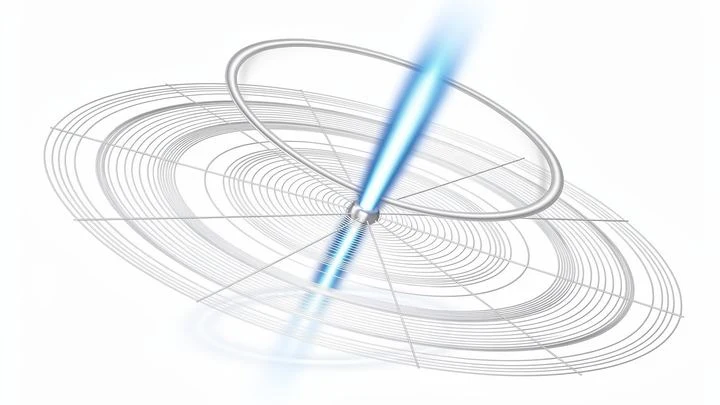
Twenty thousand years ago, the star that would become supernova 1987A put on a ring. Not one — three. The two outer ones, like lampshades, tilted relative to the equatorial ring, and the star's light, struggling through them, barely reached an observer who happened to be in the plane of the equatorial ring.
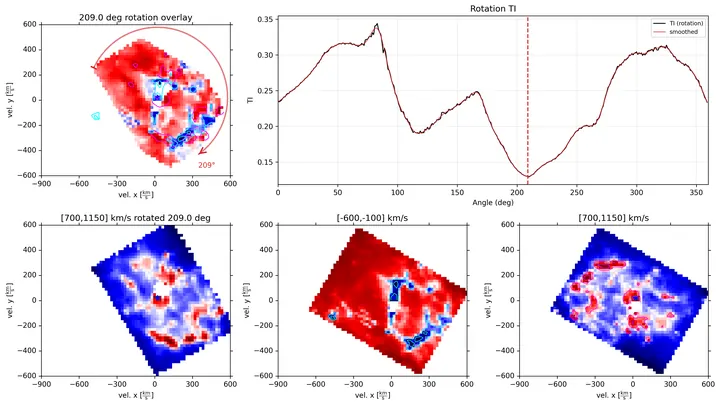
When a star explodes, its material flies into space. In the supernova remnant SNR 0509-67.5, this material did not spread into a smooth cloud but gathered into separate clumps, like lumps in batter that is quickly stirred. The MUSE telescope in Chile saw these clumps in the faint glow of forbidden iron and calcium lines.
Cosmic rays are particles that race across our Galaxy at enormous speeds. Their energies can be millions of times higher than those of particles in the most powerful accelerator on Earth. But the higher the energy, the fewer such particles there are: the plot of their numbers shows a noticeable kink, which is called the knee.
The explosion of a massive star is not just a flash: it's a blow to the surrounding gas. But until now, no one had looked at how the gas itself moves at the sites of such explosions. Now astronomers have gathered data on 33 nearby supernovae and for the first time measured the turbulence of the cold molecular gas around them.
At the end of a massive star's life, its core collapses in a fraction of a second, giving birth to a supernova flash. This cataclysm shakes spacetime itself, emitting gravitational waves — ripples that race across the Universe.
On March 26, 2026, the Chinese-European Einstein Probe observatory caught an X-ray flash that lasted a little over a quarter of an hour. A thousand seconds. The onboard WXT telescope registered a sharp rise in radiation, then a smooth decline, as if someone had screamed into silence, and the echo slowly faded.
Seventy-two protoplanetary disks, swirling cocoons of cosmic dust and gas, came under the gaze of the MIRI instrument on JWST. Most of them shoot outflows into space: dense conical structures and narrow, high-speed jets. They blast like fountains. This process is not accidental.
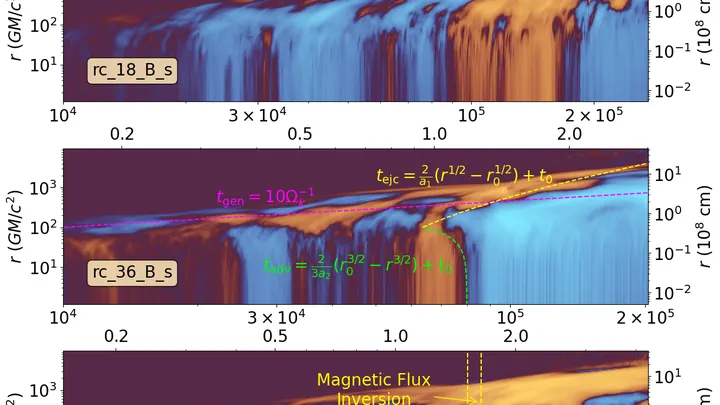
The collapse of a star's core is like compressing a spring: matter falls inward, and a neutron star is born at the center. But the fall is never perfectly smooth. In the boiling outer layers, random eddies transfer angular momentum to the infalling gas, and a disk swirls around the central object.
This disk is no calm river. It pulses, strengthening and fading.
Three milliseconds before the merger. A gargantuan black hole spinning at breakneck speed drags in a neutron star — a ball the size of a city but with 1.5 times the Sun's mass. Tidal forces stretch the star into a thread as thin as a needle and fling its matter outward.
An old factory where instead of machines there are atomic nuclei, and neutrino radiation seethes all around. When a massive star exhausts its fuel, its core compresses a hundredfold, and the temperature skyrockets to billions of degrees.
In the quiet of cold molecular clouds, where interstellar gas under gravity condenses into dense clumps, the birth of massive stars is one of the great puzzles of astrophysics.
In 1054, earthly observers recorded a 'guest star' flaring in the constellation Taurus — so bright it rivaled the Sun. Today, its remnant, the Crab Nebula, serves as a cosmic laboratory, and it has now sprung a new surprise.
When JWST peered into the young universe at redshifts of 6–10, it revealed a scattering of mysterious 'little red dots' (LRDs). These objects combined features of galaxies and active nuclei, but their spectra refused to fit into familiar patterns.
Two neutron stars, ultra-dense remnants of massive stars, merge into one, and the space around them shudders: a gravitational wave is born, a ripple in the very fabric of spacetime. Almost simultaneously, a narrow stream of matter, the jet, erupts from the scene.
The James Webb Space Telescope JWST has peered into the heart of supernova remnant SNR 0540-69.3 — what remains after a massive star died in a neighboring galaxy. Inside, amid the flying debris, astronomers saw a clear pattern: glowing clumps and voids arranged in a symmetric design.
In the constellation Aquila, about 40,000 light-years away, one of the most powerful natural accelerators in the Galaxy is at work. It's the microquasar GRS 1915+105—a pair consisting of an ordinary star and a black hole.
Stars are born in cold clouds of cosmic dust and hydrogen. Inside these cocoons, protostars — the cores of future suns — were long thought to be just hot clumps. But it turns out many of them are powerful accelerators: they shoot out narrow jets of gas that, slamming into surrounding matter, produce invisible gamma-ray light.
When a massive star dies, its core collapses, and a supernova explosion occurs. The cataclysm births streams of particles — like ripples from a thrown stone. The first to arrive are swift neutrinos, which pierce the Earth, hardly interacting. Then, hours later, ghost particles with a tiny charge appear.
A fire hose blasts into a snowdrift. The water doesn't just shove the snow aside — at the point of impact, spray, steam, and a roar are born. That's roughly how jets behave: narrow streams of matter shooting out from around a black hole at enormous speeds.
A shockwave erupts from the star's surface, and for a brief moment, a blinding flash of ultraviolet and X-rays is born. This very event, named EP260321a, was spotted by the Einstein space telescope in March 2026. The light took about 450 million years to reach Earth.
A massive star ends its life in a spectacular collapse: the core compresses into a neutron star or a black hole, while the outer layers fly off in a dazzling supernova.
The James Webb space telescope peered into an era when the Universe was less than a billion years old and discovered hundreds of strange objects there. Tiny yet dazzlingly bright, they glowed a deep red — like burning coals scattered across the black velvet of space.
A flashlight doesn't cast a uniform circle of light; it has a bright spot in the center and a blurred halo at the edges. If you switch it off quickly, the edges are the last to fade, and by how the light dies, you can guess the shape of the reflector.
A massive star collapses, and a black hole is born, surrounded by a disk of incandescent plasma. For narrow jets to burst out of this disk, an ordered magnetic field is needed. But inside the star, it's tangled.
In 2017, detectors picked up a tremor in space — gravitational waves from the merger of two neutron stars. At the same moment, telescopes saw a flash. For the first time, one event spoke in two languages at once: light and gravity.
Every second, invisible projectiles from the depths of space pierce through us. These are cosmic rays — atomic nuclei accelerated to speeds nearly indistinguishable from the speed of light. Their energy is hundreds of millions of times greater than what our most powerful accelerators can achieve. Where does this monstrous force come from?
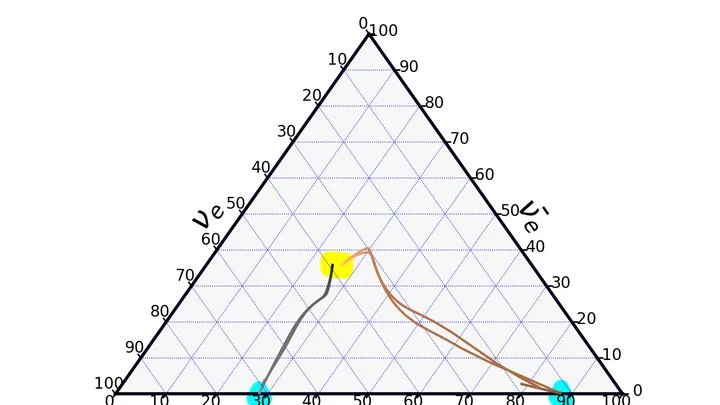
A pot of soup simmering with three ingredients. The chef adjusts the proportions on the fly, and the progress is tracked by the position of a point on a triangular scale. That's roughly how physicists tackle neutrinos from a supernova explosion.
In a dense cloud of gas and dust where giant stars are born, the ALMA telescope has spotted something familiar. Four thin gas jets shoot out from the same region, each leaving behind a chain of bright knots, like a dashed line.
A newborn star is like a kitchen mixer: it whips up the surrounding cloud, and splatters fly in all directions. Only instead of batter, it's gas and dust. Previously, astronomers had only seen gas jets, and dust was considered too fragile: the shock wave should shatter dust grains into atoms.
When a heavy atomic nucleus splits, it doesn't break into even halves. First, two fragments form that look like pears pressed together at their narrow ends. Then the junction begins to smooth out, like two droplets merging and the surface quickly leveling.
In that brief moment, the surface moves inward, and particles inside the nucleus can bounce off it, like a ball off an oncoming wall.
When a massive star dies, a supernova explosion occurs, so powerful that a single flash outshines an entire galaxy. In this fire, billions of axions are born — invisible particles that leave almost no trace. Every second, trillions of these tiny things fly right through each of us, completely unnoticed.
In the binary system Cygnus X-3, right here in our Galaxy, a black hole and a giant star whirl so tightly together that the star loses matter: it's swept away by a powerful wind. Jets blast out from near the black hole; recently, a telescope caught photons from them, each carrying the energy of a flying mosquito.
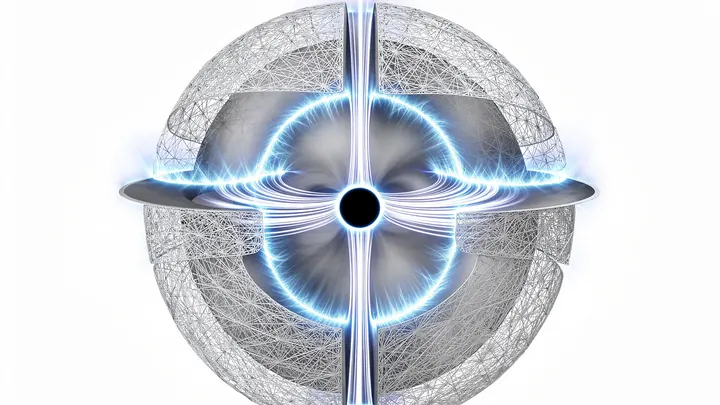
A massive star, 40 times heavier than the Sun, dies in a fraction of a second. Its core compresses like a spring squeezed too hard, then snaps back: that's a supernova explosion. But what if the star is also spinning, like a figure skater pulling in their arms, and threaded with a magnetic field, like invisible strings?
In a gas cloud left after a star exploded (called a supernova remnant), astronomers noticed a giant glowing letter S. It was drawn by two jets of superheated material ejected during the cataclysm. These jets didn't just shoot straight out — they slowly spun like a top, which bent their path into curves.
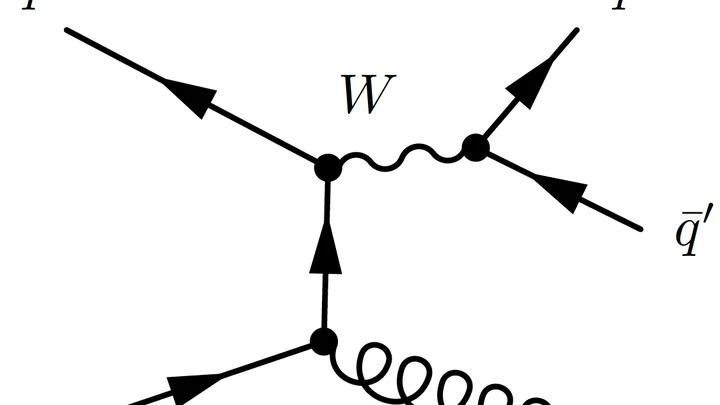
When a W boson, the particle that carries the weak force, decays into a quark and an antiquark, these two fragments fly off in nearly the same direction at the collider's immense speeds.
A stream of water from a hose hitting a wall splashes sideways. Astrophysical jets behave similarly — narrow plasma flows ejected from the vicinity of black holes or young stars. When such a flow encounters resistance from surrounding gas, a shock wave forms inside it, akin to a standing wave in a fast-flowing river.
When two lead nuclei collide at tremendous speed, a cloud of scorching matter is born for an instant — denser and hotter than the center of the Sun. Through this cloud fly jets of particles: narrow, laser-like beams knocked out by the impact. The CMS detector captures their tracks and shows how the jets change as they fight through the hot 'fog'.
Deep in the Galaxy, runaway stars are sometimes born. A monstrous force, a supernova explosion, flings them from their usual place. One such wanderer has recently been found: a star of the LP 40-365 class, a fragment of a white dwarf that survived an incomplete explosion.