A nanotesla (nT) is a unit of magnetic flux density equal to one billionth of a tesla (10⁻⁹ T). It is used to measure extremely weak magnetic fields, such as those produced by biological tissues, tiny magnetic particles, or distant astronomical objects. For context, the Earth's magnetic field is about 50,000 nT, while a human heartbeat produces a field of roughly 0.1 nT at the body's surface.
History
The tesla unit was named after Nikola Tesla in 1960, and the nanotesla subdivision became practical with the development of SQUID magnetometers in the 1960s and 1970s.
How it works
Measuring nanotesla fields requires highly sensitive instruments like superconducting quantum interference devices (SQUIDs) or nitrogen-vacancy (NV) centers in diamond. These sensors exploit quantum effects to detect minute changes in magnetic flux, converting them into readable signals. The nanotesla scale is essential for distinguishing such faint signals from background noise.
In practice
Nanotesla sensitivity is used in medical diagnostics (e.g., magnetocardiography), in detecting magnetic signals from single cells, and in studying solar flares and white dwarf magnetism, as referenced in the titles.
Fun fact
A diamond-based sensor can detect the magnetic signal of a single living cell, which produces fields on the order of a few nanotesla.
In the basement of the laboratory, an 8 tesla magnet hums. Inside it, like a bell in a bell tower, hangs a hollow copper cylinder tuned to a single note. If an axion, a dark matter particle, flies by, the cylinder responds with a faint ring. The trouble is that ordinary copper muffles this ring: at high frequencies, current flows only through a thin skin of the metal, and losses grow.
A magnet weighing just a few grains of sand hovers in midair with no support. It doesn't touch the walls, doesn't rub against bearings — it just hangs in a magnetic trap like a speck of dust in a sunbeam. Researchers have turned this tiny object into an ultra-sensitive compass: the device detects changes in the magnetic field of 23 femtotesla.
A pendulum weighing a few grains of sand swings on a hair-thin glass fiber. Its motions are so faint that the thermal jostling of air molecules seems like a hurricane. Yet such a pendulum is the key to witnessing quantum wonders in the world of large objects.
A supernova explosion blasts off the outer layers of a dying star. What remains is the core — a neutron star, packed into a sphere the size of a city. The existence of such stars was predicted back in 1934 by Fritz Zwicky.
Searching for extraterrestrial signals is like trying to hear a whisper at a roaring stadium. The Green Bank Telescope listened to 70,000 stars, but 100 million bursts turned out to be earthly noise — from phones, satellites, microwave ovens.
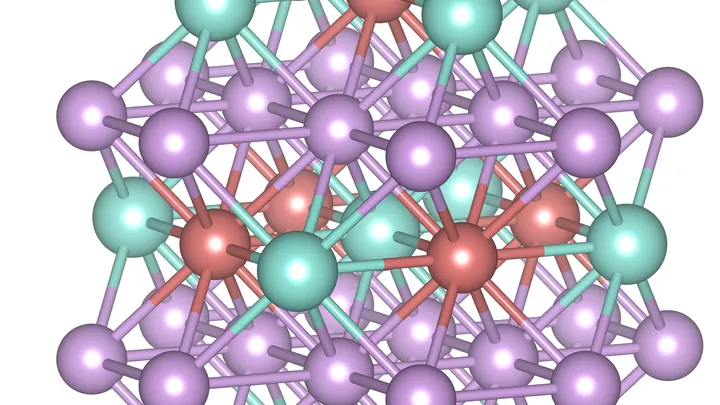
The La3Ni2O7 crystal resembles a layered pie, where the filling of nickel and oxygen atoms alternates with lanthanum layers. At ambient pressure, it does not conduct without resistance, but squeeze it or grow it as a thin film, and high-temperature superconductivity emerges.
Magnetic sensors smaller than a match head can already detect weak fields — from a beating heart or a distant planet. But making them even more sensitive involves a trade-off: improve one part, and you lose performance in another.
Eight red giants — bloated old stars like the future Sun — are not behaving by the book. Their surfaces oscillate steadily, like a bell, but within this chime there are glitches: some tones are missing, and the rhythm breaks. Scientists suspected an invisible hand inside — a magnetic field — and tried to calculate its strength.
Deep beneath the Apennine Mountains, in a tank holding three tons of liquid xenon, something gives a barely perceptible shudder every few days. It's a solar neutrino, a ghostly particle born in the Sun's thermonuclear furnace, that has traveled 150 million kilometers through empty space and solid rock to finally collide with a xenon nucleus.
Biologists often tag cells with glowing molecules — it's like searching for a dim light in the smoke. The light quickly fades, and the smoke creates interference.
A thin sheet of graphene, just a few micrometers thick, was placed in a weak magnetic field, and it began to push the field out of itself, like a sponge squeezing out water. This effect, known as the Meissner effect, is the hallmark of a superconductor: a material that conducts electricity without loss.
A white dwarf is what remains of a star like the Sun after it sheds its outer layers. What's left is a hot core the size of Earth but with a mass close to that of the Sun. A teaspoon of this material would weigh as much as a truck. Some of these stars have extremely strong magnetic fields — a billion times stronger than Earth's.
A customs officer can't take a suitcase apart to see what's inside. They shine X-rays through it and, from the shadows on the screen, tell: here's metal, here's organic matter. In much the same way, an inspector for future nuclear disarmament treaties should be able to check a warhead — without opening it or seeing its secret internals.
Neutrons are better suited for this than X-rays.
In laboratories where atoms are cooled to near absolute zero, even a tiny change in the magnetic field throws off all the settings. Conventional sensors, Hall plates or coils with ferrite cores, sit a few centimeters away from the vacuum chamber because they themselves create interference.
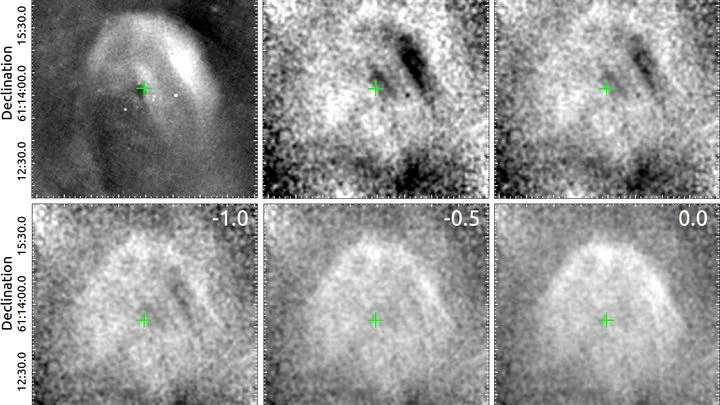
The VLA radio telescope peered into the Boomerang Nebula — a cloud inflated by the wind from a rapidly spinning neutron star. The new images reveal details as small as a lunar disk on the sky: an elongated core around the pulsar and a long arc curving around it from the north.
Light usually travels straight, like a flashlight beam. But it can be twisted, like water in a funnel, creating a vortex in the beam. Such twisted light can carry more data: different vortices don't interfere with each other, just like different radio channels. The challenge was to make a source of such light small enough for a chip.
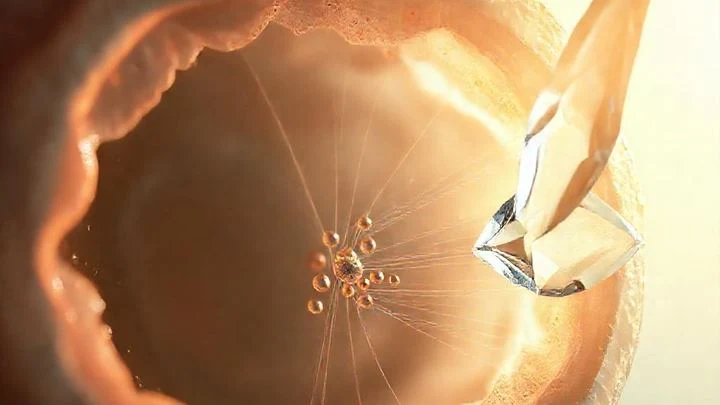
Diamonds sometimes have a defect: instead of two adjacent carbon atoms, there is one nitrogen atom and an empty spot. This defect acts like a tiny antenna that responds to magnetic fields. Scientists aimed a laser and microwaves at such a diamond, and the defect started spitting out electrons.
Tiny particles, smaller than a hundredth of the thickness of a human hair, can be magnets that don't lose their strength even at 600 degrees Celsius. These particular particles were made from a nickel-iron-aluminum alloy. The alloy has been known for a long time, but in nanoparticle form it was produced without templates — simply by mixing solutions of metal salts.
A tiny defect in diamond is like a microscopic ear, able to pick up the magnetic 'breath' of the heart. Such sensors work at room temperature and are no bigger than a grain of sand.
A magnetic field is invisible, but you can make it 'glow'. To do that, take a tiny diamond with defects — places where a carbon atom is replaced by nitrogen and a neighboring lattice site is vacant. These defects, like sensitive compass needles, respond to the slightest changes in the magnetic field and emit light of varying brightness.
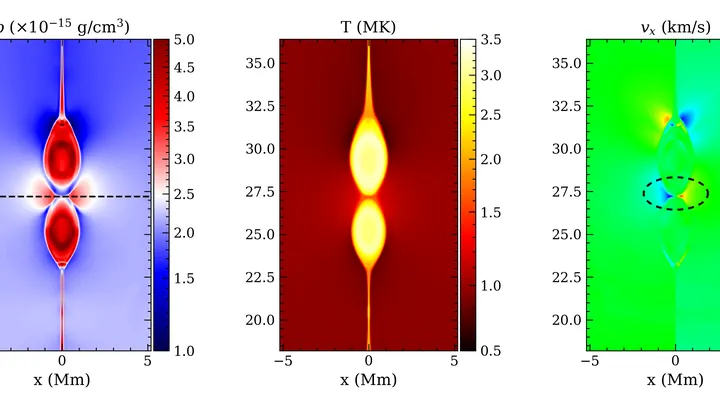
The Sun constantly produces brief plasma ejections — nanojets. They are about the size of a small city, travel at hundreds of kilometers per second, and vanish in less than half a minute. Each such flare is like a tiny explosion that hurls hot gas upward.
A cell doesn't just lie on a surface: it probes it, pulls it, and pushes it. Until now, instruments could only detect direct forces: how hard a cell presses or stretches its support. But if you grab a cell by the "shoulders" and give it a slight twist, it responds by rotating, and until recently, no one could measure that rotation.
Inside a living cell, a tiny carbon spinning top whirls — a molecule billionths of a meter across. An ordinary top falls quickly, but this one behaves differently: it can spin in both directions at once, like a quantum coin perpetually frozen mid-fall. This superposition of motions is key to its strange selectivity.