Tiny Flares on the Sun express
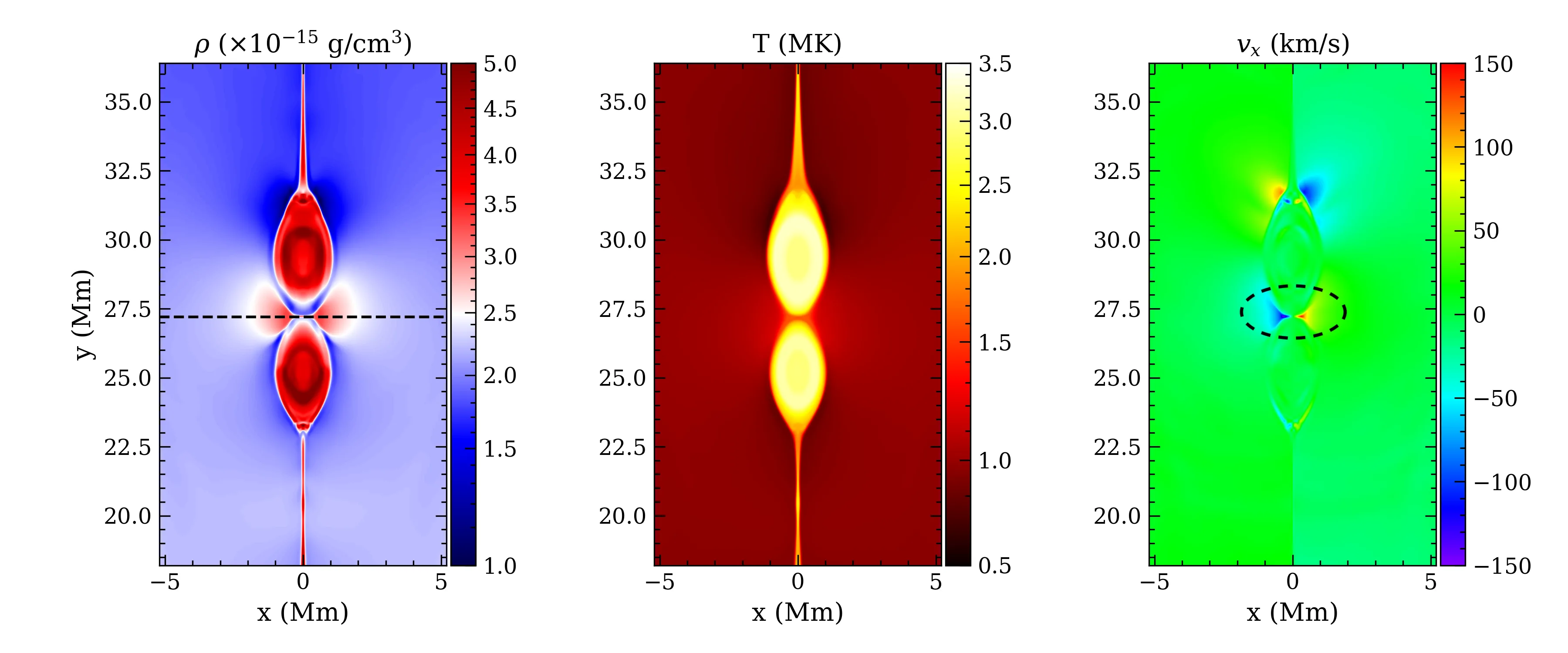
The Sun constantly produces brief plasma ejections — nanojets. They are about the size of a small city, travel at hundreds of kilometers per second, and vanish in less than half a minute. Each such flare is like a tiny explosion that hurls hot gas upward.
Astrophysicists suspect that these nanojets heat the solar corona to millions of degrees, even though the Sun's surface is hundreds of times cooler. But they are hard to observe directly: they are too small and too fast. So scientists built a computer model in which two magnetic ropes inside a solar loop merge and give birth to a nanojet, like two twisted rubber bands that, when untangled, snap upward.
The model showed what such a flare should look like in ultraviolet light, which modern telescopes capture. It turned out that nanojet signatures can be identified by brightness, Doppler shift (the change in light color due to motion), and spectral line broadening. This means that future instruments, such as the MUSE mission, will be able to spot nanojets and test whether they really heat the corona.
Thus, the computer model becomes a bridge between theory and observations: astronomers now know exactly what to look for in the data to catch these elusive nanojets.
In 30 seconds, a nanojet releases enough energy to power an ordinary light bulb for a billion years, but by solar standards, it's a tiny flash.