Tiny Crystals Rewrite the Rules of Mixing express
Perovskite crystals are building blocks where metal atoms and halogens arrange into a neat lattice. Swap one halogen for another, and the crystal glows in a different color. But there's a catch: chlorine and iodine don't like to be neighbors in the same lattice, and in large crystals the mixture separates into distinct zones, like oil and water in a glass.
However, if you take a crystal just a few nanometers across, thousands of times thinner than a human hair, the picture changes. In such a tiny volume, the lattice is more flexible, and it can accommodate three different halogens at once: chlorine, bromine, and iodine. The scientists put this to the test by synthesizing over three thousand samples with different proportions and measuring their spectra. They found that small crystals with sufficient bromine content remain stable and do not phase-separate.
This discovery matters for practical applications: perovskites are already used in solar cells and LEDs, and the ability to precisely tune their color and efficiency by simply changing the composition is a big step forward. Now it will be possible to create materials with the desired properties without worrying that the mixture will fall apart over time.
Original abstract
as written by the authors arXiv:2601.06880
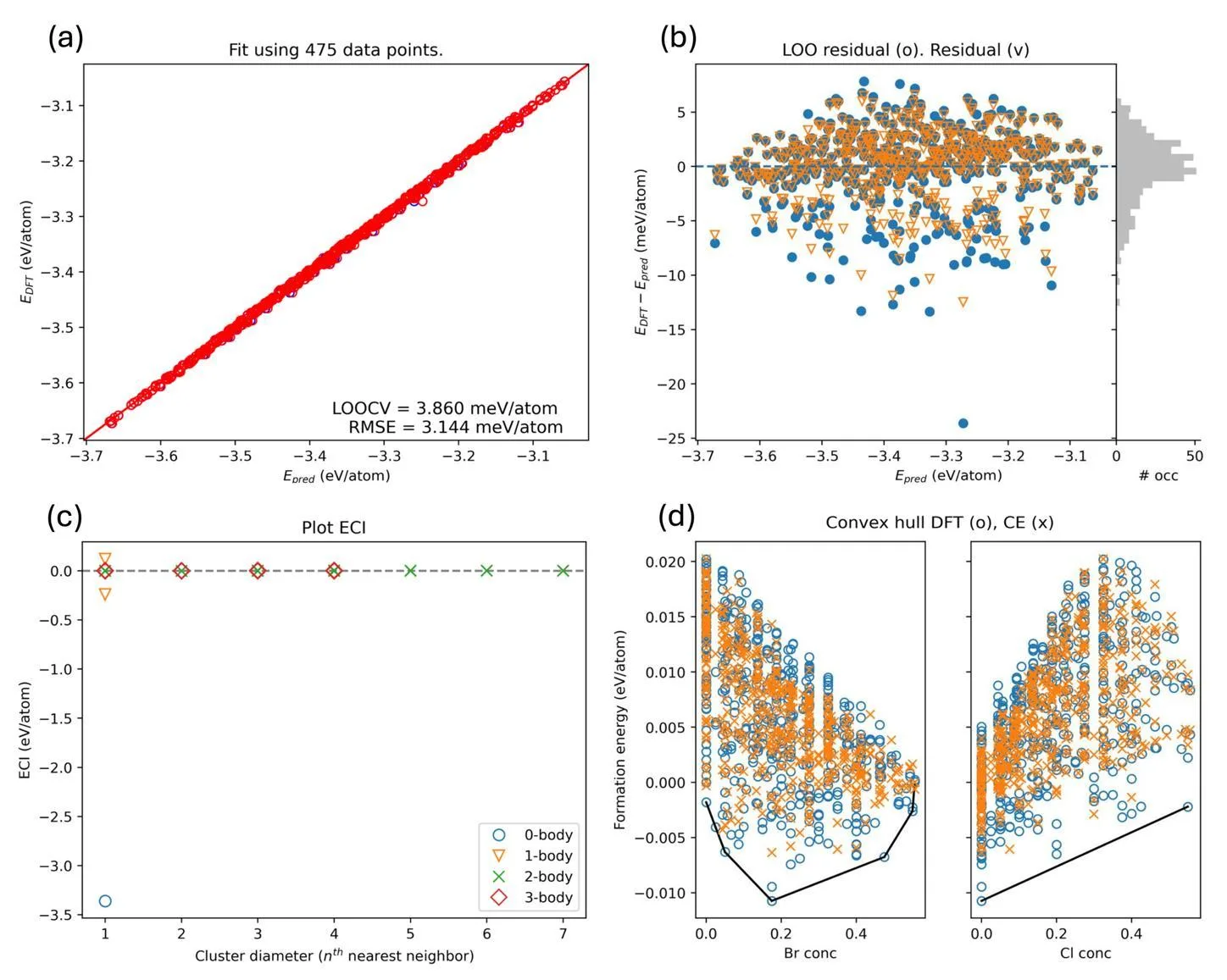
Crystalline solid solutions incorporate guest atoms by substituting host lattice sites up to a solubility limit dictated by solute host similarity. Solid solutions enable tuning various material properties, such as the optoelectronic behavior of halide perovskites. In bulk, incompatibility of Cl:I halide mixtures restricts exploration throughout the ternary halide Cl:Br:I compositional range. However, solubility is extended in nanocrystals which better accommodate a wider range of ions within their lattice. Through high throughput synthesis and spectroscopic characterization of over 3000 samples, along with density functional theory and cluster expansion models, we determine the solubility boundaries of ternary halide perovskite nanocrystals and demonstrate their extended size dependent miscibility. Smaller nanocrystals, with sufficient Br content, stabilize the Cl:Br:I solid solutions, suppress planar stacking fault defects and prevent halide segregation.
The size of perovskite nanocrystals can be compared to the thickness of a spider web: if you scaled the crystal up to the size of a football field, its thickness would be less than a millimeter.
In Stanisław Lem's novel "Solaris," the ocean changes its structure in response to external influences; perovskite nanocrystals similarly flexibly rearrange their lattice to accommodate different atoms.