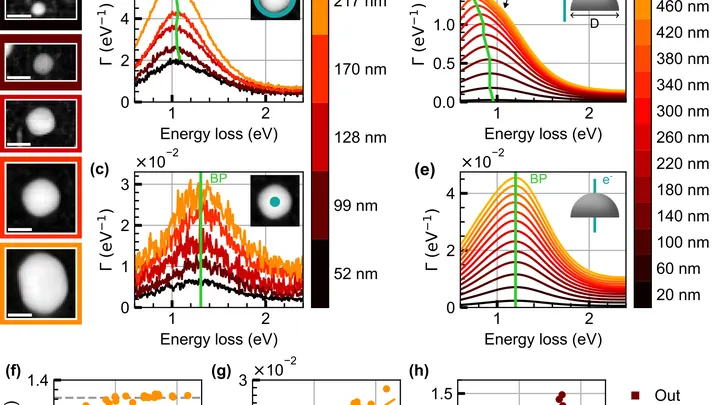
Gold nanoparticles are particles of gold with dimensions between 1 and 100 nanometers. At this scale, gold exhibits properties dramatically different from bulk gold: it appears red or purple in solution, has a very high surface-to-volume ratio, and can strongly absorb and scatter light due to localized surface plasmon resonance. These properties make gold nanoparticles valuable in sensing, imaging, and medical therapy.
History
Gold nanoparticles have been used since ancient times for staining glass, but the scientific understanding began with Michael Faraday's 1857 experiments on colloidal gold. Modern controlled synthesis and applications developed in the late 20th century.
How it works
The unique optical behavior arises from conduction electrons on the nanoparticle's surface oscillating collectively when excited by light. This resonance depends on the particle's size, shape, and surrounding medium, so changes in the environment (like binding of a molecule) shift the color. Additionally, the high surface area allows functionalization with antibodies or drugs, and the particles can convert absorbed light into heat, enabling targeted thermal therapy.
In practice
They are used in rapid diagnostic tests (e.g., pregnancy tests), cancer photothermal therapy, drug delivery, and as contrast agents in electron microscopy.
Fun fact
A single gold nanoparticle can be as small as 1/1000th the width of a human hair, yet it can absorb light so efficiently that it can be used to kill cancer cells with heat.
On a smooth silicon wafer, gold nanocubes behave like a crowd on an ice rink: at first, individual figures glide randomly across the ice, but within a minute they gather into an even carpet covering two-thirds of the area. A gap of two nanometers remains between the cubes, roughly like the space between neighbors in a queue.
When an alpha particle tears through a gas, it leaves behind not a continuous track but a chain of individual ionizations: tiny flashes where electrons are knocked off atoms. In a living cell, such flashes damage DNA, and the denser they are packed into a clump, the more severe the damage.
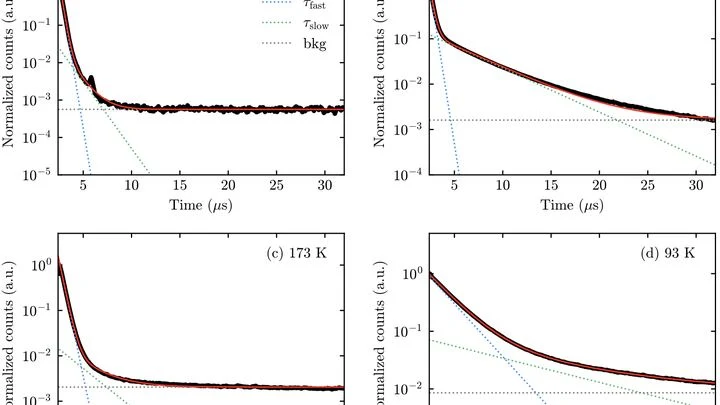
A sodium iodide crystal doped with thallium is like photographic film for invisible particles. When a gamma ray or a hypothetical dark matter particle hits it, it flashes with faint light. Two silicon photomultipliers pressed against the crystal's ends catch the flash from both sides.
For thirteen billion years, light battled through cosmic emptiness. It bent around massive galaxy clusters that, as Einstein predicted, acted as giant lenses — amplifying and distorting the distant glow. In 2023, the NIRSpec instrument on the James Webb Space Telescope captured this light and spread it into spectra.
The quantum many-body world is a jazz ensemble, where each electron improvises, continuously listening to all the others, and the overall wave function is born from this tense dialogue.
A typical laser is a cavity where light bounces between mirrors and gets amplified. But you can ditch the mirrors and make light circulate inside a tiny particle smaller than the light wave itself. That's how the new lasers work: nanoparticles of indium phosphide sitting on perfectly smooth gold.
Magnetic particles are attached to the surface of the diamond by DNA strands, like puppets on strings. They constantly dance under the thermal motion of the liquid molecules. The liquid's viscosity sets the pace: in honey, the particles barely tremble; in alcohol, they dance quickly.
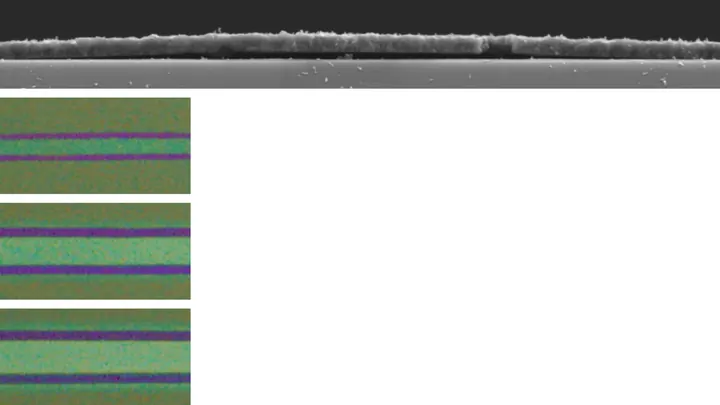
Conventional photolithography, used to make chips, hits a fundamental limit: light cannot draw features smaller than its wavelength. Here, they took a different route. First, they made sparse vertical ridges of oxide, then deposited layers of aluminum oxide, each one atom thick, onto them.
A gold particle a few nanometers across looks like a tiny faceted diamond, but with five faces instead of the usual ones. Inside it hides a defect, like a crack in glass that can either heal or shatter the whole object. Scientists set out to discover what makes this defect move and disappear.
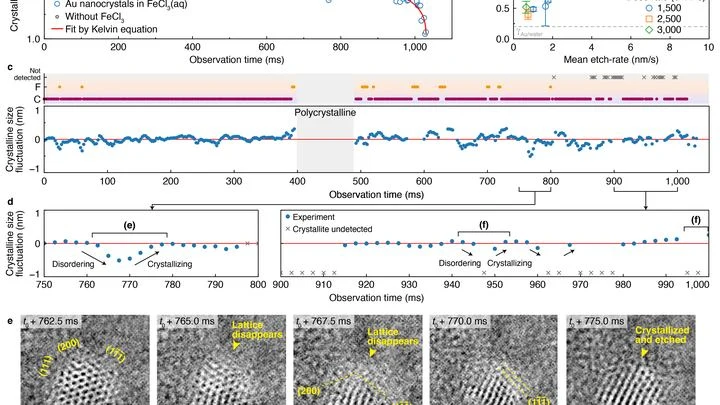
Gold nanoparticles in liquid are like tiny living creatures: they constantly change their internal structure, as if breathing. Scientists managed to peek into this process using an electron microscope that takes snapshots every millisecond, and a neural network that cleans the images from noise.
Gold on carbon is a classic pairing in chemistry. Such materials speed up important reactions, like producing vinyl chloride for plastics. But until now, no one had seen in detail how gold atoms behave on a graphite surface when the whole thing is immersed in a liquid.
A laser beam passes through glass and touches a thin diamond film. At the point of contact, the film turns into a narrow strip that lifts slightly. We place a second strip next to it, and between them remains an empty corridor. That's the channel: its width can be fifty times its height, like a sheet of paper lying on a table.
A tiny vanadium oxide particle behaves like a window with adjustable transparency: in one state it lets infrared light through, and in another it starts absorbing it. The switch doesn't happen abruptly but smoothly, like turning a dimmer knob to adjust a lamp's brightness.
A diamond speck smaller than a hundredth of a millimeter glows red. Inside it is a crystal defect: two neighboring carbon atoms, where one is missing and a nitrogen atom sits nearby. Such a pair captures light and re-emits it, like a tiny beacon that doesn't fade at room temperature.
This speck was brought near a pathway on the chip's surface.
A printer that prints not with ink but with metal and ceramic is now a reality. Scientists took an ordinary drop of water containing dissolved metal salts and made it deposit copper, zinc oxide, or nickel hydroxide onto a surface — all with precision down to millionths of a meter.
The secret lies in electricity.
A tiny speck of silver is born in a laser beam and immediately starts to grow — faster than you can blink. An ordinary microscope can't keep up with that speed, so until now no one had seen exactly how a nanoparticle appears and gains size. Now scientists have a tool that captures this 'movie' frame by frame.
Perovskite crystals are building blocks where metal atoms and halogens arrange into a neat lattice. Swap one halogen for another, and the crystal glows in a different color. But there's a catch: chlorine and iodine don't like to be neighbors in the same lattice, and in large crystals the mixture separates into distinct zones, like oil and water in a glass.
Inside a diamond anvil cell, a device where two diamonds squeeze a sample to hundreds of gigapascals, pressure is distributed unevenly. Some regions are compressed more, others less. This affects experimental results: the material may behave differently than under perfectly uniform compression.