A light-emitting diode (LED) is a semiconductor device that emits light when an electric current passes through it. Unlike incandescent bulbs, which produce light by heating a filament, LEDs generate light through a process called electroluminescence, where electrons recombine with holes in the semiconductor material and release energy as photons. This makes them highly efficient, durable, and compact, which is why they have become the dominant lighting technology in everything from household bulbs to smartphone screens.
History
The first visible-spectrum LED was demonstrated by Nick Holonyak Jr. in 1962 while working at General Electric. He developed a red LED using gallium arsenide phosphide, building on earlier infrared LEDs discovered in the 1950s.
How it works
An LED consists of a p-n junction made from a semiconductor material such as gallium arsenide or gallium nitride. When a forward voltage is applied, electrons from the n-type region and holes from the p-type region are pushed toward the junction. When they meet, they recombine, and the energy difference between the electron's initial and final states is emitted as a photon. The color of the light depends on the band gap of the semiconductor material, which determines the photon's energy and wavelength.
In practice
LEDs are used in displays, indicators, automotive lighting, and general illumination, as well as in specialized applications like optical communication and medical devices.
Fun fact
The 2014 Nobel Prize in Physics was awarded to Isamu Akasaki, Hiroshi Amano, and Shuji Nakamura for inventing the blue LED, which enabled white LED lighting and energy-efficient screens.
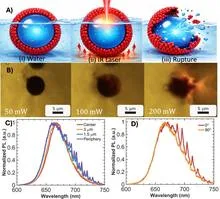
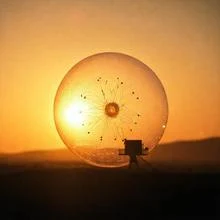
A tiny capsule, like a soap bubble but with a shell of glowing crystals, behaves like a laser. While its wall is intact, light circulates, amplifies, and escapes as a narrow, bright beam. Once the wall bursts, the beam turns into a dim spot. Such a capsule is a colloidosome, and it can change its glow on command.
The blue glow in water around a nuclear reactor is light born when a charged particle outruns light in that medium. The effect was discovered by Pavel Cherenkov in 1934, with the theory provided by Igor Tamm and Ilya Frank.
Light in an optical fiber is like a stream: it flows inside a glass thread and doesn't spill out. A thick thread carries many streams at once, a thin one only one. Astronomers often need to pour light from a thick fiber into several thin ones to split it into colors.
Catching light one particle at a time is like hearing a whisper in a roaring factory. An electron-multiplying camera (EMCCD) can do exactly that: it turns a single photon hitting a pixel into an avalanche of electrons that can be measured. These cameras are mounted on telescopes to spot a barely visible planet next to a dazzling star.
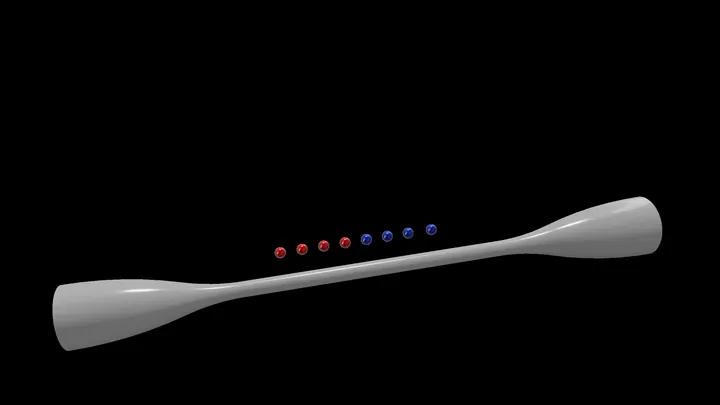
An orchestra without a conductor, where musicians hear each other through a shared wall. That's roughly how the new type of laser works: a few atoms (emitters) sit along a waveguide — a thin track for light on a chip. Light from each atom runs along this track and affects its neighbors.
A solid electrolyte is not just a crystal lattice: it’s a bustling metropolis for ions. Each act of conduction resembles a trip through the city: there are wide highways with low energy barriers, gridlocks in bottlenecks, and tricky detours where an ion can get stuck.
An ordinary diode in electronics works like a one-way street: current flows in only one direction. In superconductors, where electricity flows without resistance, such behavior has long been elusive — current is usually symmetric.
The authors of the new work found a way to create a perfect superconducting diode using light.
Light leaves a trace even when there is almost none of it. A single photon, a tiny bundle of energy, strikes a silicon wafer and knocks out a handful of electrons. The trouble is that the handful is too small to notice. You need an amplifier.
Usually, the signal is amplified by applying a voltage to metal contacts on the detector's surface.
A conventional laser is like an orchestra where musicians must warm up before playing in unison. You first need to pump enough atoms with energy so they 'flip' and are ready to emit light: this is called population inversion. Only then does the beam flash. A polariton laser plays by different rules: its 'musicians'—a mix of light and matter — join in almost without preparation.
A silicon wafer as thin as half a human hair catches a passing particle the way a palm catches a raindrop. But if that drop is a proton accelerated to enormous energy, the palm can get burned. Inside the detector, an avalanche of charge is born, and sometimes it's enough to burn a microscopic hole. This is called single-event burnout.
Blue is the most finicky part of any screen. Producing it takes a lot of energy, and the light often comes out dull. Chemists have long searched for molecules that glow deep blue brightly and for a long time. Now they've come up with a new design based on europium, a rare-earth metal that can deliver pure blue light.
Blue pixels in screens are like light bulbs that burn out fast. Conventional organic LEDs for blue are unstable: their light dims over time, and the color shifts. Chemists found a replacement — the rare metal europium.
An ordinary flash drive stores bits in electron traps, but you can only read them through a separate wire and amplifier. In the new development, the same piece of the semimetal tellurium plays both the role of storage and the light bulb.
Plain water in a glass is clear and calm. But if you add tiny carbon dots made from sugar and citric acid in an ordinary microwave, the water starts to glow when a charged particle flies through it.
A steady laser beam is like a taut string: if it vibrates even a little, the music turns into cacophony. In a quantum computer, the laser holds atoms in a trap, and any frequency jitter ruins the computation. That's why laser setups used to occupy entire tables, and tuning took weeks.
Radio waves surround us, but our eyes can't see them. This new sensor, the size of a fingernail, turns them into a colored patch on a tiny screen.
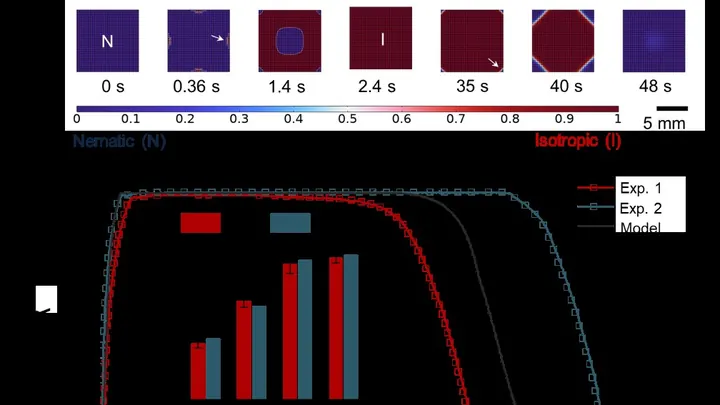
Inside the chip is a layer of liquid crystals — the same kind used in phone displays. Among them are embedded thin ferromagnetic nanowires. When a radio wave arrives, the nanowires heat up quickly.
A regular laser is like a choir where everyone sings their own part — the sound is loud, but with inevitable roughness. In the new quantum laser, the singers hear each other and harmonize their voices.
An electron beam can be compared to the light from a laser pointer: if it diverges, the spot on the wall quickly spreads out. In the lab, physicists created such a narrow beam that it remained thin over a long distance, like the beam of a good pointer.
Ultraviolet light with a wavelength of about 300 nanometers is invisible to the eye, but it can destroy the DNA of microbes, make certain substances glow, and carry information. Until now, lasers in this range were bulky, expensive, or short-lived.
A printer that prints not with ink but with metal and ceramic is now a reality. Scientists took an ordinary drop of water containing dissolved metal salts and made it deposit copper, zinc oxide, or nickel hydroxide onto a surface — all with precision down to millionths of a meter.
The secret lies in electricity.
A laser on a lithium niobate crystal comes to life with a current of 40 milliamps. Its light splits into two streams, each passing through a six-millimeter waveguide, where twin photon pairs are born. One stream rotates the polarization of its twins, after which both flows merge into a common channel.
At Jefferson Lab, electrons are accelerated to 12 GeV and smash into protons to pry out their secrets. But existing detectors are like cameras with a narrow field of view: you either see a lot but dimly, or brightly but only a tiny patch. Electron scattering is the main tool, but statistics are insufficient for subtle effects.