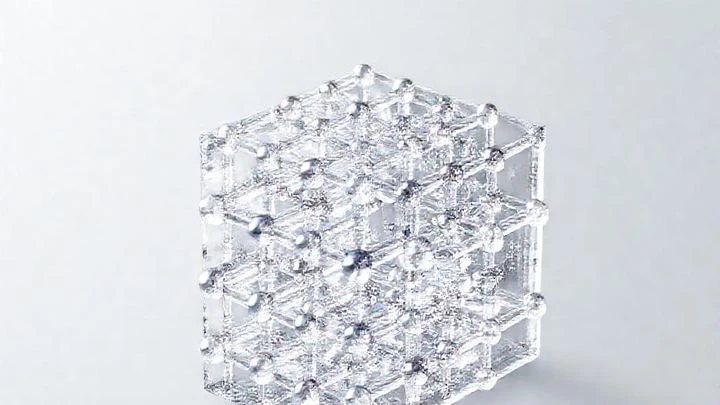
Crystal symmetry refers to the set of spatial symmetries—such as translations, rotations, reflections, and inversions—that leave a crystal latticeinvariant. These symmetries are not just mathematical curiosities; they dictate many physical properties of crystals, including their optical behavior, electrical conductivity, and mechanical strength. For example, the arrangement of atoms in a crystal determines whether it is a conductor, semiconductor, or insulator, and whether it exhibits piezoelectricity or birefringence. The study of crystal symmetry is fundamental to solid-state physics and materials science.
History
The classification of crystal symmetries was developed in the late 19th century. Auguste Bravais identified the 14 possible lattice types in 1850, and the complete enumeration of the 230 space groups was achieved independently by Evgraf Fedorov (1891) and Arthur Schoenflies (1891).
How it works
A crystal is a periodic arrangement of atoms, and its symmetry is described by one of 230 possible space groups, which combine translational symmetry (the lattice) with point group symmetries (rotations, reflections, inversions). The symmetry operations constrain the possible positions of atoms and the tensor properties of the crystal, such as its elastic constants or dielectric tensor. For instance, a crystal with inversion symmetry cannot be piezoelectric, because the effect would cancel out under inversion. Symmetry also determines the selection rules for how light interacts with the crystal, such as which vibrational modes are infrared-active or Raman-active.
In practice
Crystal symmetry is used in X-ray crystallography to determine the atomic structure of materials, in the design of semiconductors and lasers, and in the development of nonlinear optical crystals for frequency conversion.
Fun fact
Quasicrystals, discovered in 1982 by Dan Shechtman, have symmetries that are forbidden for ordinary crystals, such as five-fold rotational symmetry, and their discovery led to a paradigm shift in crystallography and a Nobel Prize in Chemistry in 2011.
The triptycene molecule resembles a three-pointed star with rigid arms. When such stars are scattered on a lead surface, they spontaneously assemble into a pattern like a woven basket: triangles and hexagons alternate, and at each node sits not one star but a pair.
In extreme cold — minus 268 degrees — a crystalline perovskite film starts transmitting light differently depending on its polarization. The beam seems to split in two: one part travels slightly faster, the other slightly slower.
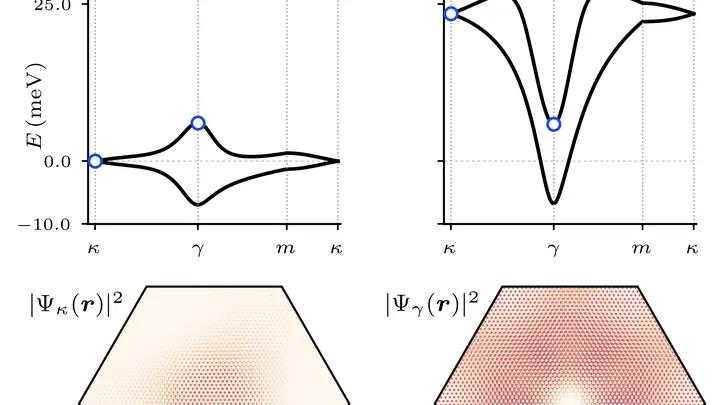
In a crystal, electrons are not distributed randomly. Their waves obey the lattice symmetry, like ripples on water taking the shape of a hoop thrown into it. The new work shows that at high-symmetry points, this ripple must have nodes — places where electron density is strictly zero.
A quantum spin chain is like a string of beads, where each bead is a microscopic magnet pointing up or down. In the XXZ model, these little magnets interact differently along the three axes, and at special parameter values, roots of unity, the system awakens with a hidden memory.
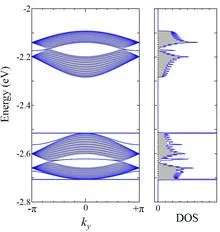
Electrons in a crystal are like cars on city streets: some race down avenues, others get stuck in traffic jams. In certain lattices, motion freezes entirely — velocity stops depending on energy, and electrons become "flat." This isn't a traffic jam but a special rhythm of the network where waves cancel each other out.
Two teams pull a rope with equal force in opposite directions — the rope doesn't move, and the net force is zero. That's how many antiferromagnets behave: the magnetic moments of atoms are aligned oppositely and cancel each other out.
In a lab where crystals are studied, a technician stares at a screen covered in bright spots and slowly rotates the sample, trying to get the spots to form a symmetric pattern. It's like tuning an old radio: you turn the knob until the static gives way to a clear signal. Now, a machine can turn that knob.
Scientists have created a program that learns to align crystals without any knowledge of how those spots work.
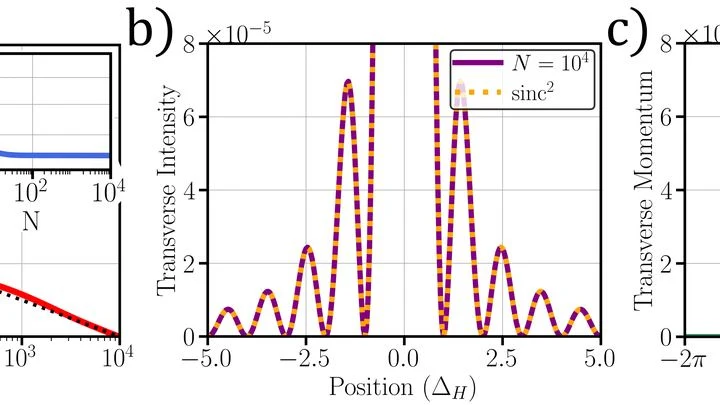
The neutron is a particle with no electric charge, making it tricky to catch: it slips through instruments like a bullet through fog. In typical experiments, it gets just one pass through a crystal, and all measurements must fit into that instant.
A new idea is to make the neutron loop inside a trap, like a ball bouncing between two walls.
A crystal of calcium ions in a trap, illuminated by a laser, is a tiny model of the matter inside a white dwarf. There, in the depths of a dying star, atomic nuclei arrange into a rigid lattice as the temperature drops.
You can edit a cell perfectly, and it still turns out useless. The gene is fixed exactly as planned, yet the cell behaves unpredictably: it drifts, changes fate, loses safety. It's like fixing one gear in a watch, but the watch still runs wrong because the whole mechanism is out of sync.
Previously, a cell was viewed as a list of independent parts.
Silicon is like a universal building block: it goes into the chips in your phone, solar panels, and lasers. But if you squeeze it with immense force, the atoms rearrange into new patterns: these forms are called allotropes. One of them, Si-XIII, was first spotted more than twenty years ago, but its exact pattern remained a mystery.
An ordinary superconductor works like a perfect conductor: electrons pair up and flow without resistance. In the new material TaPtSi, the pairs are arranged differently: their internal symmetry is skewed, and when cooled below the critical temperature, tiny magnetic fields spontaneously emerge inside the crystal.
Three charged ytterbium atoms are arranged in a triangle inside an electromagnetic trap. Normally, they all communicate with each other, like three people at a table constantly exchanging remarks. But if one of them steps into the next room, the conversation continues between the remaining two.
In a tokamak, plasma is like a crowd on a narrow street: once someone starts running, everyone takes off at once. In a stellarator with a non-circular cross-section, the street is winding, with dead ends and pockets. The crowd can't gather into a single wave — people get stuck in different corners.
In NaAlSi, as it cools, electrons form fleeting ripples — stripes that appear and vanish, like patterns on water stirred by wind. These stripes intertwine with superconductivity, a state where current flows without resistance. Typically, for this, electrons pair up with uniform binding energy.
Perovskite crystals are building blocks where metal atoms and halogens arrange into a neat lattice. Swap one halogen for another, and the crystal glows in a different color. But there's a catch: chlorine and iodine don't like to be neighbors in the same lattice, and in large crystals the mixture separates into distinct zones, like oil and water in a glass.
Throw pebbles along a tight row of posts: they ricochet into a dense spray. Throw at an angle, and they scatter. Gamma rays in a crystal do the same: they spawn particle cascades that spread out unless the crystal’s atomic rows are perfectly aligned. Align them within a hair’s width, and the cascade sharpens into a tight beam. A small crystal then outperforms a large one.