Phase separation is a phenomenon where a homogeneous mixture spontaneously splits into distinct regions with different compositions, like oil and water separating into layers. This process is driven by thermodynamics: the system lowers its free energy by segregating components. It occurs in a wide range of contexts, from the formation of lipid rafts in cell membranes to the demixing of alloys during solidification.
History
The thermodynamictheory of phase separation was developed in the late 19th century by Gibbs, with later contributions by Cahn and Hilliard in the 1950s for spinodal decomposition.
How it works
When the interactions between different components are unfavorable (e.g., repulsive), mixing becomes energetically costly. At certain temperatures and concentrations, the system becomes unstable, and small fluctuations in composition grow, leading to the nucleation and growth of domains. This can happen via spinodal decomposition, where the mixture spontaneously separates everywhere, or via nucleation, where droplets form and grow. The final pattern depends on the balance of diffusion and interfacial energy.
In practice
Phase separation is exploited in materials science to create alloys with tailored properties, in biology to understand cellular organization, and in industry for processes like polymer blending and protein purification.
Fun fact
In cells, phase separation creates membraneless organelles like stress granules, which act as tiny reaction vessels, and their malfunction is linked to neurodegenerative diseases.
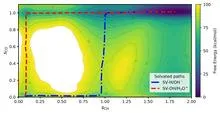
Picture a tiny hole in a sheet of graphene: a single missing carbon atom. It used to be thought that a water molecule splits apart at this defect only on its own, in dry gas. But if liquid water is sloshing all around, everything changes.
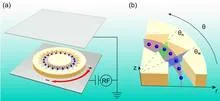
In a ring-shaped channel between two toothed rings, microspheres are suspended: some with a radius of 8 micrometers, others 14. The discharge is switched on, and the particles start moving. The small ones go one way, the large ones the other. It is like a shopping mall where escalators for people of different heights run in opposite directions.
A sheet of paper tears where tension exceeds strength. Epithelium, the cell sheet lining our organs, behaves similarly, but until recently models could not show how tears appear in it. The classical vertex model describes tissue as a network of polygons tightly packed together and forbids cells from detaching.
Plasma is a gas in which electrons are stripped from atoms and roam freely. Sometimes, regions where electrons are almost absent spontaneously appear in such a gas; they are called holes. It is like a whirlpool forming in a stream, pulling everything around it in. But exactly how such a whirlpool is born has long remained a mystery.
In a glass of water, oil gathers into droplets: that's equilibrium separation dictated by chemistry. But there are systems where order arises not from rest but from a constant flow of energy.
A tuning fork struck once rings pure and long. But if you shake the fork itself while it sounds, the tone wavers and dies out quickly. Something similar happens to electrons in any piece of matter. Atoms in a lattice never stay put: thermal vibrations keep them jittering.
If you squeeze water between two glass plates so that only two layers of molecules fit, it becomes something between a liquid and ice. At room temperature, molecules in such a trap still move but arrange themselves into a semblance of a crystal lattice.
A lump of plasticine, when kneaded, behaves like an amorphous solid — not a crystal, but not a liquid either. Inside such a material, avalanches can occur: one tiny rearrangement triggers neighboring ones, and a wave sweeps through the entire sample.
A chef pours hot sugar syrup onto a cold table, and it sets into crystals. That's roughly how engineers pictured metal solidification: the liquid instantly becomes a scatter of crystalline grains. But close-up imaging revealed an extra stage wedged between liquid and solid.
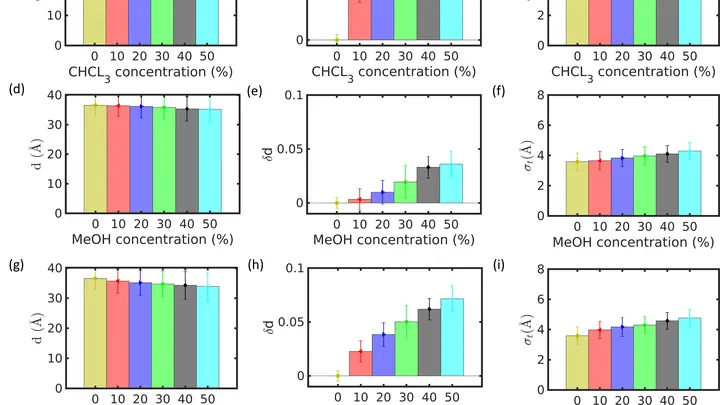
A cell membrane is like a picket fence of tightly packed molecules — long as matchsticks, with a water-loving head and a water-fearing tail. It's not just a wrapper but a living barrier: it lets the right things in, keeps the wrong ones out, and holds its shape. But add a bit of chloroform or alcohol to the water, and that fence starts to sway.
Water churns behind a rock in a river, air swirls behind an airplane wing: it seems like completely random motion. But the authors of the study found a rigid kitchen recipe in this chaos.
They decomposed the fluid's rotation (angular momentum) into two independent parts.
Long protein threads, their tangled entanglements, and random contacts: this is how the birth of cellular droplets was usually explained. These membrane-less organelles, where important reactions take place, resemble oil drops in water: they arise on their own when molecules separate into phases.
In porous materials (soil, rocks, filters) fluids move through tiny, winding channels. When two immiscible fluids, such as water and air, are present simultaneously, their interface constantly shifts: air bubbles push water out of some pores and open paths through others.
In a narrow gap between two plates, water from humid air collects on its own: this is capillary condensation. If the gap is only a few nanometers wide, water no longer behaves like a continuous liquid: every molecule counts.
Molecules in a solution behave like a crowd in a square: they can jostle randomly or line up in neat rows. An aqueous solution of disodium cromoglycate is a well-known model for chromonic liquid crystals, where such 'rows' form spontaneously. But if you shine ultraviolet light on the solution, order collapses: molecules start breaking apart.
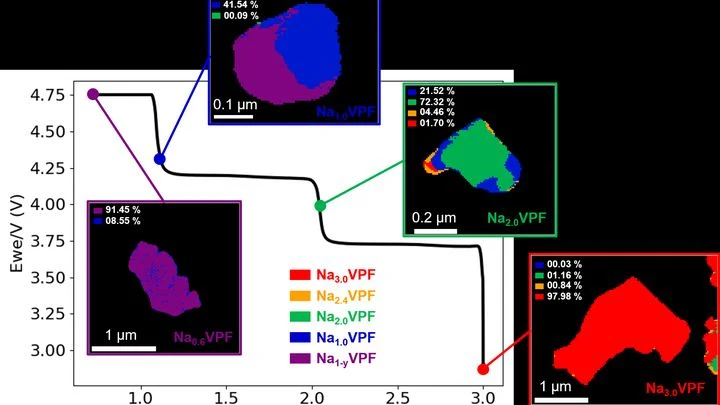
Inside each tiny particle that makes up the cathode of a sodium-ion battery, sodium is unevenly distributed — like sugar clumping in tea. This reduces the battery's capacity and lifespan. To see this hidden landscape, scientists used X-ray microscopy and trained artificial intelligence to interpret the data.
The layer of cells lining internal organs is like a crowd in a packed subway: everyone stands shoulder to shoulder, but sometimes the crowd starts to flow, and people slip past each other. Biologists call this behavior a transition from a jammed, solid state to a fluid one.
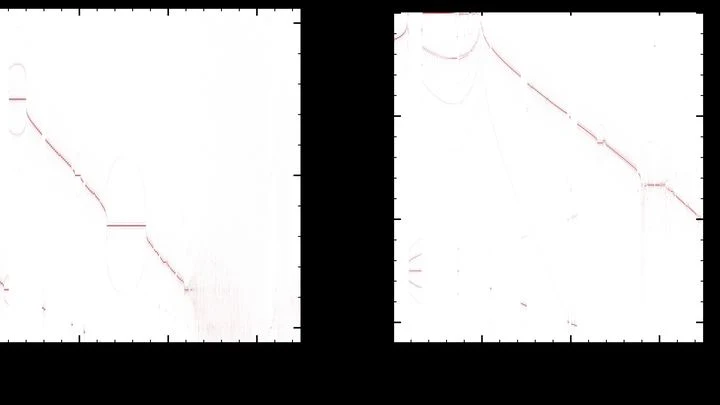
Deep beneath our feet, at the very center of Earth, lies a solid iron core. But it's not pure iron — there are lighter elements too, such as hydrogen. Exactly how hydrogen is distributed within the core has long been a mystery.
In the air we breathe, invisible chemical events are constantly unfolding. One of them is the birth and instant death of a particle with the formula H₂COO. Known as an 'intermediate,' it appears for a split second when ozone molecules collide with organic compounds, then immediately shatters into simpler fragments.
Dissolve a few salts and formaldehyde in a glass of water. After a while, the liquid spontaneously separates: droplets with membranes appear, like tiny bubbles. Inside each droplet, chemical transformations occur, and the droplet itself grows, absorbing material from the surrounding solution.
These droplets are not just bubbles.
Time crystals are an exotic phase of matter that exhibits periodic motion not in space but in time, even while in its ground, unexcited state. This idea, reminiscent of a perpetual clock that never needs winding, was first proposed by Frank Wilczek.
A drop of oil in water behaves like a tiny ball: it seeks the spot with the least energy. If a wall is nearby, the drop often sticks to it, just as a raindrop spreads on glass. In a mixture of two immiscible liquids, such as polyethylene glycol and dextran, tiny droplets of one liquid form inside the other.
Water in a glass settles down once you stop stirring it. Oil in an engine dampens vibrations. It seems viscosity is always about damping. But in some flows, it's the opposite: add friction, and waves start to grow as if from nowhere.
Physicists have found a simple explanation.
In superfluid helium, a state where liquid flows without friction, quantized vortices spontaneously arise: microscopic funnels resembling whirlpools in ordinary Water, but governed by quantum mechanics.