Thin Films Give Magnets a Stronger Twist express
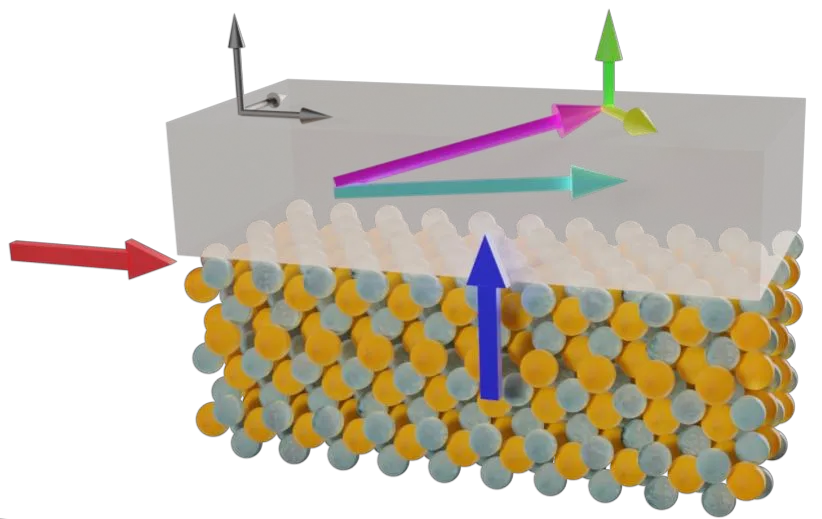
A magnet in a microchip is like a compass needle that needs to be turned without touching it. Usually, heavy metals are used for this, but they heat up and waste energy. Physicists have found a replacement — a layered material called GeTe, which resembles a stack of ultra-thin sheets.
In the experiment, current was passed through the interface between the magnetic alloy NiFe and GeTe. The electric flow caused the magnetization to rotate with a strength that was previously thought impossible for such layered materials. The value even exceeded that of the best heavy metals: −(1.25 ± 0.11) × $10^5$ (ħ/2e) Ω⁻¹·m⁻¹.
The secret lies in the combined action of three effects. The electron's spin (its tiny magnetic moment) and its orbital motion work together, and the interface between materials helps transmit the torque. Computer calculations confirmed that charge flows across the junction and enhances the rotation.
Now engineers can build memory and logic microchips that consume less energy for switching. Thin films of GeTe pave the way for devices where a magnet is controlled by current with almost no loss — all at room temperature.
Germanium telluride is the same material used in rewritable DVDs: when heated, it changes its structure, and a laser reads the difference.