A ferromagnet is a material that exhibits strong, permanent magnetism because its atomic magnetic moments — tiny quantum spins of electrons — align parallel to each other over large regions called domains. This alignment creates a net macroscopic magnetic field, which is why ferromagnets are the familiar 'magnets' that stick to refrigerators. Unlike paramagnets, which only magnetize weakly in an external field, ferromagnets retain their magnetization after the external field is removed, a property known as hysteresis.
History
The term 'ferromagnetism' derives from 'ferrum,' the Latin word for iron, which has been known as a magnetic material since antiquity. The modern scientific understanding began with Pierre Curie's work in the 1890s on the temperature dependence of magnetism, and the exchange interaction was explained in the 1920s by Werner Heisenberg.
How it works
The key mechanism is the exchange interaction, a quantum effect arising from the Pauli exclusion principle and Coulomb repulsion between electrons. In ferromagnetic materials like iron, cobalt, and nickel, this interaction energetically favors parallel alignment of neighboring electron spins. Thermal fluctuations can disrupt this order, which is why ferromagnets lose their magnetism above the Curie temperature. The material's magnetic behavior is also shaped by domain walls — boundaries between regions of uniform magnetization — whose movement and pinning determine how easily the material is magnetized or demagnetized.
In practice
Ferromagnets are essential in electric motors, generators, transformers, data storage (hard drives), and magnetic sensors, as well as in the magnetic detectors used in particle physics experiments.
Fun fact
The magnetic field of a ferromagnet can be so strong that it can levitate a live frog, as demonstrated by the 2000 Ig Nobel Prize-winning experiment using a superconducting magnet.
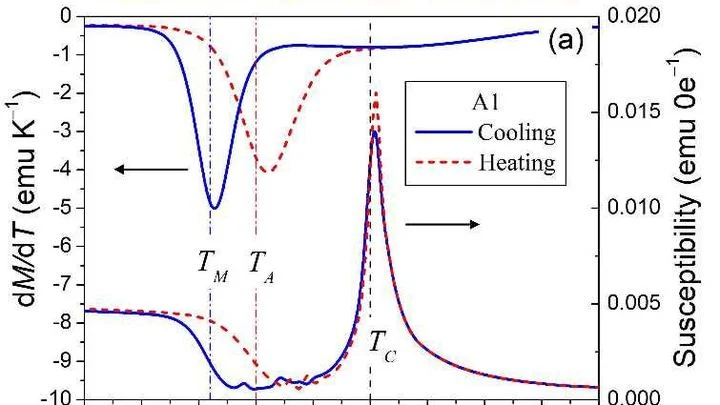
Picture an orchestra in which violins and trumpets play different parts but together create a powerful sound. In a crystal of the layered magnet Fe5GeTe2 doped with nickel, tiny regions of a different phase, Fe6GeTe2 nanoprecipitates, take on the role of those instruments. It is they, not the nickel itself, that keep the material magnetic at 478 kelvin, that is, at 205 degrees Celsius.
A frozen orchestra where musicians swap seats when the conductor, magnetism, sets a new score. In a spinel crystal, iron and magnesium atoms sit in two types of seats: some surrounded by four neighbors, others by six. At room temperature, they barely stir, but cool the material to 5 K and a mass migration begins.
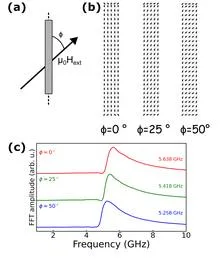
In a large hall, two tuning forks stand on rotating stands. Each is tuned to its own note, but if the stands are turned to the right angle, the forks begin to sound in unison, exchanging vibrations through the air.
A vortex in a magnetic disk usually behaves like a large spinning top: to keep it from toppling, you need a spacious platform and a strong self-field that returns it to the center. But what if you shrink the platform to the size of a virus? Then the usual support disappears, and the vortex should fall apart.
A magnetic field usually acts like a strict traffic cop: for heat to turn into electricity, it must stand across the road. If the field lies along the heat flow, the effect disappears, or so it was believed for decades.
Scientists took an ultra-thin film of a magnetic oxide — a material where electron spins are aligned in a plane, like compass needles on a table.
A magnetic vortex is like a tiny whirlpool in the sea, except that instead of water, it's magnetization that swirls. Such vortices could become memory cells in future computers, but to write and read information, you need to be able to move each vortex individually. So far, this is done crudely — shifting a whole bunch at once.
A magnet weighing just a few grains of sand hovers in midair with no support. It doesn't touch the walls, doesn't rub against bearings — it just hangs in a magnetic trap like a speck of dust in a sunbeam. Researchers have turned this tiny object into an ultra-sensitive compass: the device detects changes in the magnetic field of 23 femtotesla.
In a pot of water carefully heated above its boiling point, the liquid remains calm. But the slightest disturbance, and it violently turns to steam. Physicists call this a metastable state: it seems stable, but in reality it's ready to break apart at the slightest nudge.
A black hole is not a vacuum cleaner. By itself, it doesn't pull everything in more strongly than an ordinary star of the same mass. But if there's a magnetic field nearby and charged particles flying around, an interesting game begins.
A magnetic mirror is a tube open at both ends. The magnetic field inside is arranged so that hot plasma doesn't leak out: at the ends, the field lines bunch up like a cork in a bottle. Plasma particles flying toward the exit are repelled by these "corks" and bounce back. But some still escape: that's the classic "loss cone" argument.
A sheet of paper with magnetic properties: that's roughly what the new material 1T-CrS₂ is like. Its layers are held together by weak forces, like the pages of a notebook, but each layer is a true magnet.
A parquet floor where every other plank is turned the opposite way looks symmetric. But if you run your hand over it, in one direction your fingers glide along the grain, and in the other they catch. That's roughly how the new type of magnetism studied in the crystal AgCrP2S6 works.
Inside a supercomputer, fifteen stable wave clumps — solitons — collide to form a halo of dark matter. These waves obey an equation that Erwin Schrödinger derived for electrons at the beginning of the 20th century, but now they paint a portrait of a giant galactic cocoon.
A Tesla coil crackles, and a beam of light begins to rotate around it. The medium it passes through is still stable, but the field grows, and the rotation intensifies. This is not a trick but the behavior of special materials that couple electricity and magnetism. For such coupling, there is a fundamental limit — the Tellegen limit.
An inflatable balloon with magnetic field lines drawn on it with a marker is a simple model of how a weak magnetic field behaves in an expanding universe. While the balloon is small, the lines lie obediently on the rubber and don't hinder its stretching. That's roughly how a field fills ready-made space without arguing with its geometry.
Fast radio bursts — millisecond radio pulses arriving from distant galaxies — long remained a puzzle. Their colossal energy, compressed into instants, pointed to cataclysms on neutron stars, perhaps pulsars or magnetars.
In a crystal that for centuries was called 'fool's gold,' physicists have spotted genuine treasure. The compound MnTe2 with a pyrite structure has become the stage for a quantum ballet: spin waves here twist into left- and right-handed vortices, with the twist direction firmly tied to momentum.
The solar wind rushes from the Sun to Earth, but the magnetosphere bends the flow and sculpts it into plasma tails. The same motif plays out at the heart of galaxies: jets from accretion disks around black holes are twisted by the invisible hand of a magnetic field.
A thin magnetic film is like a row of toy soldiers with tiny magnetic arrows. In the flat world, thermal jostling quickly disrupts this formation — even the slightest heating destroys the order. This is the Mermin–Wagner prohibition: in two dimensions, continuous symmetry cannot survive at finite temperature.
In the pitch darkness of a vacuum chamber, a tiny magnet floats. It touches no walls and loses almost no energy — an ideal sentinel, ready to catch the faintest nudge. Such a sentinel is exactly what you need for axion hunting. These particles are prime suspects in the case of the Universe's hidden mass, which we call dark matter.
The thinner the ferroelectric film, the stronger the depolarizing field — a dictate of classical physics. Imagine a pencil balancing on a fingertip: the shorter it is, the harder to keep it upright. Nanoscale polarization likewise strives to vanish.
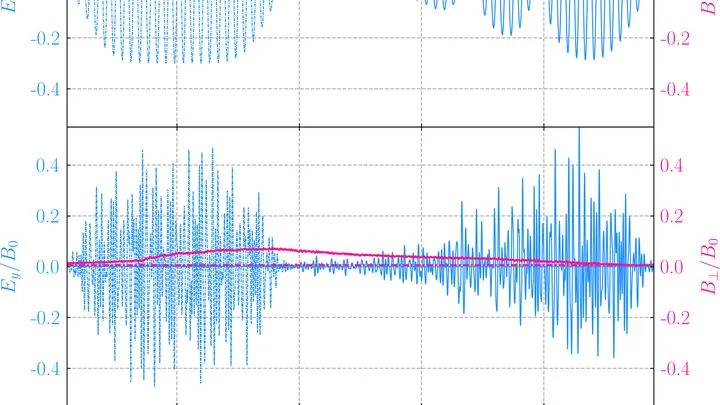
A lighthouse sends its beam through a storm of its own mirrors: that's roughly how fast radio bursts behave when trying to leave a magnetar's vicinity. A magnetar is a neutron star with a magnetic field a quadrillion times stronger than Earth's.
An ordinary magnet is like a compass: its needle points north. But a quantum compass can look in both directions at once. If a magnet floating in a vacuum is gently spun, its electron 'tops' synchronize so the whole piece of metal starts living by the rules of the microworld — freezes in a superposition, like a split pointer.
Two teams pull a rope with equal force in opposite directions — the rope doesn't move, and the net force is zero. That's how many antiferromagnets behave: the magnetic moments of atoms are aligned oppositely and cancel each other out.
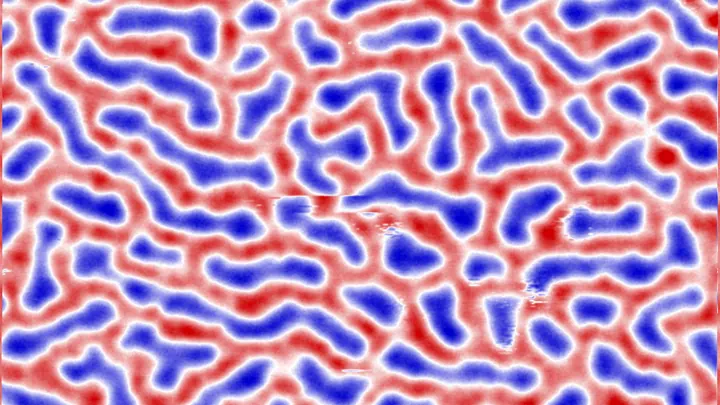
Two magnets on a table either attract or repel — depending on how their poles are oriented. Inside each piece hide tiny regions where all the magnetic arrows point in the same direction. These regions are called domains, and their arrangement determines how the material behaves in an electrical circuit.
In altermagnets, a new class of materials, domains are trickier.
A translator works in two worlds at once: to an outside observer, they are silent and unobtrusive, but inside their mind, a flurry of activity unfolds along clear lines of meaning. Altermagnets, a recently discovered class of magnetic materials, are much the same.
Each electron is a tiny magnet. In a single-atom-thick layer of iron chloride, they all align in the same direction, like dancers in a perfectly synchronized routine. Nature usually avoids such order (that's high entropy), but quantum forces compel them to comply.
In the orchestra of atoms, each instrument has its own score. But sometimes two musicians start playing in unison, and the sound amplifies many times over. In the quantum world, this 'harmony' is called a Feshbach resonance. It allows you to control atomic interactions with jeweler-like precision.
A thick rubber band is twisted tighter and tighter. At some point, it can't take it anymore — it snaps and whips around, releasing the stored energy. That's roughly how magnetic fields inside neutron stars — the ultra-dense remnants of exploded stars — behave.
A metal bar suddenly becomes stiff when heated, and at the same time loses or gains magnetic properties. In alloys based on nickel and manganese, such transformations occur not smoothly but abruptly — atoms rearrange into a new order, and the material changes its behavior.
A comb rubbed through your hair picks up scraps of paper. Physicists decided to apply this simple trick at the microscopic level — to control magnetic vortices called skyrmions. A skyrmion is like a tiny tornado in a sea of magnetization: at its center, compass arrows point up, while at the edges they twist downward.
A magnetic vortex, or skyrmion, is like a tiny whirlpool in the sea of spins — the atoms' intrinsic magnetic moments. Like a whirlpool in a river, it twists the magnetization around itself, and this pattern is remarkably robust: hard to destroy with a random jolt.
A pot of water on the stove: the hotter the burner, the faster ice turns to water, and water to steam. Heat destroys order. But sometimes nature pulls a trick, and heating makes a liquid freeze, like a puddle turning to ice on a frosty morning.
The La3Ni2O7 crystal resembles a layered pie, where the filling of nickel and oxygen atoms alternates with lanthanum layers. At ambient pressure, it does not conduct without resistance, but squeeze it or grow it as a thin film, and high-temperature superconductivity emerges.
A vast, dark cloud of gas stretched across the young universe. Inside it, like invisible fingers, magnetic field lines left over from the very birth of the cosmos threaded through. These fields act on charged particles, pushing them together, like a gentle breeze gathering fallen leaves into piles.
A stack of magnetic plates, each magnetized opposite to its neighbor, is like a layered sandwich where electrons move as a single organism. The whole material starts mimicking an axion — a ghost particle that physicists suspect might be dark matter.
In the crystal Rb1-xV2Te2O, the spins of vanadium atoms arrange in a checkerboard pattern: each spin is surrounded by opposite spins. This pattern is called G-type antiferromagnetism. Neutrons passing through the sample scatter off this pattern and reveal its geometry, like light from a flashlight shining through blinds casting stripes on a wall.
A regular fridge magnet attracts iron because all its tiny magnetic arrows point in the same direction. But there are materials where the arrows arrange themselves more cunningly: neighboring rows point in opposite directions, so from the outside it looks like there's no magnetism at all. Such materials are called altermagnets.
In a tiny magnetic dot, smaller than a micron, lives a vortex — magnetization swirls like water in a drain. At the center of this swirl is a core that itself orbits in a small circle, like a spinning top that's been given a nudge.