How a Single Atom Decides Whether You See or Not express
Deep in the eye, in a thin layer of cells, a tiny molecular machine works. It captures light and turns it into a signal that the brain interprets as an image. But sometimes a typo occurs in the blueprints of this machine — a single letter of the genetic code changes, and a person is born blind.
For a long time, scientists couldn't understand why some typos completely break the machine while others merely slow it down. It turns out it's not about the mutation plugging an important hole like a cork. It's subtler: inside the protein, there's a tunnel through which a proton, a tiny particle, jumps from one place to another. This jump obeys the laws of the quantum world, where a particle can pass through barriers like a ghost through a wall. But if the wall becomes slightly thicker, by just a fraction of an atom, the probability of passage drops by hundreds and thousands of times.
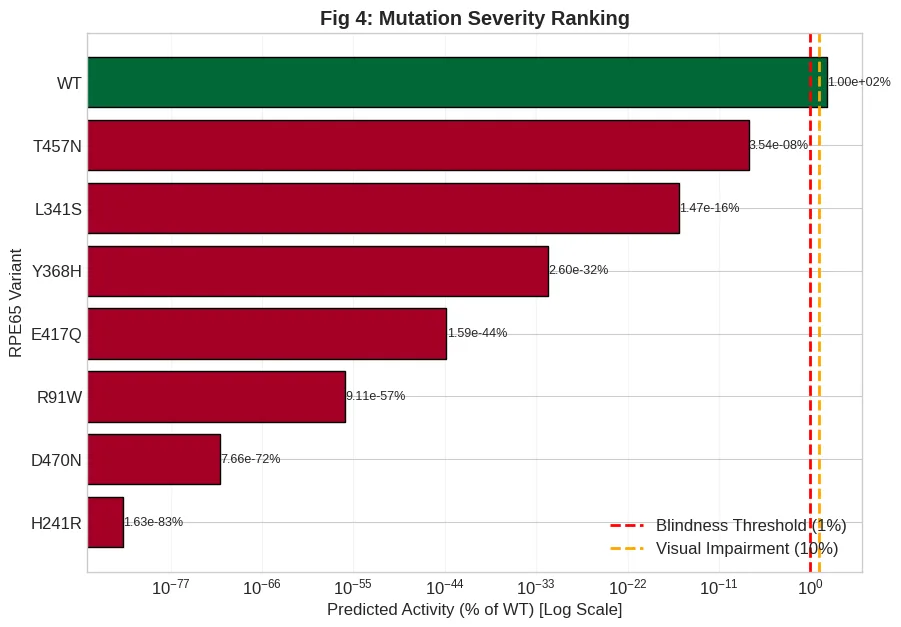
To measure this effect, the researchers combined computer predictions of protein shape with quantum calculations. They introduced a simple metric, relative quantum activity, which shows how strongly a mutation weakens proton tunneling. This metric clearly separated patients into two groups: those with severe blindness and those with mild disease.
Now doctors will be able to predict in advance how severe the disease will be, simply by looking at the protein structure. And the approach itself, looking for "quantum cliffs" in proteins, could be useful for many other inherited diseases where fractions of an angstrom make all the difference.
Protons don't just tunnel in the eye. Without quantum tunneling, the Sun wouldn't shine: it's how protons overcome electrical repulsion and trigger thermonuclear reactions.
In the series "The Expanse," the alien protomolecule rebuilds living organisms at the quantum level — much like RPE65 mutations change protein function due to quantum effects.