A critical threshold is a specific value of a parameter at which a system undergoes a qualitative change in behavior. Below the threshold, the system may be stable or exhibit one type of dynamics; above it, a completely different regime emerges. This concept appears across physics, biology, and social science, from the onset of turbulence in fluids to the spread of epidemics. Understanding critical thresholds helps predict when systems will transition from one state to another, often with dramatic consequences.
History
The concept of critical thresholds has roots in the study of phase transitions, with important contributions from Lev Landau and Kenneth Wilson in the mid-20th century. The broader idea of criticality in complex systems was popularized by Per Bak in the 1980s with self-organized criticality.
How it works
In many systems, the response to a driving parameter is nonlinear. Near a critical threshold, small changes in the parameter can lead to large changes in the system's state, a phenomenon known as critical slowing down. The system may exhibit fluctuations that grow in size and duration as the threshold approaches. Mathematically, these thresholds often correspond to bifurcation points in dynamical systemstheory, where the stability of equilibrium solutions changes.
In practice
Critical thresholds are used in earthquakeprediction (stress accumulation), in epidemiology (herd immunity), and in engineering to design fail-safe systems that operate below dangerous thresholds.
Fun fact
The human eye's ability to detect a single photon is an example of a system operating right at a critical threshold, where the signal-to-noise ratio is balanced at the physicallimit.
A mountain pass connects two valleys. In one, the protein is folded; in the other, it is unfolded. To get from one to the other, you must cross the saddle — the highest point on the path. In protein science, this point is called the transition state, and the coordinate that shows the distance to it is the committor.
One hundred milliseconds. In that time, after a lightning strike or a short circuit, the power system either returns to normal operation or loses stability. A new-generation Neural Network Oscillations learns to sense this moment, like an experienced tightrope walker anticipating a gust of wind.
Two pieces of sandpaper are pressed tightly together. As you start to slide them, they first catch on the rough spots, then suddenly slip. A fault in the Earth behaves much the same way during an earthquake. But there's a crucial detail: how far do you need to push the edges before the grip gives way? This distance is called the critical slip distance.
In the infinite river of integers, where whirlpools of primes swirl, mathematicians have been sifting sand for centuries in search of golden nuggets — the zeros of L‑functions. These enigmatic objects, discovered by Riemann in 1859, act like an invisible hand governing the distribution of primes.
A pot of water always boils the same way: hit 100 degrees and bubbles start. Quantum fluids are different. When a cloud of atoms is cooled to near absolute zero, it can turn into a single matter wave — a Bose–Einstein condensate. But the transition itself, it turns out, can happen in three different ways.
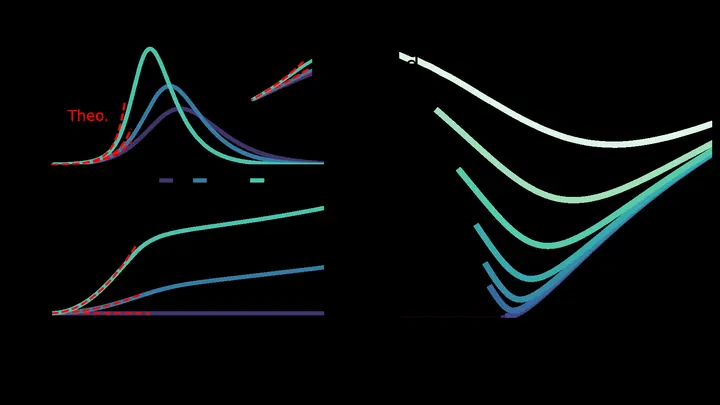
A long chain of atoms, each a tiny magnet. They talk to each other and to a common field, like musicians in an orchestra who hear both the conductor and their neighbors. When the external field changes, the orchestra either plays out of sync or all instruments come in together: that's a quantum phase transition.
A vast hall with a thousand doors, and only one leads to the stars. The rest are locked, and the keys aren't just hidden: they're wrapped in other keys and tangled into a knot. That's the Great Filter in a new reading: not a chain of failures but a tangled hierarchy where each step depends on the previous one nonlinearly.
Every group has its unspoken trios: three friends who are always together. And there are pairs that exist on their own. It turns out that how much trios "contain" pairs determines how everything, from a virus to a new idea, spreads through the group.
Scientists introduced a measure they call the nesting coefficient.
Astronomers occasionally spot interstellar objects — rocky chunks or comets from other star systems. Most look ordinary, but some puzzle us with their shape, speed, or shine. To stop guessing, scientists applied the Loeb scale: from 0 (plain rock) to 5 (technosignature — an artificial signal from space).
An epidemic is like a fire in a dry forest: a spark flares up, the flames leap from tree to tree, and within a week the whole area is burning. A hundred years ago, scientists devised a simple mathematical model for such a fire: they divided people into those who had not yet fallen ill, those who were ill, and those who had already recovered.
A quiet tube with a heated grid inside. The voltage on the grid is suddenly raised, and the tube starts to hum, sustaining itself. This is not a malfunction but a transition to another stable state, like a ball rolling over a hill into a neighboring hollow.
Light trapped in a tiny cavity is like a pendulum that gets pushed harder and harder. At first, it swings smoothly and predictably, like an ordinary clock. But if you push it hard enough, the motion becomes strange: the pendulum seems to be in two extreme positions at once.
To tell one protein from another, you need to describe its shape and composition. There are dozens of such descriptions: molecular length, charge, solubility. But not all are equally useful. A method called Differentiable Information Imbalance (DII) can pick out the most informative features while discarding the rest.
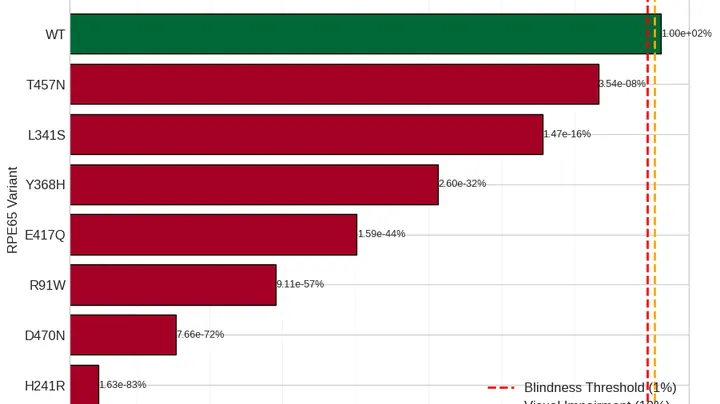
Deep in the eye, in a thin layer of cells, a tiny molecular machine works. It captures light and turns it into a signal that the brain interprets as an image. But sometimes a typo occurs in the blueprints of this machine — a single letter of the genetic code changes, and a person is born blind.
A snowflake falling from a cloud chooses between a left-handed and a right-handed form. The difference between them is almost imperceptible, like a breath of wind, yet it is that very breath that decides which pattern will grow.
In a chain of cold spins stretched along a single line, order and disorder can intertwine into a pattern that defies the usual rules. Two states of matter, two kinds of "order," are separated by a crossroads where the roads do not converge but diverge.