How to Grow the Perfect Photocathode express
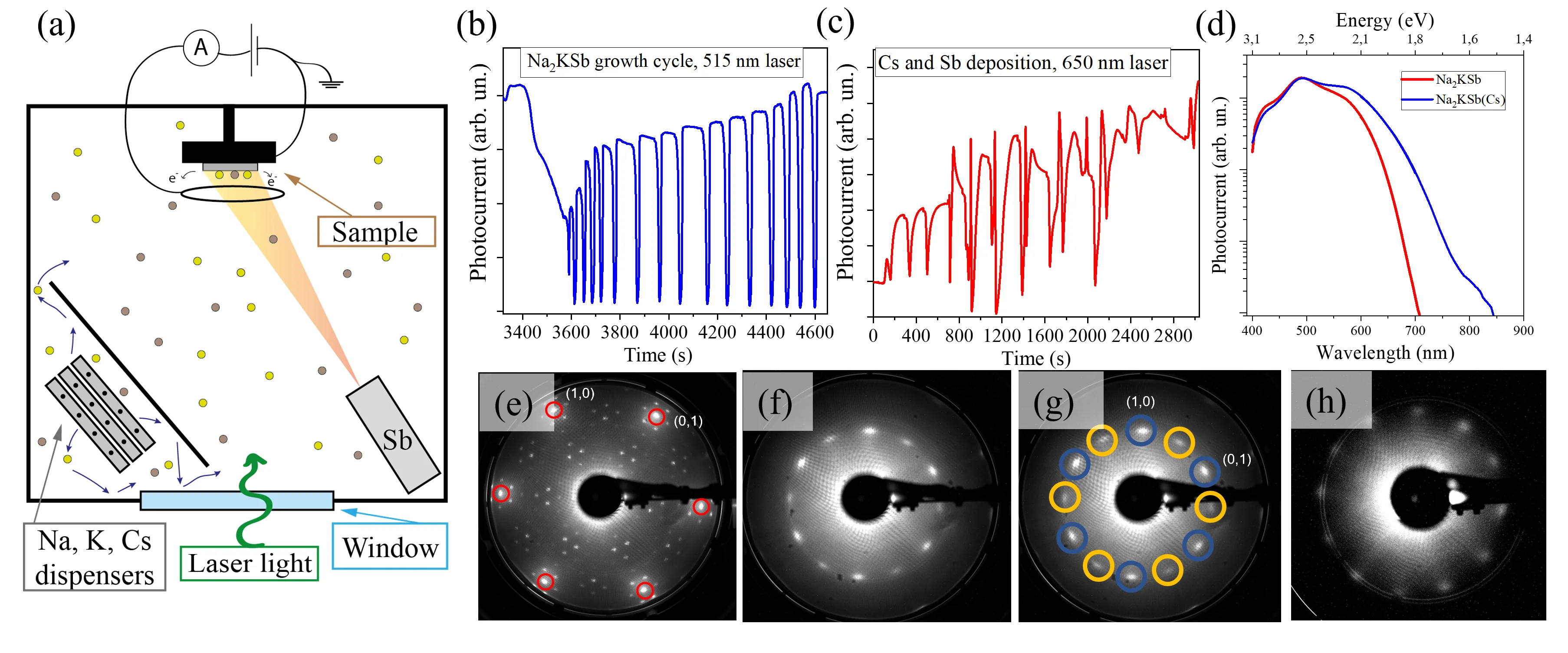
To pull a beam of electrons with aligned spins out of a material, you need a photocathode — a substance that emits electrons when illuminated. One of the best such materials is the sodium–potassium–antimony compound Na2KSb, but its internal workings have so far been studied blindly. Now, researchers have for the first time grown it as a thin crystalline film on a substrate of graphene and silicon carbide.
The crystal came out so smooth that they could apply a technique that reveals how electrons move inside the material: the angle and energy of the emitted electrons tell you about their "home" orbitals. Comparing these data with calculations, the scientists saw special states on the surface: they arise because the crystal terminates in different ways: sometimes sodium atoms end up on the outside, sometimes antimony atoms.
After depositing cesium and antimony, a step known as activation, the crystalline order was preserved. This means you can study a ready-made multicomponent photocathode, Na2KSb(Cs), and deliberately improve its properties: increase the electron yield or the degree of spin polarization.
Now researchers have a clean playground for experiments: grow a film, activate it, look at ARPES, and tweak the composition until the photocathode is perfect. The path from a "black box" to a comprehensible device is open.
Original abstract
as written by the authors arXiv:2601.19652
A recent study has established the Na$$_2$$KSb(Cs) photocathode as a highly efficient emitter of spin-polarized electrons. However, the electronic structure of alkali antimonides remains poorly understood. In this work, we report the first crystalline epitaxial growth of Na$$_2$$KSb films, achieved via chemical vapor deposition (CVD) on a graphene-coated SiC(0001) substrate. The high crystalline quality of these films enabled a direct investigation of the material's electronic structure using angle-resolved photoemission spectroscopy (ARPES). By comparing the experimental results with density functional theory (DFT) calculations, we have identified dispersive surface states originating from different terminations of the Na$$_2$$KSb(111) surface. Furthermore, we demonstrate that the crystalline order of the film is preserved following its activation via the deposition of Cs and Sb. This finding opens a pathway for investigating the electronic structure of multialkali Na$$_2$$KSb(Cs) photocathodes and for rationally improving their properties.
Antimony, a component of the photocathode, has been known since antiquity: its compounds were used to make black eye paint in ancient Egypt.