Cesium is a soft, silvery-gold alkali metal that sits near the bottom of the periodic table. In physics, it is best known for its role in timekeeping: the international standard for the second is defined by the microwave transition between two hyperfine energy levels of the cesium-133 atom. Because this transition is extremely stable and reproducible, cesium atomic clocks serve as the primary reference for Coordinated Universal Time (UTC), underpinning GPS navigation, financial transactions, and telecommunications synchronization.
History
Cesium was discovered spectroscopically by Robert Bunsen and Gustav Kirchhoff in 1860, making it the first element found by spectral analysis. The use of cesium in atomic clocks began with Louis Essen's prototype at the National Physical Laboratory in 1955.
How it works
In a cesium atomic clock, atoms are heated into a vapor, then sorted by velocity using lasers or magnets. The atoms pass through a microwave cavity tuned to the hyperfine transition frequency of about 9.19 GHz. A feedback loop adjusts the microwave source to maximize the number of atoms that flip their spin state, locking the oscillator to the atomic resonance. In the context of quantum optics, hot cesium vapor is also used to generate correlated photon pairs through spontaneous four-wave mixing, where two pump photons are converted into a signal and idler photon pair inside the vapor cell.
In practice
Cesium atomic clocks are the backbone of GPS satellites and global time standards, while hot cesium vapor cells are used in quantum optics experiments to produce entangled photon pairs for quantum communication and cryptography.
Fun fact
Cesium is so reactive that it can explode on contact with water, and it is one of only five elements that are liquid at or near room temperature.
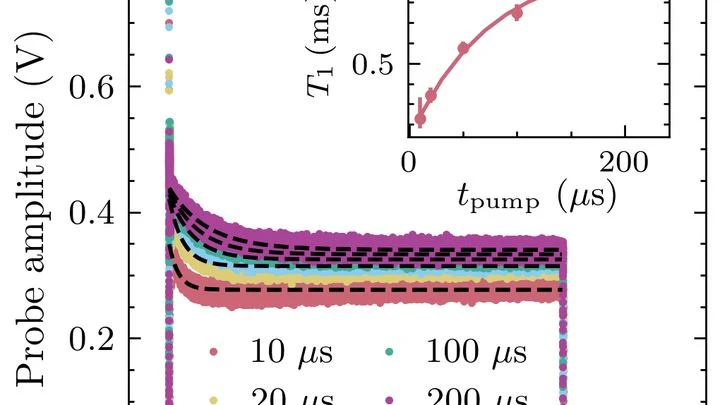
A beam of light enters a glass cell filled with cesium vapor and changes the internal state of the atoms: this is how information is recorded. A moment later, another beam reads it out by how the atoms absorb light. It's not a hard drive, but rather a notebook that turns its own pages.
Eight such "pages" are created by an acousto-optic deflector — a device that bends light with sound.
The pendulum in these clocks doesn't swing from a spring or a weight, but from a tiny kick inside the atomic nucleus. Ordinary atomic clocks keep time by the oscillations of electrons, but here the pendulum is the nucleus itself — a dense ball of protons and neutrons.
The world's most accurate pendulum isn't a steel rod: it's a tiny atomic nucleus. The isotope thorium-229 has a special excited state: to nudge the nucleus into it, you need surprisingly little energy — about what an ultraviolet laser delivers.
A pendulum that almost nothing can knock off balance (not shaking, not heat, not magnetic fields) because it is hidden in the very heart of the atom. That is the kind of pendulum physicists used when they first switched on a nuclear clock. Previously, the best clocks, optical ones, relied on electron transitions.
The most precise modern clocks count time by the oscillations of electrons in atoms. But their rhythm can be thrown off, like a mechanical watch's spring gets jolted by shaking. Physicists found a more reliable pendulum: the atomic nucleus.
In cold molecular clouds, where temperatures drop to 10 K, chemistry does not freeze. It turns into a slow, error-free dance. Invisible ions, like nocturnal bees, carry carbon 'pollen grains' from molecule to molecule. They stitch aromatic rings into intricate polycyclic structures.
Light from a bulb or even a regular laser resembles a crowd at a subway exit: people move haphazardly, sometimes dense, sometimes sparse. Physicists call this behavior shot noise — random fluctuations in the number of particles arriving per second.
In a sealed glass bulb the size of a finger, metallic vapor boils. The main component is cesium, but one percent rubidium hides within. A laser beam at 795 nanometers finds this impurity and makes it glow.
Rubidium alone would give a weak signal: atoms quickly fly through the beam.
Ordinary atomic clocks tick when an electron jumps between energy levels. But external fields and jolts can disrupt this rhythm. Highly charged ions, atoms stripped of many electrons, barely notice such disturbances: their electrons sit deep and tight. That makes them ultra-stable 'pendulums.'
The Cf17+ ion is a curium atom that has lost 17 electrons.
Conventional atomic clocks are essentially optical counters: they rely on spectroscopy — a method for measuring the frequency of radiation with high precision as electrons jump between energy levels.