Lithium niobate (LiNbO₃) is a synthetic crystalline material prized for its exceptional electro-optic, nonlinear, and piezoelectric properties. It is a workhorse of photonics, used to manipulate light with electric fields, generate new frequencies, and create entangled photon pairs for quantum technologies. Its versatility has made it a key platform for everything from high-speed optical modulators in telecommunications to compact quantum chips.
History
Lithium niobate was first synthesized in the 1940s, and its ferroelectric and electro-optic properties were characterized in the 1960s. The development of lithium niobate waveguides in the 1970s and, more recently, thin-film lithium niobate (TFLN) in the 2010s, has dramatically expanded its applications.
How it works
The material's power comes from its crystal structure, which lacks inversion symmetry. This allows the Pockels effect: an applied electric field changes the refractive index of the crystal proportionally, enabling precise control of light phase and intensity. Additionally, its strong second-order nonlinearity (χ⁽²⁾) enables processes like second-harmonic generation and spontaneous parametric down-conversion, where a single photon splits into two entangled photons — a cornerstone of quantum optics.
In practice
It is used in optical modulators for fiber-optic communication, in quantum photonic chips for generating entangled photons, and in nonlinear frequency converters for laser systems.
Fun fact
Lithium niobate is also used in surface acoustic wave (SAW) filters, which are found in virtually every smartphone to filter radio signals.
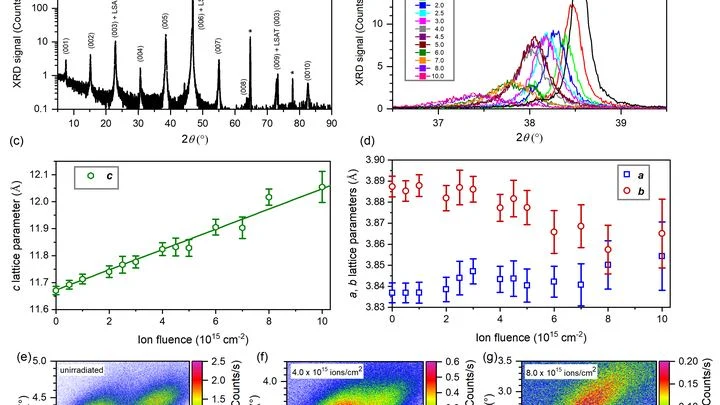
A thin film of neodymium nickelate, fifteen nanometers thick, sits on a neodymium gallate substrate. Below one hundred eighty kelvin it behaves as an insulator: electrons are locked inside their atomic cells and cannot move freely.
Beyond Neptune's orbit lies an ocean of icy islands that has remained nearly unchanged for four billion years. These islands, known as trans-Neptunian objects, hold the recipe for planet formation. Until recently, astronomers could only see the large ones, while the small, city-sized ones stayed invisible.
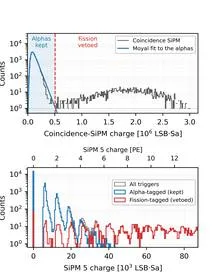
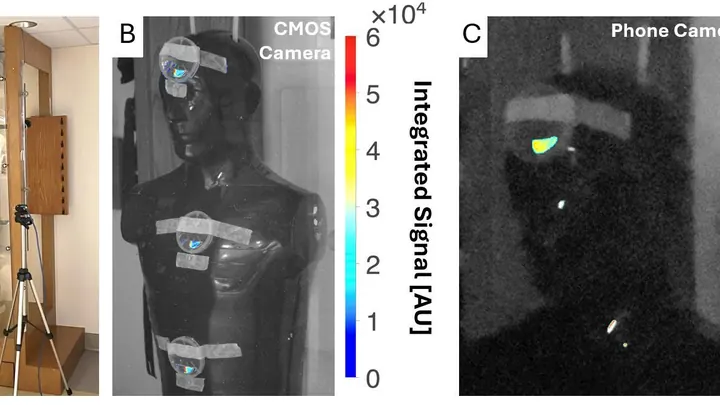
The stage is bathed in icy light, and on it stand silicon spectators. Each is an array of tiny avalanche diodes capable of spotting a single photon, but only if the surrounding temperature drops to 165 K.
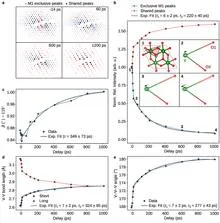
The camera captures not a race but a dance of atoms. In vanadium dioxide, the transition from an insulating to a metallic state occurs within trillionths of a second, yet until now no one had seen exactly how the vanadium and oxygen atoms move. Now, ultrafast electron diffraction has captured this route frame by frame.
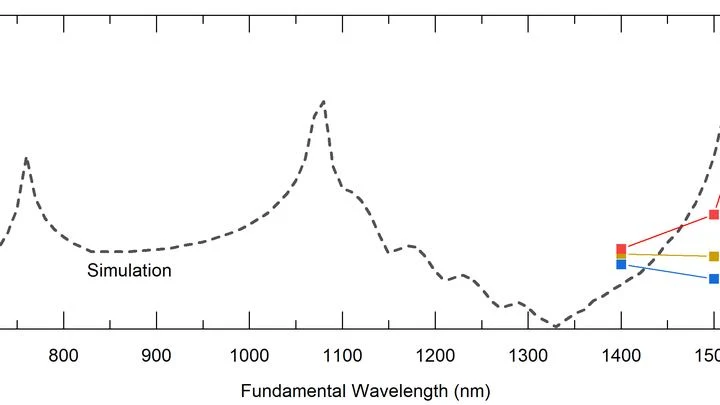
Light that never reaches the camera still leaves its mark on it. That's how the new imaging method works: you illuminate the object with one color, and the picture is assembled from another. Inside the crystal, light waves mix, and information about the invisible transfers to a visible beam.
In the experiment, they used a silver thiogallate crystal.
No one has ever seen dark matter, but it should pass through detectors like wind through leaves. Sometimes, very rarely, a dark matter particle bumps into an atomic nucleus, and then the detector must catch that jolt. The trouble is that light dark matter particles can hardly move heavy nuclei: it's like trying to knock down a bowling pin by throwing a feather at it.
You can make light turn on command, like water in a hose — if you know where to squeeze. That's what electro-optic circuits do: they change the direction of a beam inside a chip using an electric field. The classic material for such tricks is lithium niobate, a crystal that responds to voltage like a string to a pluck.
In an ordinary room, light vanishes the moment you switch off the lamp. In a tiny silicon nitride cavity, a photon can bounce between the walls 80,000 times before it gets lost. It's like a ball thrown into a room that rebounds off the walls with almost no loss of speed.
A light beam usually travels in a straight line, but you can make it spin around its axis, like water swirling into a vortex as it drains. This 'twisted' light carries more information and is needed for ultra-fast communication and quantum computing.
A short flash of light is like a musical phrase: you can distinguish individual notes if you listen very carefully. But in the quantum world, these 'notes'—temporal modes — are squeezed down to picoseconds, and ordinary optics can barely tell them apart.
In the cold Taurus cloud, where stars are born, telescopes have detected molecules with the smell of bitter almonds — aromatic nitriles. On Earth, you can find them in peach pits, but in space they hang in icy dust. What happens to them under the harsh ultraviolet light of young stars? Chemists recreated this process in the lab.
A piece of metal is cooled to minus two hundred degrees, and electric current begins to flow through it without the slightest friction, like water in a pipe flowing without touching the walls. This behavior is called superconductivity.
Organic light-emitting materials are like a busy intersection without traffic lights. Molecules receive energy but, instead of honestly giving it back as light, they often turn into dead ends: they form dark pairs (exciplexes — short-lived complexes that do not emit) or collide with each other, losing charge.
Building a quantum network node is like teaching a dancer to balance on a carbon thread over an abyss. One leg must spring lightly from the wire, hurling photon-messengers into the external world. The other must grip the rope tightly, guarding precious quantum information.
A crystal the size of a matchbox was placed under the beam of a clinical accelerator. Half of its surface was covered with a pattern of nanoscale bumps — tiny, smaller than the wavelength of light. The other half was left smooth. The difference was striking: the coated part produced a signal 4.1 times brighter.
A potter uses a sharp stylus to trace a pattern on a still-damp clay tile. One wrong move, and the line blurs, the tile cracks. Physicists work with films of the high-temperature superconductor YBCO (a compound of yttrium, barium, copper, and oxygen) in much the same way.
The atomic nucleus is a natural spring of colossal power. When the protons and neutrons inside it rearrange, it enters a special long-lived state — a nuclear isomer. It stores energy like a spring compressed to its limit.
A typical photon source can be likened to a club entrance with a single bouncer. He tries to let people in one at a time, but occasionally couples sneak past. Physicists call this the purity problem: photons must arrive strictly solo, otherwise quantum computing breaks down.
Quantum networks need a mediator between storage — spin — and carrier — light. No single molecule had ever pulled off such a feat. But now physicists have found a solution. They placed a carbene molecule into a crystal and cooled it to -269°C.
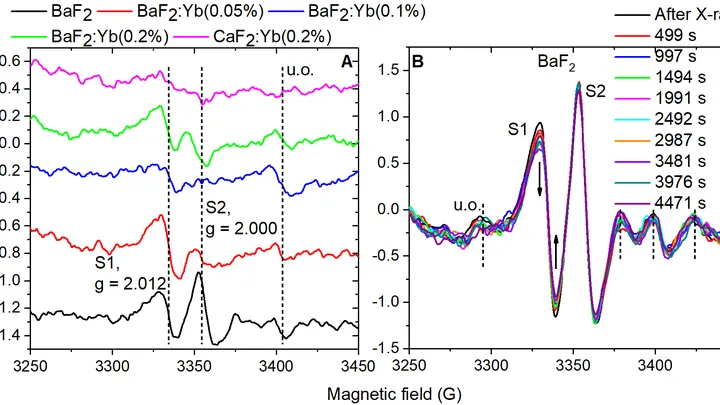
Light passing through a transparent crystal can subtly change color. That's how many lasers work: a tiny addition of a rare-earth metal makes the crystal glow. But the same metal behaves differently in different crystals, and physicists have studied this quirk using ytterbium.
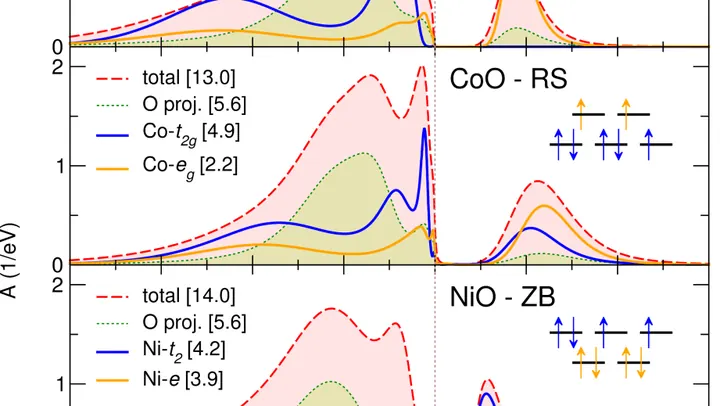
If you change not the composition but only the arrangement of atoms, you can make the same material conduct electricity or absorb light differently. That's exactly what the authors did with nickel and cobalt oxides. In one case, atoms are stacked like balls in a cubic box: each metal atom is surrounded by six oxygen atoms (rock salt structure).
Light leaves a trace even when there is almost none of it. A single photon, a tiny bundle of energy, strikes a silicon wafer and knocks out a handful of electrons. The trouble is that the handful is too small to notice. You need an amplifier.
Usually, the signal is amplified by applying a voltage to metal contacts on the detector's surface.
An ordinary kitchen knife made of niobium would suddenly start conducting electricity with zero loss at −258 °C. That's how superconductivity works, and you can "switch it on" right at the metal's surface by blasting it with a laser in a nitrogen atmosphere.
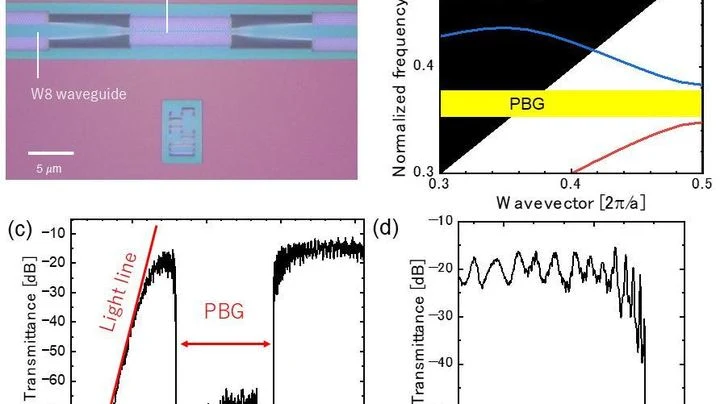
Light can act as a courier carrying secret messages. But to ensure the courier doesn't lose a single letter, you need to meet and check it very quickly. The new chip made from a thin film of lithium niobate is like a turnstile that opens and closes in billionths of a second, letting light pulses through at just the right moment.
A memristor is a resistor with a memory: after the current is turned off, it retains its resistance. Inside, a thin film of metal oxide is sandwiched between two metal electrodes. When a strong current is first passed through the device, conductive filaments of oxygen vacancies form in the oxide, and the resistance drops sharply.
A superconductor is a material through which current flows without loss, like water through a perfectly smooth pipe. But to make the pipe perfect, you have to cool it to very low temperatures. Physicists have long been looking for ways to make such a pipe at warmer temperatures, and one clue is the quantum critical point.
A freshly polished niobium surface shines like a mirror. But within minutes, a dull oxide film, invisible to the eye, forms on it. For a superconducting qubit, this film is like sand in an hourglass: it causes the quantum state to decay prematurely.
Two pendulums on a stable table swing independently. If you place them on a shaky surface, vibrations synchronize their motion. The same principle worked on a silicon chip with photons.
Scientists created two sources of light that emit pairs of particles.
An ordinary flash drive stores bits in electron traps, but you can only read them through a separate wire and amplifier. In the new development, the same piece of the semimetal tellurium plays both the role of storage and the light bulb.
Two laser beams of different colors strike a crystal, and inside it, triplets of light particles are occasionally born, like three coins popping out of the same vending machine slot. For the first time, this process has been made efficient enough: 11.6 triplets per second.
The beams were green and invisible infrared.
You can launch sound in a crystal at a frequency so high that the human ear can't hear it, and make that sound run in circles, like a train on a loop track. Engineers took a thin film of silicon nitride, deposited it on a lithium niobate substrate, and carved waveguides for sound waves into it.
Infrared light is invisible to the eye, but it's everywhere: from TV remotes to the heat of the human body. Catching it requires special materials. Conventional detectors are bulky, rigid, and not easily tuned to specific wavelengths.
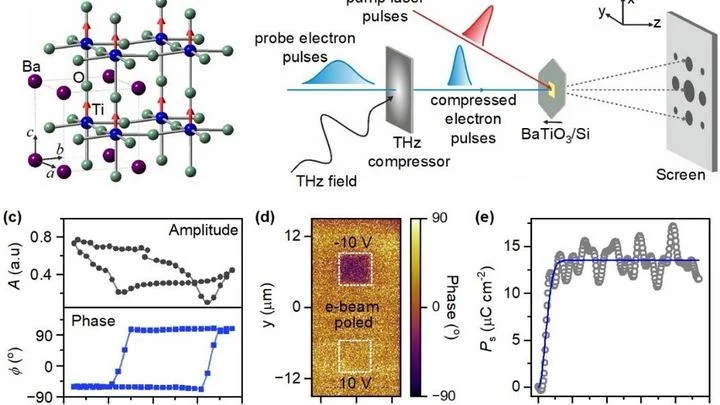
Inside a barium titanate crystal, there's a built-in electric field, like a permanent magnet, but for charges. When a flash of light hits it, electrons are knocked loose and start darting around, colliding with atoms. But the crystal isn't the same in all directions: it has an axis along which the field is strongest.
Niobium is a metal that, when cooled to a few degrees above absolute zero, conducts electricity without resistance. In labs, it is deposited as thin strips onto a substrate, like frosting on a cake. But during deposition, oxygen from the special mask seeps into the metal, and it spoils the superconducting properties.
A green flashlight beam dives into a pool and reaches the bottom with barely any loss. Water is transparent to green light, which is why it's used for underwater communication. But to send video or sensor data, the light needs to be switched on and off very quickly — billions of times per second. Ordinary lasers are too slow and unstable for this.
A solid electrolyte is like a sponge for lithium ions. In a regular lithium battery, ions float in a liquid, like fish in an aquarium. In a solid-state battery, they have to squeeze through the crystal lattice, like through narrow corridors.
Hidden inside a zinc oxide crystal is a quantum duo: a tin atom and a lithium atom sitting side by side. Their bond is so tight that the electron captured by this pair seems to live on the tin, while the lithium merely plays along. This complex was long sought after, but only now has it been deliberately created and identified by its characteristic glow.
An ordinary piece of semiconductor weakly changes the color of light passing through it. For decades, physicists worked around this limitation by placing the crystal in clever surroundings, but the material itself remained the same.
Now researchers have assembled a "sandwich" of alternating thin layers of gallium arsenide and aluminum gallium arsenide.
Silver niobium oxide, AgNbO₃, is a layered pie of silver, niobium, and oxygen atoms. At room temperature, it behaves like an ordinary dielectric, but when cooled, the atoms start to shift, and the crystal gains electric polarization, like a compass needle, but instead of pointing north, it points in the direction of the internal…
A thin crystal of hexagonal boron nitride is a relative of graphite, but transparent and insulating. Occasionally, single defects appear in its lattice: a boron or nitrogen atom is missing, leaving a trap for electrons. Such a trap can absorb light and re-emit it, like a tiny flashlight.