A Lattice That Senses Cracks Before They Appear express
Ordinary materials break in silence. First, invisible struts inside them snap, and only then does a crack appear that you can see with your eyes. Engineers at Carnegie Mellon University have taught a material to 'talk' about such hidden damage.
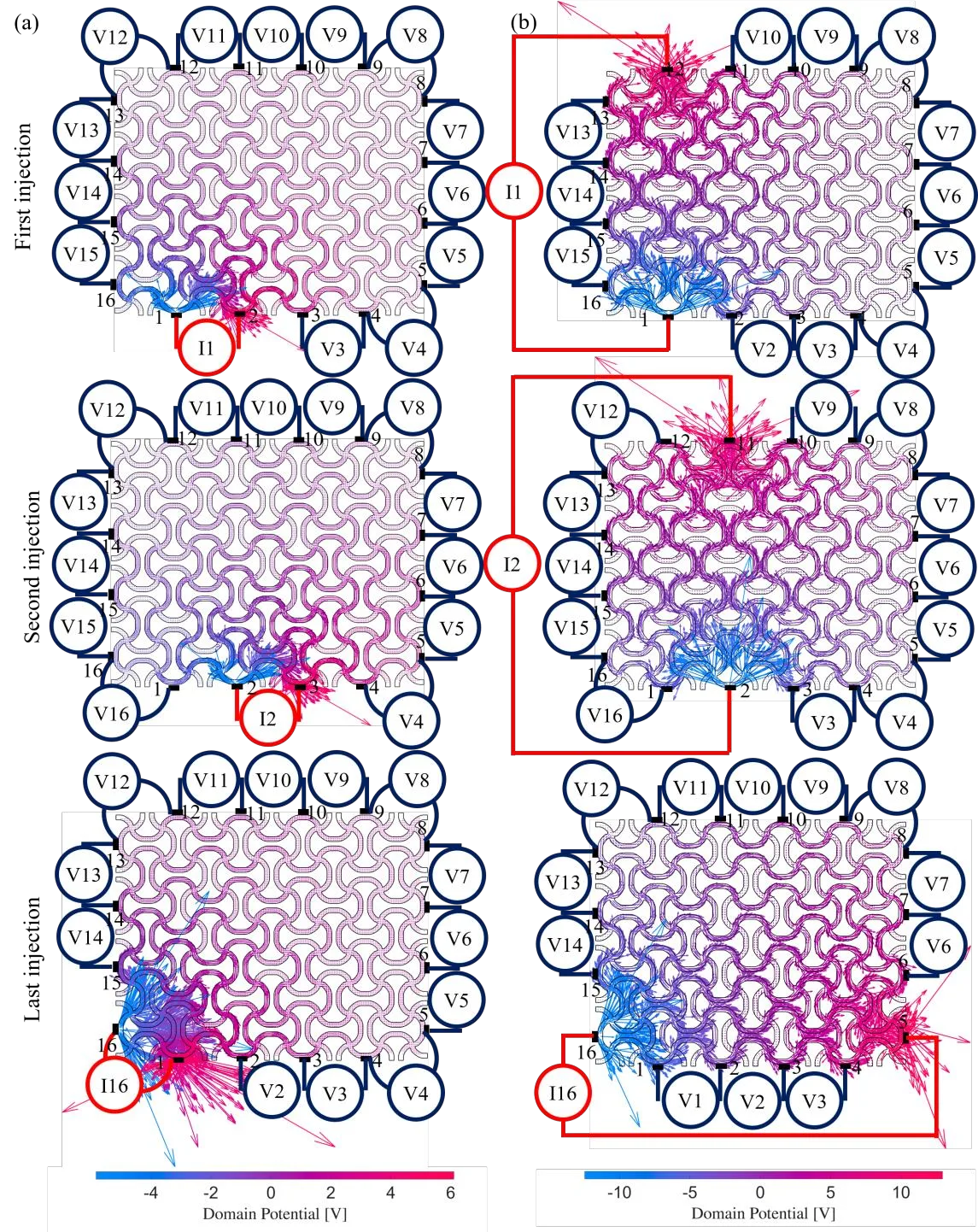
They 3D-printed a lattice resembling honeycomb but with a more intricate pattern. Carbon nanotubes, tiny conductors just a few atoms thick, were mixed into the resin. Sixteen electrodes were placed around the lattice's edges, like microphones around a stage. A weak current is sent through them, and the way it spreads through the structure is observed.
When the material is stretched, the struts in the lattice snap one by one. Each broken strut is a 'hole' in the electrical network: the current detours, and the conductivity map changes. The computer notices this instantly and shows exactly where the break occurred — even if it's far from the electrodes. This method is called electrical impedance tomography: by measuring changes in resistance, one reconstructs what's happening inside.
By changing the lattice pattern, you can tune the material's sensitivity: make it 'see' the earliest cracks or, conversely, focus on major fractures. It's like adjusting the focus on a camera — except instead of light, you're catching damage.
Such a material is a step toward 'smart' structures that monitor their own health. An airplane wing, a bone implant, or a battery casing could report a problem long before failure. And a digital copy, a digital twin, would reflect the real part's condition in real time.
Original abstract
as written by the authors arXiv:2602.15048
Electrical impedance tomography (EIT) enables non-invasive, spatially continuous reconstruction of internal conductivity distributions, providing full field sensing beyond conventional point measurements. Here, we report the first in situ implementation of EIT within a tunable architected lattice materials framework, enabling systematic exploration across a broad lattice design space while achieving real time monitoring of damage evolution, including early stage, prefracture events, in 3D printed multifunctional lattice composites. Lattices are designed via Voronoi based branch trunk branch motifs inspired by 2D wallpaper symmetries and fabricated using CNT infused photocurable resins, with nanoscale filler dispersion confirmed by field emission scanning electron microscopy. Sixteen electrodes distributed along the lattice periphery enable EIT measurements during quasi static tensile loading. Conductivity maps reconstructed using adjacent and across current injection schemes resolve sequential ligament fracture with high temporal resolution, with localised conductivity loss quantitatively coinciding with fracture sites, including regions remote from electrodes. Architectural tunability allows systematic control of EIT imaging sensitivity to early stage damage, while pronounced resistance discontinuities at failure further corroborate spatial localisation; global end to end resistance measurements complement macroscopic stress strain responses. Collectively, these results establish in situ EIT as a scalable, full field sensing modality for architected multifunctional materials, providing an experimentally validated pathway toward autonomous, intelligent materials and data rich material states that can inform digital twin frameworks for structural, biomedical, and energy related applications.
Carbon nanotubes in the resin make the material conductive but don't make it heavy. A lattice with these filaments weighs as much as plastic but senses damage like a nervous system.