Non-destructive testing (NDT) refers to a family of inspection techniques used to evaluate the properties of a material, component, or structure without causing permanent damage. It allows engineers to detect flaws, measure thickness, or assess integrity while the object remains in service. Common methods include ultrasonic testing, X-ray radiography, eddy current testing, and thermography.
History
The earliest NDT practice dates to the late 19th century with X-ray inspection, but the field grew rapidly during World War II for military equipment inspection. The term 'non-destructive testing' was formally established in the 1950s.
How it works
NDT methods exploit physical phenomena that interact with matter in ways that reveal internal structure. Ultrasonic testing sends high-frequency sound waves into a material; reflections from internal flaws return to a sensor, producing a signal that maps defects. X-ray radiography passes radiation through the object, and variations in absorption reveal density changes. Eddy current testing induces electrical currents in conductive materials; flaws disrupt the current flow, altering the measured impedance.
In practice
NDT is used in aerospace to inspect turbine blades, in pipelines to detect corrosion, in civil engineering to assess concrete structures, and in medicine (as non-invasive imaging like ultrasound and MRI).
Fun fact
The Titanic's hull was inspected with rudimentary NDT methods in 1912, but the techniques were too primitive to detect the microstructural weaknesses that contributed to the disaster.
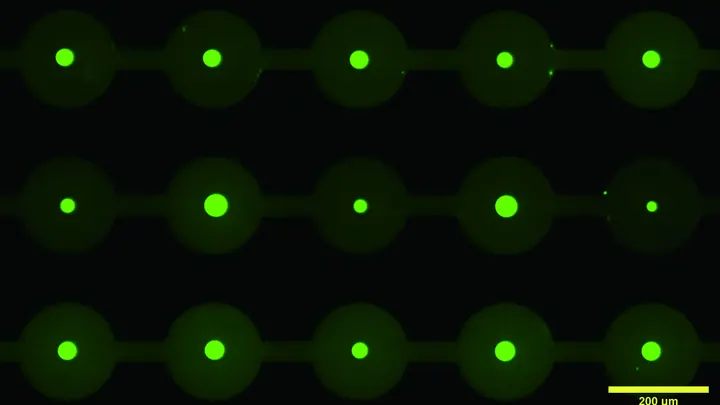
Magnetic particles are attached to the surface of the diamond by DNA strands, like puppets on strings. They constantly dance under the thermal motion of the liquid molecules. The liquid's viscosity sets the pace: in honey, the particles barely tremble; in alcohol, they dance quickly.
When you need to see inside the brain, you usually lie in a tight tube of an MRI scanner or get zapped with X-rays. Both methods are costly, bulky, and not always available.
Two dice always land on the same number, no matter how far apart you toss them. In quantum physics, this behavior is called entanglement, and it's the key resource for future computers and secure communication. The trouble is, not all entanglement is easy to spot.
A drop of oil in a glass of water forms a sphere. Inside a living cell, a similar separation occurs, but instead of oil, proteins and nucleic acids form dense droplets — condensates. These droplets act as temporary workshops: they gather needed molecules, speed up reactions, and break apart when the task is done.
A heat engine doesn't have to be made of iron. In the microworld, a single electron can play the role of a piston, and the measurement process itself can serve as fuel. Two neighboring 'pockets' for electrons are connected by a narrow bridge.
A baker follows a recipe for a cake, but instead of a fluffy sponge, they get a hard crust. They start running through possible causes: maybe the flour was damp, or the oven heats unevenly, or the eggs were too cold.
You taste a fruit smoothie through two different straws. One lets through only the big chunks, the other only the liquid. Individually, the sensations are misleading, but together they give you the key: here, it seems, is banana, and here, strawberry.
When matter is heated to millions of degrees, it turns into plasma — a mix of free electrons and ions, like a boiling soup of charged particles. You can't measure the temperature of such a 'soup' with an ordinary thermometer, but you can shine X-rays through it.
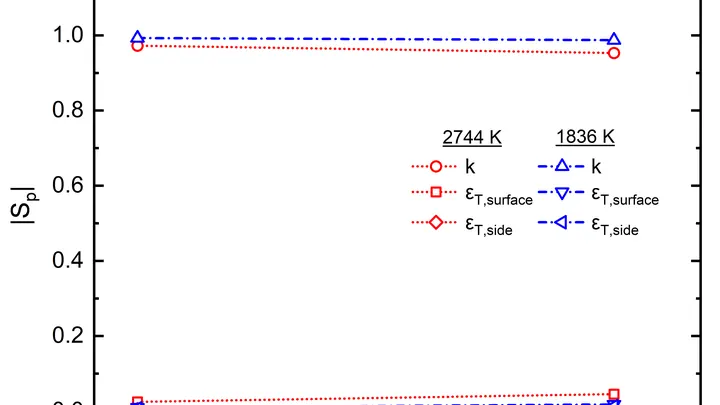
A red-hot piece of metal in a furnace is like a frying pan on the stove: the hotter it gets, the faster heat travels to your hand if you touch it. But at temperatures where the metal is close to melting, measuring that speed is very tricky: sensors don't make good contact, heat escapes into the air, and the glowing sample confuses the instruments.
This new method sidesteps those obstacles.
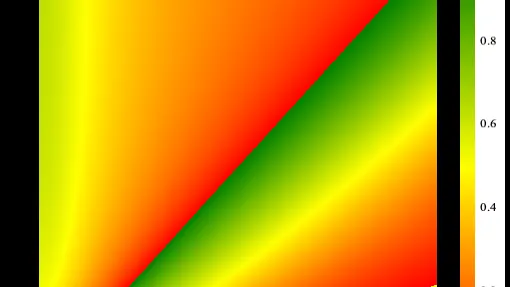
When matter is compressed to pressures of millions of atmospheres and heated to thousands of degrees, it is neither solid nor gas. This warm dense state is like the interiors of giant planets or the moment of a meteorite impact. You can't look inside directly, but you can shine X-rays and see how they scatter off electrons.
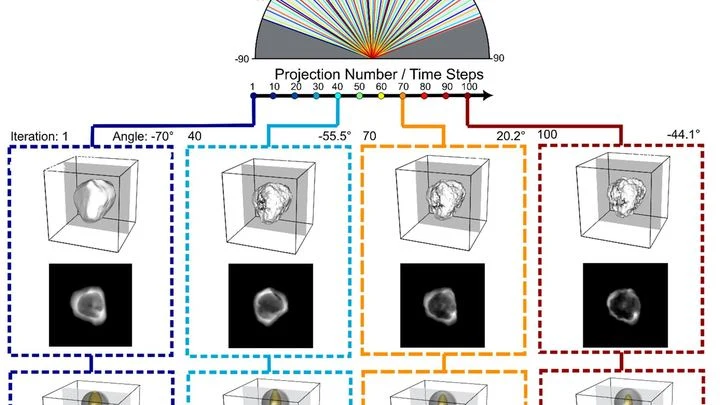
A tiny gold star melts under the beam of an electron microscope, its points slowly rounding off. In the past, such a process could only be seen in snapshots taken with long pauses, and the probing beam itself would alter the sample.
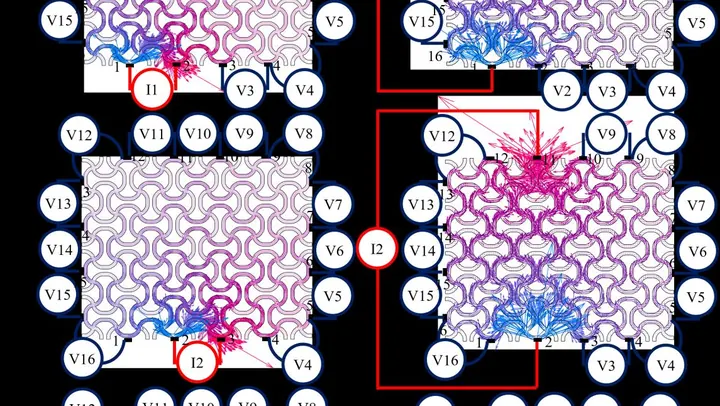
Ordinary materials break in silence. First, invisible struts inside them snap, and only then does a crack appear that you can see with your eyes. Engineers at Carnegie Mellon University have taught a material to 'talk' about such hidden damage.
They 3D-printed a lattice resembling honeycomb but with a more intricate pattern.
A warm cup or a human hand emits invisible light — mid-infrared radiation. Every substance absorbs this light in its own way, leaving a unique 'fingerprint'. From this fingerprint, you can tell what an object is made of without touching it.
Previously, seeing this fingerprint required huge lasers that fired very short pulses. They were expensive and complex.