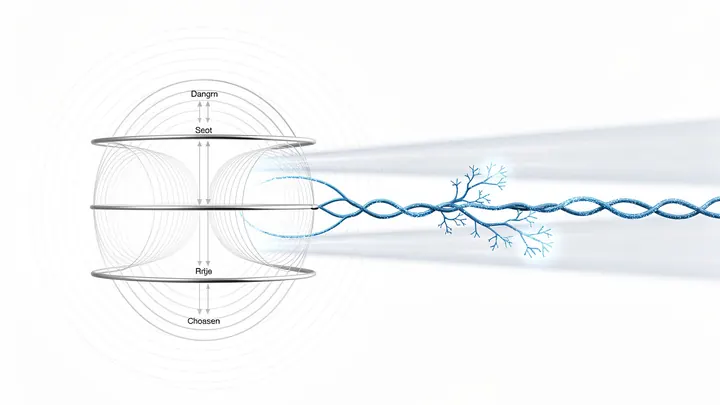
Electromagnetically induced transparency (EIT) is a quantum optical effect in which a medium that would normally absorb a light beam becomes transparent when a second, stronger 'control' beam is applied. The effect arises from quantum interference between two excitation pathways in the atoms of the medium, which cancels the absorption for a narrow frequency range of the probe beam. This makes EIT a powerful tool for slowing light dramatically, even to a standstill, and for storing light pulses as atomic excitations.
History
The effect was first predicted theoretically by Olga Kocharovskaya and Ya. I. Khanin in 1988, and independently by Stephen Harris and collaborators in 1990. The first experimental demonstration was by Harris and colleagues at Stanford University in 1991.
How it works
In a typical EIT setup, a medium of atoms has three energy levels arranged in a lambda configuration: two lower states and one excited state. The probe beam couples one lower state to the excited state, while the control beam couples the other lower state to the same excited state. When both beams are on, the atoms can be in a coherent superposition of the two lower states, a 'dark state' that does not interact with the light. Because the atoms are trapped in this dark state, they cannot absorb the probe beam, so the medium becomes transparent. The transparency is accompanied by a steep dispersion, which slows the group velocity of the probe pulse.
In practice
EIT is used in quantum memory devices for storing and retrieving light pulses, in slow-light experiments for optical delay lines, and in precision magnetometry and atomic clocks.
Fun fact
In EIT experiments, light has been slowed to speeds as low as a few meters per second, and even brought to a complete halt and then released intact.
On the table lies a layered cake of hexagonal boron nitride flakes, a material similar to graphite but made of boron and nitrogen atoms. One flake is carefully transferred onto another, and at the spot where they overlap, after heating in oxygen, bright single light sources are born.
The electron beam of a microscope usually flies through emptiness, like a courier on an empty highway. Any air molecule is a bump that makes it bounce and lose direction. So before, to examine a sample, you had to freeze it, dry it, or coat it with metal—and still you could only look in a vacuum.
A laser hits an atom, and tears out an electron. The brighter the light, the stronger the kick, and the faster the electron flies away. That's how the familiar picture works, where light is a smooth wave. But what if the light isn't smooth but 'squeezed,' with quantum fluctuations, like the trembling of a string?
An electron beam is a stream of tiny particles carrying an electric charge. When such a beam hits a material, it doesn't just heat it or knock out atoms: it also gives the surface a slight push, like a jet of water pushing against your palm.
In 1976, physicists predicted that an electron could do more than just fly past a nucleus: it could slam into it, transferring energy and making the nucleus 'shudder.' They called this effect NEEC — nuclear excitation by electron capture. But for nearly fifty years, no one has managed to observe it in an experiment.
A pale green crystal was placed in a magnetic field and cooled below one kelvin — almost to absolute zero. Inside it hide chains of copper atoms that behave like tiny magnetic needles. Usually their orientation is chaotic, but the strong field and cold make the needles align in a unified impulse, like soldiers on a parade ground.
A thin sandwich made of two different materials. You run an electric current through it, and the top slice magnetizes in one direction, the bottom in the opposite. This isn't a magic trick; it's the layer Edelstein effect, just described by physicists.
A beam of light enters frosted glass and fades — nothing unusual. But physicists have long known how to make light pass through without losing a single photon. This trick is called electromagnetically induced transparency: two light waves cancel each other at the right point, and absorption disappears. Now a similar feat has been pulled off with atoms.
A neat stack of atomic layers lies on a substrate. An invisible beam of terahertz light shines down on it, with a magnetic field applied from the side. After reflection, the beam's polarization rotates slightly.
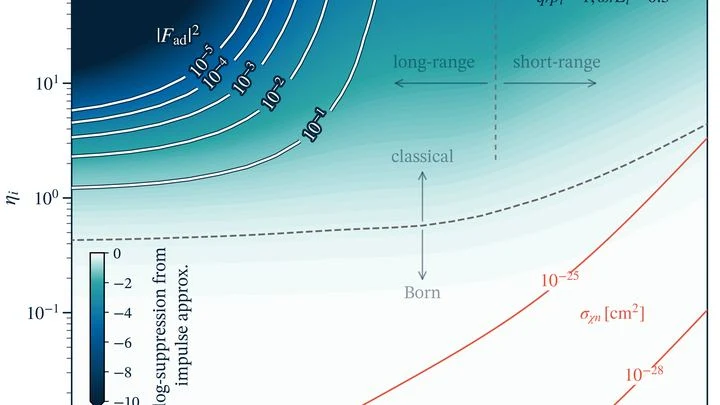
A billiard ball slams into another. Impact, and the balls scatter. But if the push is not sharp but very gentle, the balls just roll together without bouncing. An atom behaves much the same way when hit by a dark matter particle.
A single camera shot stores both a normal picture and a hidden map of how light rippled through the scene. Quantum entanglement makes this possible. Pairs of linked photons are generated: one visits the object, its twin takes a detour. Later, measuring the twin one way pulls out the brightness information.
Drop two pebbles into a pond at the same time — the ripples will spread evenly and in sync. The same happens in a quantum interferometer: a particle is split into two waves that travel along different paths and then meet. Ideally, their crests align.
A detector filled with superfluid helium-4 is like a perfectly still lake. The liquid doesn't slosh or bubble: it's frozen in a single quantum state. An invisible guest, a dark matter particle, flies through it. It doesn't shine or leave a track. But sometimes it nudges a helium nucleus.
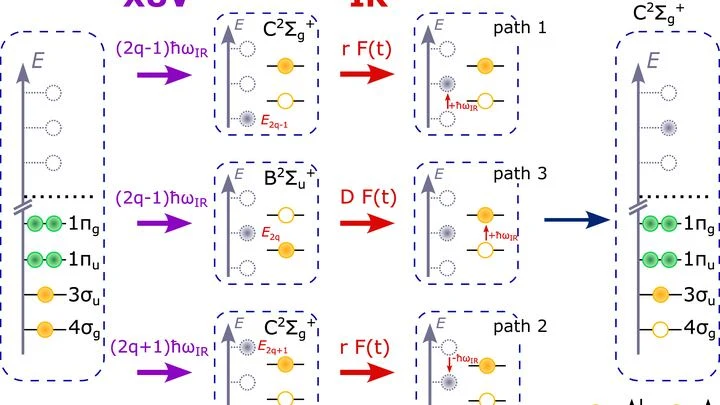
A high-speed camera capable of capturing the motion of electrons is an attosecond interferometer. It sends two laser pulses at a substance with a tiny delay. The first, ultraviolet, acts like a flash, knocking an electron out of the molecule. The second, infrared, like an invisible hand, gently nudges or slows this electron in flight.
Physicists are trying to hear a whisper in a noisy room. They build a soundproof booth, but even inside, their own breathing and heartbeat create interference. That's roughly how the search for quantum gravity goes: they want to see gravity bind two particles into a single whole — entangle them.
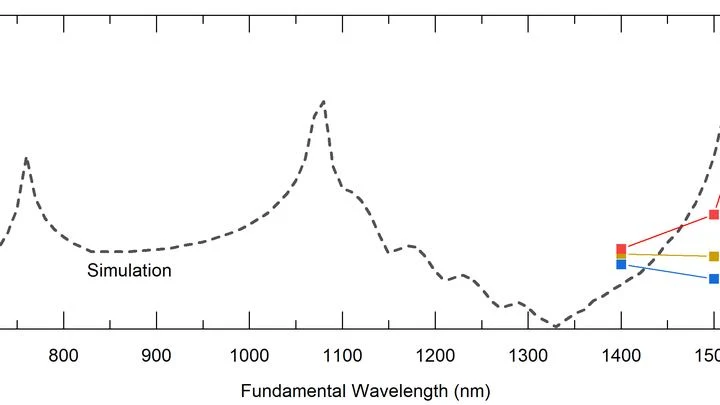
A laser beam hits an atom, and an electron is knocked loose. It accelerates, returns, and, crashing into the atom, emits a flash of light — a harmonic. If there are two light beams and they are crossed like an intersection, the electron can choose different routes. In the new experiment, the two beams had comparable strength and were directed at right angles.
An ordinary sheet of paper looks white because it scatters all light rays chaotically. But a butterfly's wing shimmers blue and green without a drop of paint: its surface is covered with microscopic grooves that dampen some light waves and amplify others. Engineers have long dreamed of replicating this trick: creating a material that colors itself simply by trapping light in the right places.
Normally, electric current is the same in both directions, like water in a straight pipe. But at the boundary between a normal metal and a superconductor, this rule breaks down. Two waves on water, going around a wide obstacle from different sides, can arrive with different delays and meet ‘out of step’.
In a sealed glass bulb the size of a finger, metallic vapor boils. The main component is cesium, but one percent rubidium hides within. A laser beam at 795 nanometers finds this impurity and makes it glow.
Rubidium alone would give a weak signal: atoms quickly fly through the beam.
An ion quantum computer is like a chandelier with a dozen pendants: pull one, and they all start swinging. Each ion is a qubit, but when there are many, their collective vibrations crowd the stage. Any operation on one pair disturbs the neighbors, and the computation goes awry.
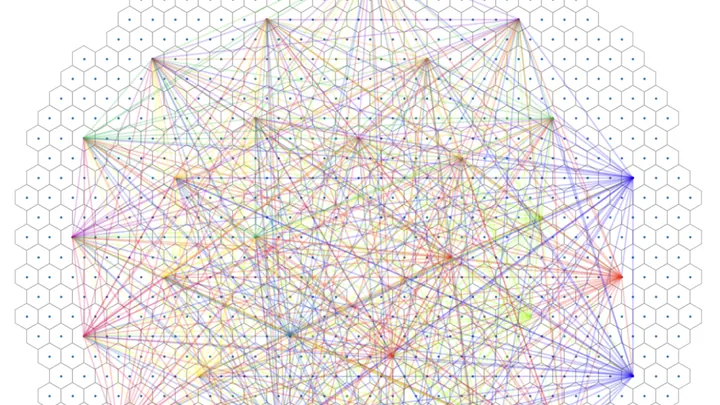
Light from a star travels for millions of years, yet in a telescope it still appears as a point: it's just too far away. To see a star's surface, you need an instrument the size of a city. In Chile, such a giant is already under construction: ELT with a 39-meter mirror made of 798 hexagonal segments.
An ordinary piece of semiconductor weakly changes the color of light passing through it. For decades, physicists worked around this limitation by placing the crystal in clever surroundings, but the material itself remained the same.
Now researchers have assembled a "sandwich" of alternating thin layers of gallium arsenide and aluminum gallium arsenide.
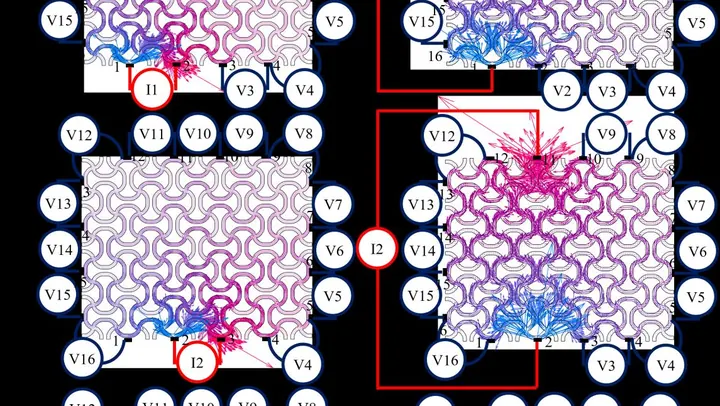
Ordinary materials break in silence. First, invisible struts inside them snap, and only then does a crack appear that you can see with your eyes. Engineers at Carnegie Mellon University have taught a material to 'talk' about such hidden damage.
They 3D-printed a lattice resembling honeycomb but with a more intricate pattern.
A football kicked with spin doesn't fly straight: it bends to the side. A tightly focused beam of light does something similar: it starts pushing an atom not just forward but also sideways. Physicists measured this shift on a single calcium ion trapped in a light trap.
The beam was aimed at the atom like a spotlight on a grain of sand.
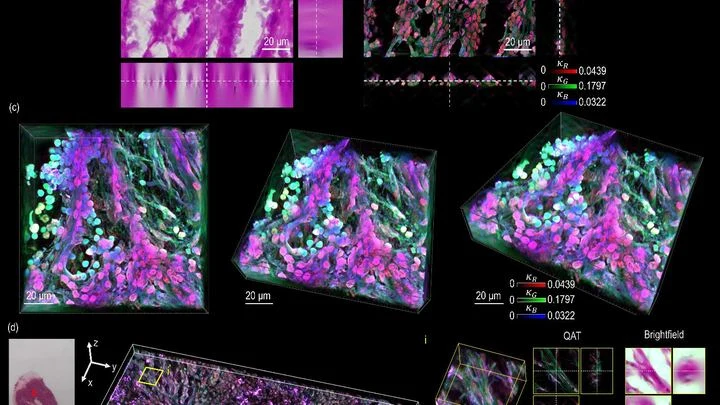
Light passing through a stained cell loses some of its strength, like a flashlight beam cutting through a glass of tea. The denser the color, the more light is absorbed. But until now, a microscope could only show a flat shadow of this process, not its volume.
Every breath you take and every muscle twitch runs on a stream of electrons flowing through proteins inside your cells. These proteins aren't static: they constantly change shape, like a spring that compresses and releases. But until now, no one has seen exactly how these movements open or close the path for electrons.
Gravity works like an invisible photographer. When a piece of metal falls, inside it, according to Albert Einstein and the electromagnetism of James Clerk Maxwell, an electric field is born — that's how spacetime curvature…
Detecting a single quantum emitter is like tuning a piano on a factory floor full of screaming machines: the pure tone drowns in noise. But the tuner doesn’t try to outshout the racket — he picks up a tuning fork and listens for beatings. That’s how even a barely audible echo becomes clear.
Spontaneous emission, the very process that lights up lamps and stars, has long been considered a pesky noise in quantum physics. This cacophony of random photons ruthlessly destroys fragile quantum entanglement, like radio static drowning out a distant melody.