Heat Breaks Magnetic Order express
A thin film of the compound of manganese, bismuth, and tellurium resembles a layered cake: each layer is an atomic plane, and the magnetic moments within the layer are aligned like compass needles. At room temperature, these needles hold formation, but just heating the sample to 45°C makes the order start to fall apart.
Random defects in the crystal act like tiny magnets that pull neighboring needles in different directions. The more such defects, the easier it is for heat to destroy the overall order. Scientists compared samples with different defect densities and saw: the magnetic properties degrade with heating more strongly when there are more defects.
This discovery explains long-standing disagreements between laboratories: some obtained 'ideal' magnetic states, others did not. Now it is clear that it all comes down to heat and defects. Therefore, to create devices based on this material, one must strictly control temperature and crystal quality.
Original abstract
as written by the authors arXiv:2602.07976
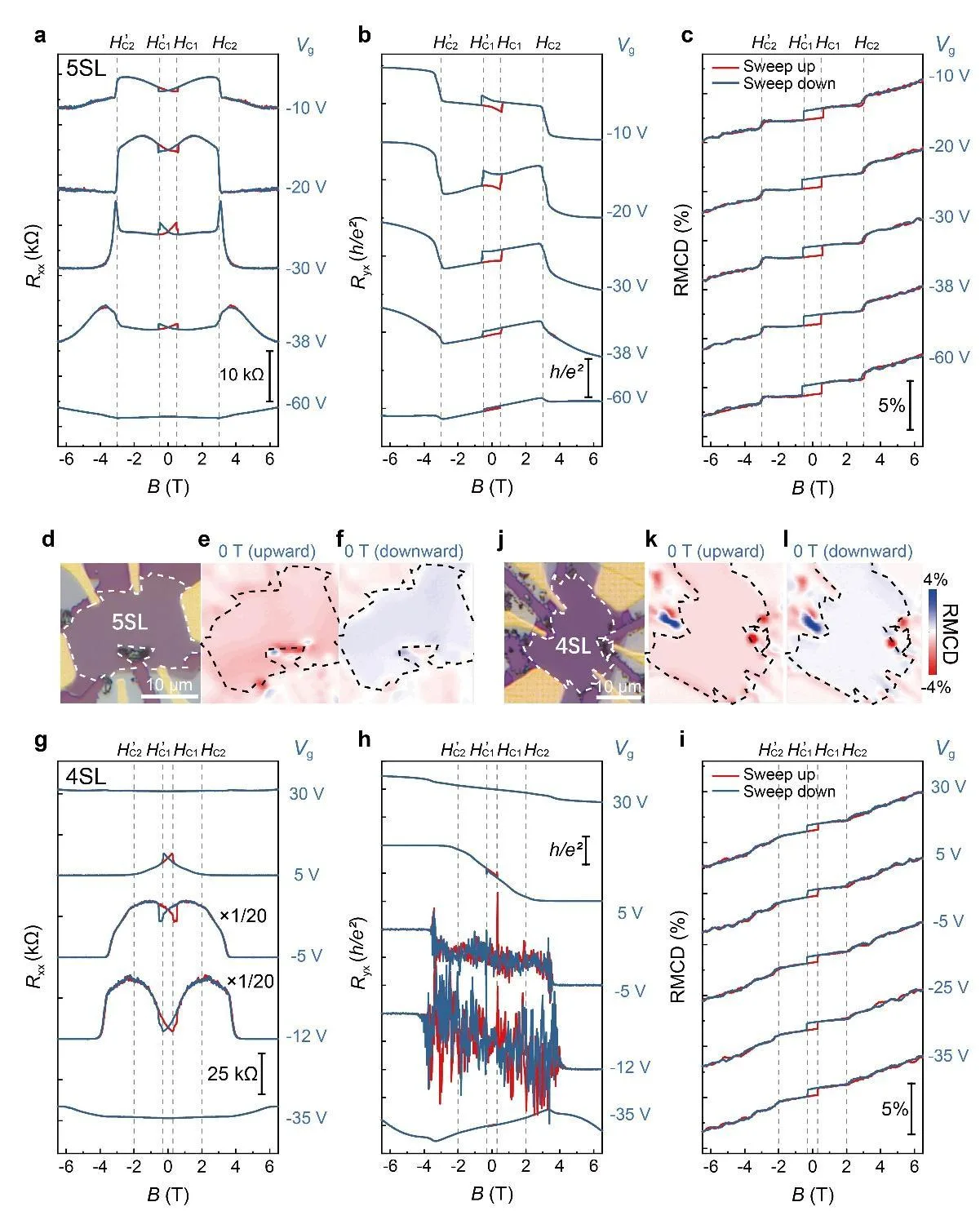
As the first experimentally discovered intrinsic magnetic topological insulator, MnBi2Te4 has attracted widespread attentions, providing a unique platform for the exploration of topological quantum phases, such as quantum anomalous Hall effect and axion insulator state. Despite the increasing number of potential factors affecting samples being identified, obtaining the high-quality device performance with desired topological quantum phases remains a challenge. In this work, by comparing the reflective magnetic circular dichroism (RMCD) of crystals with different defect densities that are characterized by atomically resolved scanning tunneling microscopy, we demonstrate that anti-site defects play an essential role in achieving ideal magnetic states. By measuring RMCD hysteresis loops with operando heating, we find that MnBi2Te4 few-layer samples are highly susceptible to thermal impact, even at temperature as low as 45{\deg}C. The magnetic behavior of heating-treated samples is akin to that of samples fabricated into devices, revealing the thermal impact on devices as well. Starting from few-layers with ideal layer-dependent magnetic order, thermal heating leads to the convergence of magnetization and transition fields between odd- and even-layers. The observed heating-induced magnetic evolution can serve as a valuable reference for assessing the sample quality or the density of anti-site defects. Our findings not only point out the long-standing hidden factor that arose controversies in MnBi2Te4, but also pave the way for controllably engineering the topological quantum phenomena.
Heating to 45°C is like the temperature of a warm summer day. For thin MnBi2Te4 films, this is enough to noticeably change the magnetic order.