The magnetocaloric effect is a phenomenon where a magnetic material changes its temperature when exposed to a changing magnetic field. When a magnetic field is applied, the material heats up; when the field is removed, it cools down. This effect is the basis for magnetic refrigeration, a technology that promises to replace traditional gas-compression cooling systems with a more environmentally friendly alternative that does not rely on ozone-depleting refrigerants or mechanical compressors.
History
The effect was discovered by Emil Warburg in 1881 in iron, and the theoretical explanation was developed by Pierre Weiss and Auguste Piccard in 1917. The idea for magnetic refrigeration was proposed by Peter Debye and William Giauque in the 1920s and 1930s, respectively.
How it works
The effect arises from the coupling between magnetic moments and the lattice vibrations (phonons) in a material. In a paramagnetic or ferromagnetic material, the magnetic moments are randomly oriented at zero field. Applying a magnetic field aligns the moments, reducing the magnetic entropy. To keep the total entropy constant (in an adiabatic process), the lattice entropy must increase, which means the material heats up. Conversely, removing the field randomizes the moments, increasing magnetic entropy, so the lattice cools down. This temperature change can be harnessed in a refrigeration cycle by repeatedly applying and removing the field while transferring heat away or into the material.
In practice
Magnetic refrigeration is used in cryogenics to reach ultra-low temperatures (below 1 K) and is being developed for room-temperature cooling in household refrigerators and air conditioning systems, offering higher energy efficiency and no harmful refrigerants.
Fun fact
The magnetocaloric effect is also observed in the Sun's corona, where magnetic field changes can heat plasma to millions of degrees, contributing to solar flares.
In a binary star system, a white dwarf acts like a vacuum cleaner, pulling gas from its companion star. If the dwarf has a magnetic field, the gas does not fall anywhere but flows toward the poles, like iron filings to a magnet. There it accumulates into a pile. But what keeps this pile from spreading out?
On the lab bench lies a piece of graphite grown from gas, like a deposit on the wall of a reactor. Usually, such material is not suitable for converting heat into electricity: inside it, electrons and holes run in opposite directions and cancel each other out.
Two dancers on one stage: one pulls the partner in one direction, the other in the opposite. In the crystal Cu2(OH)3Br, known as botallackite, copper atoms form chains where the spins (magnetic moments) of neighboring ions align either parallel, as in a ferromagnet, or antiparallel, as in an antiferromagnet.
In the layered crystal CrSBr, the magnetic moments of atoms are arranged like notes in a score: within each layer they point in the same direction, but between layers they point in opposite directions. This antiferromagnetic melody plays up to 132 kelvin, beyond which thermal motion destroys the order.
A magnetic field usually acts like a strict traffic cop: for heat to turn into electricity, it must stand across the road. If the field lies along the heat flow, the effect disappears, or so it was believed for decades.
Scientists took an ultra-thin film of a magnetic oxide — a material where electron spins are aligned in a plane, like compass needles on a table.
Electricians working with high voltage are like divers: they need to see what's happening deep underwater without going down themselves. What's needed is a sensor that stays away from the dangerous current and relays information to the surface. Usually, light is used: a beam passes through a transparent crystal, and the electric field slightly rotates it.
In a pot of boiling soup, light fat droplets rise to the top, while heavy vegetable chunks sink to the bottom. Particles in the tenuous hot gas around the Sun and other stars behave much the same way — except instead of broth, there's a mixture of charged particles: electrons, protons, and alpha particles.
In the solar corona, it rains from time to time — only not water, but plasma. The hot gas cools, clumps into blobs, and rushes downward along magnetic loops, like drops running down invisible gutters.
Ion current through a membrane is like a queue at a turnstile. Sometimes the turnstile is free — ions pass through quickly. Sometimes it gets stuck — the flow drops. A weak magnetic field, it turns out, doesn't push ions from behind; it simply changes the number of open turnstiles.
A waterfall that doesn't heat up from the fall but freezes — that's roughly how gas behaves as it flows onto a neutron star in an X-ray pulsar when the star shines dimly. Usually, infalling matter is heated to a white-hot glow, but new work shows the opposite.
In the vast clouds of rarefied gas that fill the space between stars, something is always churning. Supernova explosions, colliding streams — all of it shakes the plasma. And in this rippling, as it turns out, hides the mechanism that gives birth to magnetic fields.
Plasma is a gas in which electrons are stripped from atoms.
Deep underground, iron glows white-hot, and the pressure is so intense that an ordinary instrument would be crushed flat. To peer into this world, physicists built a special microscope based on tiny diamond defects (so-called NV centers).
Inflation is the ultra-fast expansion of the universe in its first moments. It was driven by a field resembling a ball rolling down a hill. But there could have been a second, almost imperceptible ball nearby. The authors of this work considered exactly that scenario: a light spectator field (the axion), frozen at the top of its potential.
Deep underground, in the thickness of granite, detectors catch rare visitors from space — muons. These particles are born high in the atmosphere when cosmic rays slam into air nuclei. They make it to the underground lab thanks to their enormous speed, close to the speed of light.
Heat a nail in a fire, and it will lengthen — everyone knows that. But heat only the tip and leave the other end cold, and the nail doesn't just get longer: it bends, because hot metal expands more than cold metal. It's this very bending, but at the atomic level, that physicists have turned into electricity.
A superconductor is like a perfect electron dance: electrons move in pairs without losing energy, like dancers who never miss a beat. But add a few magnetic impurities, and strangers crash into the dance, disrupting the synchronized motion. The temperature at which this dance begins drops.
A thick rubber band is twisted tighter and tighter. At some point, it can't take it anymore — it snaps and whips around, releasing the stored energy. That's roughly how magnetic fields inside neutron stars — the ultra-dense remnants of exploded stars — behave.
If you squeeze an ordinary piece of metal, it heats up — even those who have pumped a bicycle tire know that. But what happens if you squeeze a magnet in which atomic arrows refuse to freeze even at absolute zero?
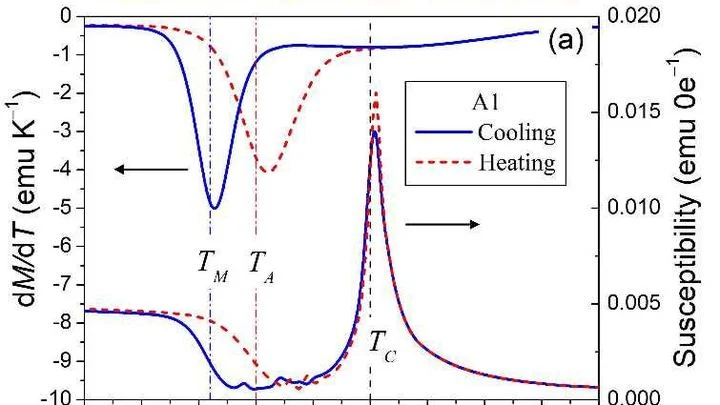
A metal bar suddenly becomes stiff when heated, and at the same time loses or gains magnetic properties. In alloys based on nickel and manganese, such transformations occur not smoothly but abruptly — atoms rearrange into a new order, and the material changes its behavior.
A comb rubbed through your hair picks up scraps of paper. Physicists decided to apply this simple trick at the microscopic level — to control magnetic vortices called skyrmions. A skyrmion is like a tiny tornado in a sea of magnetization: at its center, compass arrows point up, while at the edges they twist downward.
A pot of water on the stove: the hotter the burner, the faster ice turns to water, and water to steam. Heat destroys order. But sometimes nature pulls a trick, and heating makes a liquid freeze, like a puddle turning to ice on a frosty morning.
A stack of magnetic plates, each magnetized opposite to its neighbor, is like a layered sandwich where electrons move as a single organism. The whole material starts mimicking an axion — a ghost particle that physicists suspect might be dark matter.
A crystal that looks like a stack of pancakes was placed on a smooth substrate of magnesium oxide. The result was a film only a few hundred atoms thick. When they ran a current through it and switched on a magnet, the resistance jumped by nearly a quarter—22.5% in a 9-tesla field.
Inside the film, electricity is carried by two streams of particles.
Hundreds of people on a dance floor stand at equal distances from each other — strict order, like in a crystal lattice. Slow music is thermal vibrations, making dancers sway slightly. If the music gets louder and faster, order collapses: everyone mixes. That's how thermal motion destroys ordered states of electrons in solids.
Gas falls onto a neutron star — the ultra-dense remnant of an exploded star. This gas accumulates at the magnetic poles and forms a mountain. But a mountain on a neutron star is not like one on Earth: it is held not by rock but by magnetic field lines, like iron filings on a magnet.
When there is too much gas, the mountain begins to break apart.
An iron crystal is like a mosaic of tightly packed grains. Where one grain meets another, a boundary forms — a narrow seam with disrupted order. It is in these seams that surprises for magnetism hide.
Scientists calculated how iron atoms interact with each other at three types of such boundaries.
The strontium ferrite crystal is like a multi-story building where each floor hosts iron atoms. Some floors "look" up, others down, and their magnetic fields partially cancel each other out. But if some of the residents are replaced with aluminum, which doesn't play the magnetic game, the balance of forces shifts.
Space plasma is not a calm gas but a boiling soup of charged particles threaded with magnetic fields. These fields behave like stretched rubber bands: sometimes they snap and immediately reconnect, but in a different configuration. This process, called magnetic reconnection, releases enormous energy.
The Mpemba effect is surprising: hot water sometimes freezes faster than cold. Scientists built a simple model: a bead in a thick, honey-like medium, on a landscape with two dips and a wall at the edge. The bead moves viscously, unable to hop over the central bump.
Water boils at 100 degrees Celsius, but if you squeeze it hard enough, it behaves differently. Similarly, quarks and gluons, the building blocks of protons and neutrons, change their properties in a strong magnetic field.
About 380,000 years after the Big Bang, the universe cooled enough for electrons and protons to finally combine into neutral hydrogen. Although this event is called recombination, it was actually their first meeting — the heat had kept them from sticking together until then.
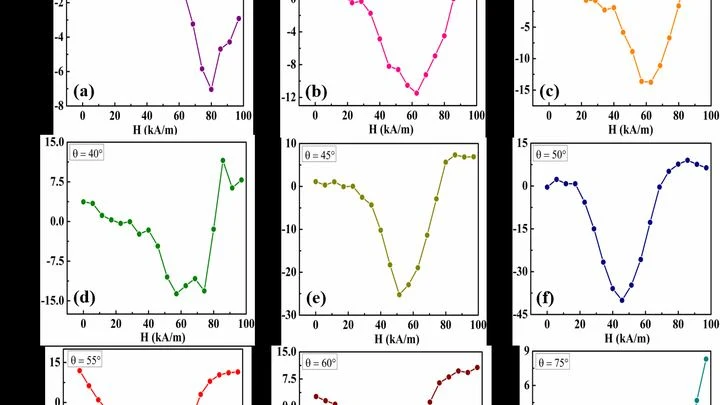
A piece of zinc oxide film lies on a table. A magnet is brought near, and slowly rotated around the film. The film, thinner than a human hair, begins to change its dimensions: now contracting, now stretching. This property is called magnetostriction — the ability of a material to deform under a magnetic field.
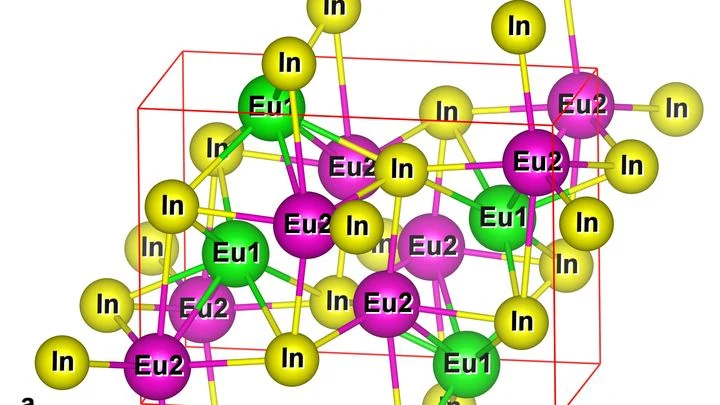
A piece of europium-indium alloy, when cooled in a magnetic field, behaves like water that does not freeze all at once but first in one corner of the glass, then in another.
The magnetic refrigerator of the future won't hum with a compressor. Instead, it will cool your groceries by exploiting a special material that heats up in a magnetic field and cools down when the field is removed. This cycle resembles the compression and expansion of gas in a conventional fridge, but here a magnet does the work of a piston.
The crystal changes its internal geometry like a building frame that slightly twists during an earthquake. In the manganese-gallium alloy (Mn₃Ga), at around 485 Kelvin (about 212°C), a magnetic transition occurs: the atoms align into an antiferromagnetic order, where neighboring magnetic…
A powerful laser strikes a tiny target, and it instantly turns into a cloud of scorching gas — plasma. Within this cloud, magnetic fields spontaneously arise. Like invisible hands, they prevent heat from freely escaping the hot core.
The crystal CeB6 is like a box with a secret: inside it, electrons can occupy four nearly identical positions, like four chairs around a table. While no one is watching, the electron seems to sit on all four at once. Physicists call this hidden state quadrupolar, and it affects magnetic properties, but it is hard to see directly.
Magnetic moments in a crystal are like compass needles fixed at lattice sites. In the normal state, they line up in neat order, but if an electromagnetic wave strikes the crystal, the needles start to sway, like wheat stalks in the wind. These oscillations are called magnons, and they carry energy without the atoms themselves moving.
The crystal Co2SeO3Cl2 resembles a layered cake, with each layer being a buckled honeycomb grid of cobalt atoms. When cooled to 25.4 K (−247.75 °C), the magnetic moments of the atoms begin to align like compass needles, but not all at once — rather in four steps, at 25.4, 16.8, 11, and 3 K. Each step brings a new pattern of magnetic order.
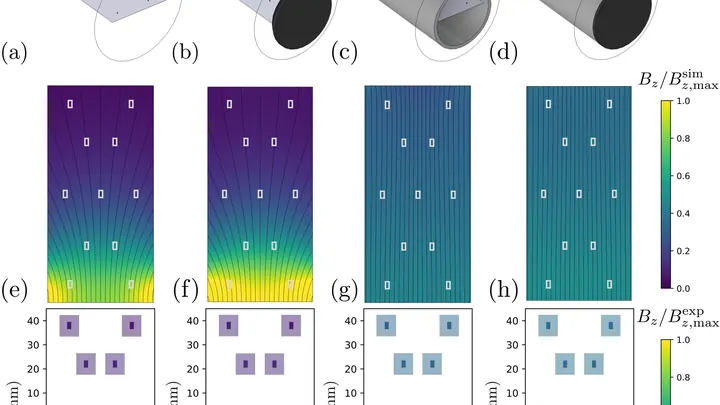
A magnetic field is like a shadow cast by an object: it changes with the shape of the source. But if you put a lens in the path of light, you can alter the shadow. Here, the authors devised a 'lens' for magnetic fields — an assembly of ordinary materials with different magnetic permeabilities (their ability to let the field through).