A magnetic state refers to the collective arrangement of magnetic moments (spins) in a material or a system of ions. These states range from simple ferromagnetic order, where all spins align parallel, to more exotic configurations like antiferromagnetism (alternating alignment), spin liquids (disordered but strongly correlated), or spin glasses (frozen random disorder). The magnetic state determines a material's response to external magnetic fields and is central to understanding phenomena like magnetism, superconductivity, and quantum phase transitions.
History
The concept of magnetic order dates back to Pierre Weiss's 1907 molecular field theory, which explained ferromagnetism. Later, Louis Néel's 1936 work on antiferromagnetism and the 1970s discovery of spin glasses expanded the understanding of magnetic states.
How it works
The magnetic state arises from the interplay of exchange interactions between neighboring spins, thermal fluctuations, and quantum effects. At low temperatures, interactions dominate, and the system may settle into an ordered state that minimizes energy. In quantum magnets, fluctuations can prevent ordering even at absolute zero, leading to quantum spin liquids. External parameters like temperature, pressure, or magnetic field can drive transitions between different magnetic states.
In practice
Magnetic states underpin data storage technologies (ferromagnets in hard drives), spintronics, and quantum computing proposals that use spin states as qubits. They are also key to understanding high-temperature superconductors, where magnetic correlations play a central role.
Fun fact
In a quantum spin liquid, spins remain in a fluctuating, entangled state even at absolute zero, never freezing into an ordered pattern — a state that was first proposed by Philip Anderson in 1973 but only recently observed in real materials.
In some crystals, electrons are not spread uniformly but arrange themselves into a strict checkerboard: one cell has more electrons, the neighboring cell has fewer. Such a pattern is called charge order, and for a long time it was considered something frozen, like a pattern on frosty glass.
In nature's workshop, there is a strange lathe: it cuts threads on screws but forbids left-handed ones. You can tighten a screw as much as you like, in any clockwise direction, but counterclockwise is not allowed. This lathe is not a fantasy but an exact quantum rule that physicists have just built for magnetic materials.
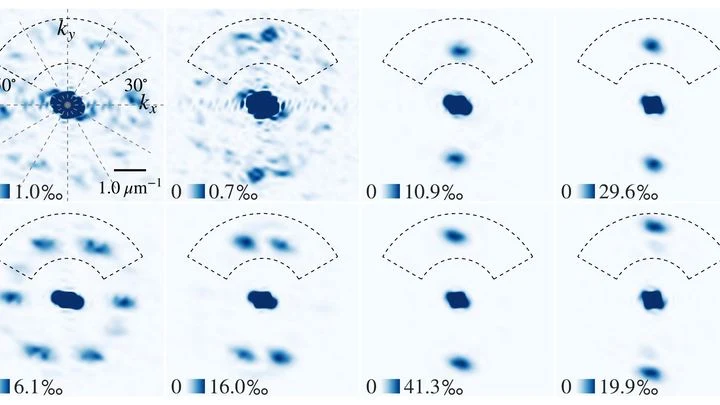
Two dancers on one stage: the triangle and the stripe. In a quantum gas of dysprosium atoms cooled to 62 nanokelvin, these two spatial structures have met for the first time in a single experiment. The gas is held in a trap shaped like a surfboard, and its atoms are among the most magnetic in the periodic table.
A thin sandwich made of two different materials. You run an electric current through it, and the top slice magnetizes in one direction, the bottom in the opposite. This isn't a magic trick; it's the layer Edelstein effect, just described by physicists.
A parquet floor where every other plank is turned the opposite way looks symmetric. But if you run your hand over it, in one direction your fingers glide along the grain, and in the other they catch. That's roughly how the new type of magnetism studied in the crystal AgCrP2S6 works.
In the conventional Heisenberg picture, spins at low temperatures are supposed to line up in a strict pattern. But there are crystals — like pyrochlore — where geometry has its own way. Each ion sits at a vertex of a tetrahedron, and the main interaction enforces a rule: two spins point inward, two outward.
Inside a crystal, an invisible ballet unfolds: the magnetic moments of atoms, like dancers, sometimes align in unison, sometimes scatter in antiphase. The choreography is dictated by quantum exchange — music sensitive to the geometry of bonds.
Some materials are internally like a Möbius strip: their electronic states are twisted in a special way. Such topological properties are usually manipulated with a powerful magnetic field, as if trying to flatten the strip with a sledgehammer. A group of researchers has found a more delicate tool.
In a world striving for chaos, rhythm sometimes arises. The Belousov–Zhabotinsky reaction has amazed for decades: in a test tube, color waves run on their own, as if a living organism breathing matter. Something similar lurks in crystals where iron atoms balance between two magnetic states — high-spin and low-spin.
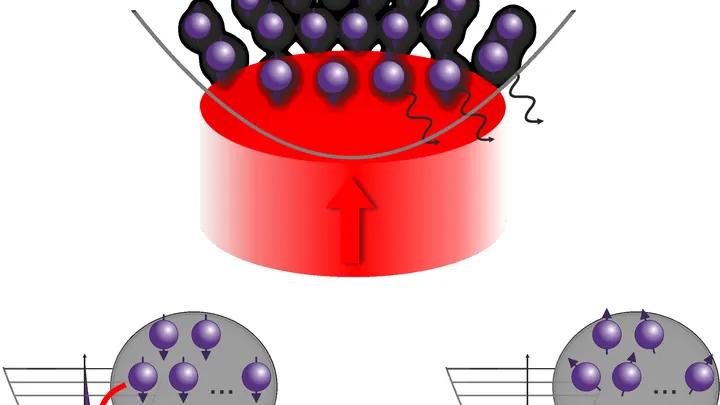
A tiny crystal of charged atoms, trapped in a trap, trembles with heat. Each ion oscillates like a ball on a spring, and these vibrations hinder using the crystal for precise quantum operations. Usually, excess energy is removed with a laser — the beam hits the ions and slows their motion, like a stream of air damping a pendulum.
Imagine a slide with three dips: the deepest one is a stable position for a ball, the middle one is precarious. A slight push and the ball rolls down. Yet, constant vibration of the right strength can hold it in the middle hollow for a long time.
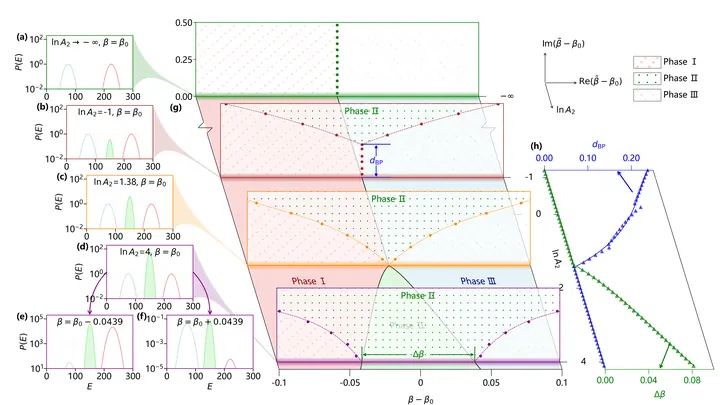
In the 1950s, physicists Lee and Yang discovered that all states of matter are separated by invisible points in the world of imaginary numbers.
An ordinary magnet is like a compass: its needle points north. But a quantum compass can look in both directions at once. If a magnet floating in a vacuum is gently spun, its electron 'tops' synchronize so the whole piece of metal starts living by the rules of the microworld — freezes in a superposition, like a split pointer.
Two teams pull a rope with equal force in opposite directions — the rope doesn't move, and the net force is zero. That's how many antiferromagnets behave: the magnetic moments of atoms are aligned oppositely and cancel each other out.
A magnetic field in plasma resembles a stretched soap film: pressure from inside pushes it out, while surface tension pulls it in, giving it shape. Here too, magnetic pressure and tension forces balance each other.
In an ordinary crystal, atoms stand in neat rows like soldiers on a parade ground. Any deviation from this formation is usually considered harmful: disorder scatters waves and quickly dampens collective motions of particles.
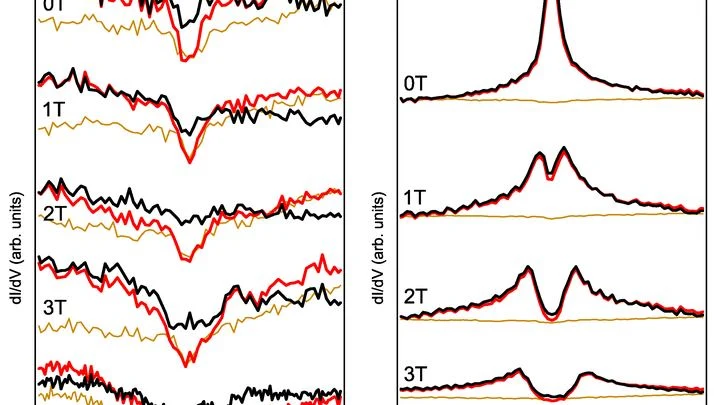
A tiny magnet, made from just two molecules, was placed on a metal surface, and it behaved like a temperamental conductor. Normally, electrons in a metal move in a coordinated way, like a crowd on an escalator. But when cooled significantly, this order breaks down, and the motion becomes unpredictable.
A drop of water on the table looks calm, but inside it, quantum life is bustling. Protons in hydrogen atoms are like tiny spinning tops that constantly rotate. Each has its own direction of spin.
Magnetic atoms in a solid are like compass needles: usually, when cooled, they align in one direction: that's how magnetism arises. But in TbInO3, the terbium needles sit on a triangular lattice where it's impossible to please all neighbors at once. One needle wants to point north, another south, and in the end none can settle into a stable position.
Magnetic waves in an ultracold gas behave like elastic cords. Two or three such cords can twist into a single knot that breathes: it contracts and expands, but never unravels. For the first time, scientists assembled such knots in the lab and confirmed that their breathing matches calculations exactly.
The gas consisted of two atomic species that do not mix, like oil and water.
There is always noise in the microworld. Even in absolute emptiness, something trembles, and these quantum fluctuations interfere with precise measurements. But noise can be "squeezed," like a balloon: if you squeeze it from the sides, one part gets thinner while the other bulges.
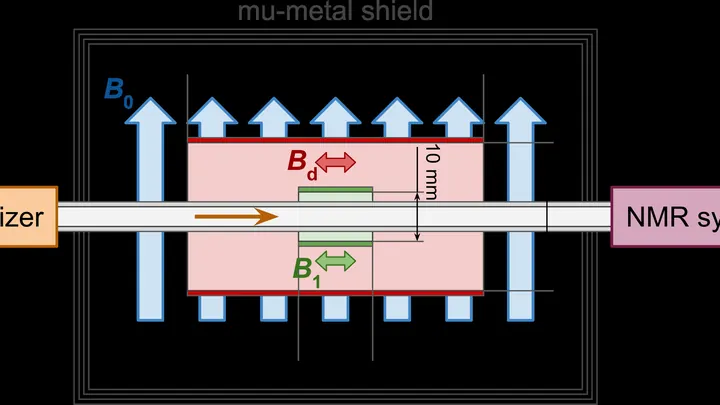
A tuning fork rings dully when it strikes a crack. That principle scales up in this experiment: physicists turned molecules into an ultrasensitive tuning fork to eavesdrop on the electron's asymmetry.
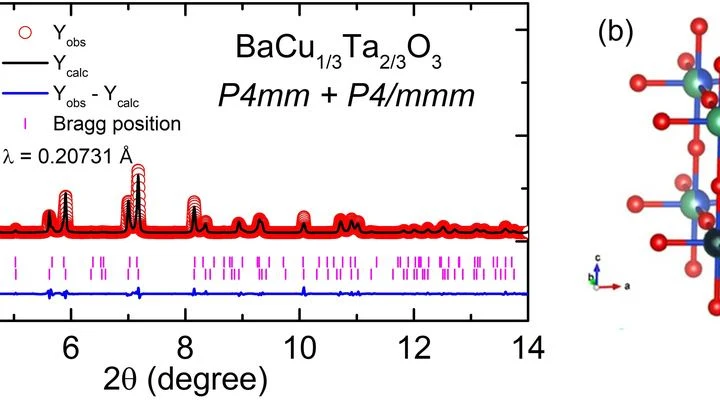
Atoms in a crystal usually sit in their designated spots, like passengers on a plane with assigned seats. But in this material, copper and tantalum have taken their places randomly, as if the tickets got mixed up. Scientists peered into the crystal using X-rays and saw that the disorder is not just on paper but in the actual arrangement of atoms.
Plasma in a fusion reactor is like a swarm of fireflies that you need to keep inside an invisible jar. It used to be thought that the jar's walls had to be perfectly smooth, or the fireflies would find a crack and escape. New work shows that the jar can be glued together from pieces with noticeable seams, and the swarm will still stay inside.
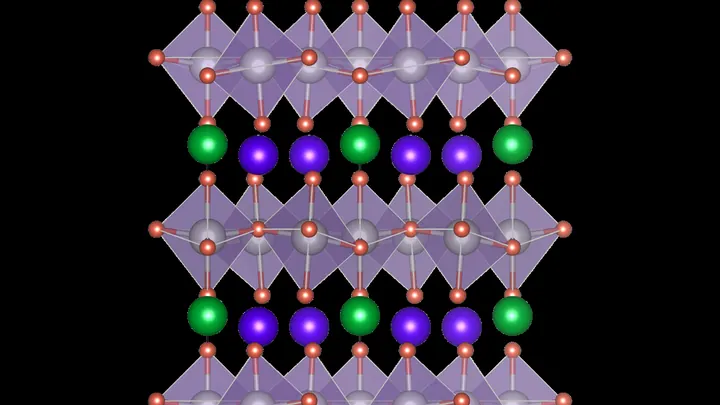
The tiny magnetic arrows inside a crystal of terbium-iridium oxide behave strangely: instead of lying along their preferred axis, they stand across it. This state fully forms when cooled to 1.5 Kelvin — colder than outer space.
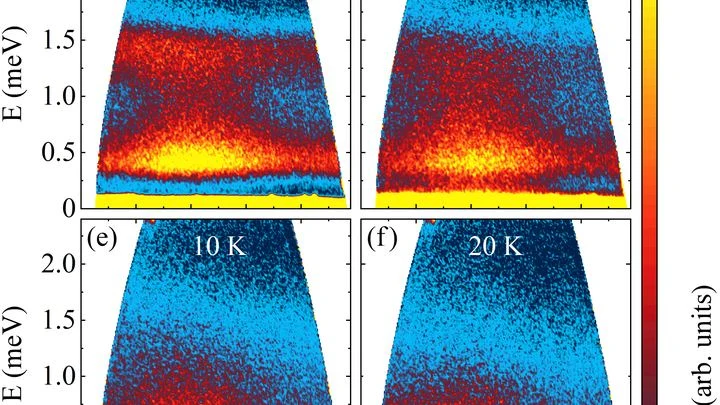
Researchers probed the crystal with neutrons and observed how these flipped arrows oscillate and exchange energy.
In a typical magnet, all spins of electrons (internal ‘arrows’-magnets, discovered by Pauli) point one way. Altermagnets, like MnTe, are trickier: these arrows alternate direction, like ripples spreading from a pebble tossed into water. But here’s the twist — the ripple arises from the electrons’ own motion.
Two muons are born in the decay of an eta meson and fly apart, linked by quantum entanglement. One experimenter, Alice, measures the spin of the negative muon, while another, Bob, records the direction of the positron from the decay of the positive muon. It would seem that the order of events should affect the correlations.