A metal-insulator transition (MIT) is a phenomenon where a material abruptly changes from conducting electricity (like a metal) to insulating (like a ceramic), often triggered by external conditions such as pressure, temperature, or magnetic field. This transition is not just about electrons being 'stuck' — it often involves complex interactions between electrons, lattice vibrations, and disorder. MITs are central to understanding why some materials conduct and others don't, and they underpin technologies like switches and sensors.
History
The concept was formalized by Nevill Mott in 1949, who explained why some materials with partially filled bands are insulators. Philip Anderson's 1958 work on disorder added another pathway. Both won Nobel Prizes (Mott in 1977, Anderson in 1977).
How it works
In simple metals, electrons move freely. In insulators, they're bound to atoms. MITs occur when the balance shifts. One mechanism is the Mott transition, where electron-electron repulsion prevents conduction despite a half-filled band. Another is the Anderson transition, where disorder traps electrons, turning a conductor into an insulator. Pressure or temperature can change the balance of kinetic energy versus interaction energy, tipping the material across the transition. In some materials, like vanadium dioxide, the transition is accompanied by a structural change.
In practice
MIT materials are used in electronic switches, memory devices (like resistive RAM), and smart windows that change transparency with temperature.
Fun fact
Vanadium dioxide undergoes a metal-insulator transition at just 68°C, changing its electrical resistance by a factor of up to 100,000 — and it happens in femtoseconds.
A thin film of neodymium nickelate, fifteen nanometers thick, sits on a neodymium gallate substrate. Below one hundred eighty kelvin it behaves as an insulator: electrons are locked inside their atomic cells and cannot move freely.
A thin film of neodymium nickelate, fifteen nanometers thick, sits on a neodymium gallate substrate. Below one hundred eighty kelvin it behaves as an insulator: electrons are locked inside their atomic cells and cannot move freely.
In the dark chamber of the trap, thousands of charged particles dance under electric fields. At first they move freely, like a crowd in a square, but cool the cloud and the dance slows: ions begin to sense each other, their steps become constrained.
A frozen orchestra where musicians swap seats when the conductor, magnetism, sets a new score. In a spinel crystal, iron and magnesium atoms sit in two types of seats: some surrounded by four neighbors, others by six. At room temperature, they barely stir, but cool the material to 5 K and a mass migration begins.
The magnetic framework of the EuMnSb2 crystal resembles scaffolding: manganese atoms form rigid vertical pillars, while europium atoms act as movable crossbars. Until now, there was no consensus on the angle at which these crossbars rest and how they rotate when a magnetic field presses on the scaffold.
A light switch clicks, and the light comes on. But imagine a switch that, with the same press, can either turn on the lamp or leave the room dark. It also remembers what it did last time, and sometimes it seems to flip a coin to decide whether to light up.
This kind of behavior was found in a crystal of black phosphorus — a semiconductor just a few atomic layers thick.
A highway where opposing flows are separated not just onto different sides, but onto two independent roads: each with its own entrance and exit. Something similar happens to electrons in a new type of topological insulator described by the authors of the study.
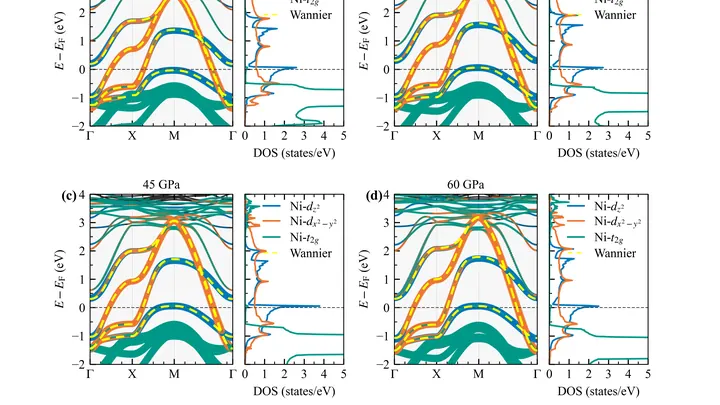
Under pressure, the layered crystal La₃Ni₂O₇ behaves like an orchestra where the conductor adjusts the volume of different instrument sections. Compression increases electron hopping between layers — which, one might think, should boost superconductivity. But at the same time, some electrons become too mobile.
In a two-dimensional crystal of tungsten diselenide (WSe₂), light creates pairs — an electron and a hole that stick together. Such pairs are called excitons. Among them are "dark" ones: they barely emit, but they set the tone at low temperatures.
Usually, light does not turn an insulator into a conductor: that requires powerful laser pulses that break the material's structure. But in twisted bilayer graphene at the magic angle, things are different.
Crystals glued to the outside and inside of a metal wall act as an invisible channel. One, receiving current, starts to tremble, and these vibrations, like ripples on water, spread out in all directions through the metal. The inner crystal catches this tremor and generates electricity again.
Some crystals behave like a switch: nudge the temperature or pressure, and they turn from a conductor into an insulator. This is called a metal–insulator transition (a change in the ability to conduct electricity).
Two thin layers of a semiconductor were twisted relative to each other by 2.29 degrees, like two sheets of transparent paper with printed grids. Where the lines nearly align, a large pattern of dark and bright spots emerges. Electrons in this pattern behave very differently from those in a regular crystal.
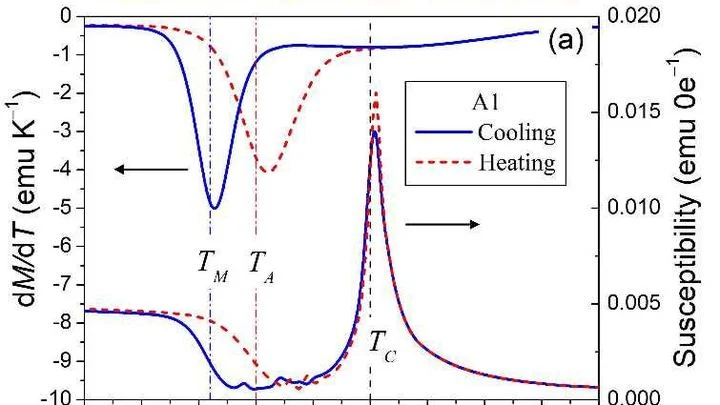
A metal bar suddenly becomes stiff when heated, and at the same time loses or gains magnetic properties. In alloys based on nickel and manganese, such transformations occur not smoothly but abruptly — atoms rearrange into a new order, and the material changes its behavior.
Two paper-thin sheets of a semiconductor are stacked and slightly rotated — by about three to four degrees. The atomic lattices don't match, creating a large-scale pattern — a moiré, like the ripples from two washboards shifted by a small angle. In this pattern, electrons move quite differently than in a regular crystal.
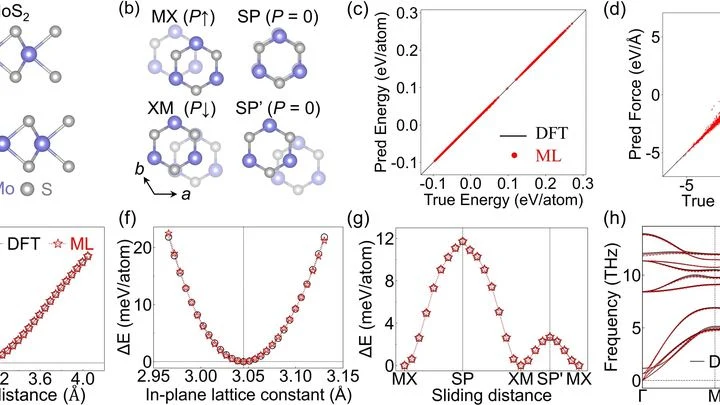
Two sheets of paper stacked together start to creep ever so slightly over each other when heated. That's roughly how layers of molybdenum disulfide, a material one atom thick, behave. At room temperature, they spontaneously slide at a speed of about one meter per second.
A lithium-ion battery is like a multi-story building where lithium ions live on every floor. When you charge the battery, the ions move from floor to floor, and the whole building warms up a bit. Usually, this heat dissipates evenly, like from underfloor heating. But sometimes one spot gets too hot, and then the whole building can go up in flames.
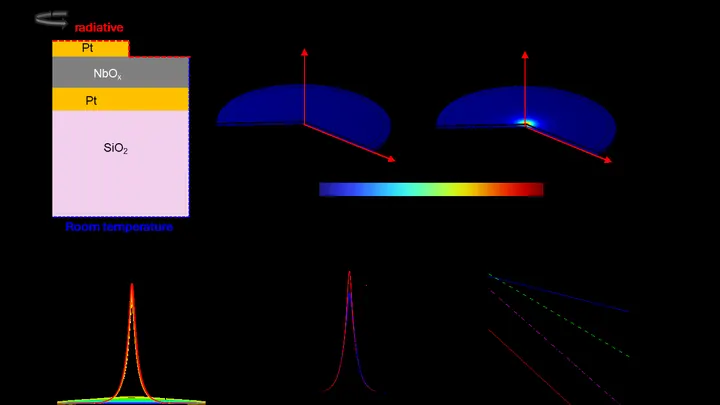
A memristor is a resistor with a memory: after the current is turned off, it retains its resistance. Inside, a thin film of metal oxide is sandwiched between two metal electrodes. When a strong current is first passed through the device, conductive filaments of oxygen vacancies form in the oxide, and the resistance drops sharply.
In a solid piece of tin-lead alloy, the layers of the two metals lie like pages in a book. When heated from one side, the layers don't melt uniformly but in whimsical tongues and fingers. Scientists studied this process using a transparent alloy that can be seen through under a microscope and compared it with a computer model.
A superconductor is a material that, when strongly cooled, loses its electrical resistance: current flows through it without losses. Scientists took a layered crystal of PdTe2, similar to a stack of sheets of paper, and cooled it to temperatures below 1.8 kelvin (that's about -271°C).
An ordinary transistor in a phone is made in a vacuum chamber, where atoms are deposited layer by layer. Expensive and slow. But indium oxide can be printed like ink — from a drop of liquid metal that, in air, coats itself with a thin oxide film.
The authors took indium, melted it, and rolled it over a substrate at 250 degrees.
Heat flows through matter like water through pipes: sometimes fast, sometimes barely. Engineers seek materials that almost don't let heat pass — like clogged pipes. Such insulators are vital for energy saving and devices that turn heat into electricity. The neural network KappaFormer quickly evaluates the "throughput" of an atomic structure.
In an insulating crystal, heat usually flows from the hot end to the cold end. But when you switch on a magnetic field, part of the heat flow veers sideways, like water running down a slope that drifts to the side when the wind pushes it. This behavior is called the thermal Hall effect.
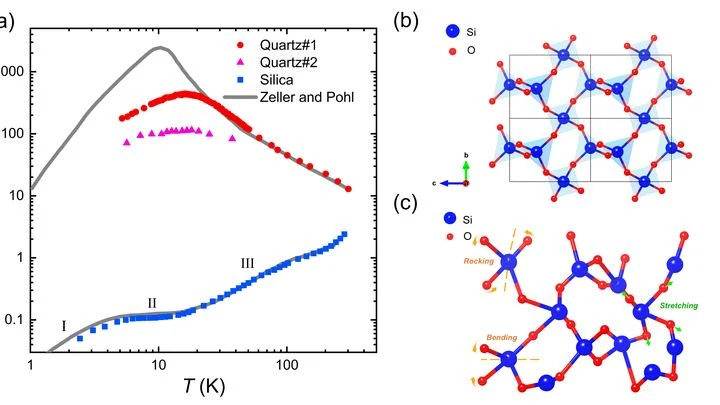
If you push heat through a piece of quartz, it usually goes straight, like water through a pipe. But switch on a magnetic field, and the flow veers slightly sideways, as if the pipe suddenly grew a side branch.
Two identical cars roll off the same assembly line. Body, wheels, steering — everything matches. Only one has a regular gasoline engine, while the other has a hybrid engine that can be tuned to the road. And the hybrid stalls after a couple of kilometers, while the gasoline one runs for tens.
A sheet of graphene one atom thick is like a flexible metal mesh through which electrons zip almost unimpeded. Stack two such sheets with a slight twist, and the material's properties change dramatically: it can become an insulator that blocks current.
A thin film of nickel oxide, tens of nanometers thick, is like a sheet of paper folded hundreds of times thinner. At room temperature, it conducts electricity, but cool it slightly and it becomes an insulator.
The crystal changes its internal geometry like a building frame that slightly twists during an earthquake. In the manganese-gallium alloy (Mn₃Ga), at around 485 Kelvin (about 212°C), a magnetic transition occurs: the atoms align into an antiferromagnetic order, where neighboring magnetic…
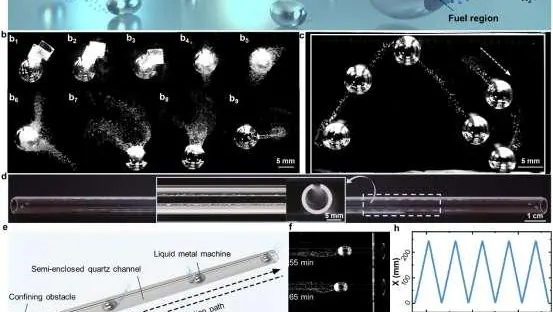
A droplet of liquid metal glides along a narrow channel like mercury from a broken thermometer. It needs no motor — the fuel is a chemical reaction with the surrounding liquid. But what happens when the droplet hits a wall? Previously, such machines were studied in open spaces, and in tight channels they behave differently.
The crystal Pr₄Ni₃O₁₀ is like a three-layer sandwich: nickel oxide layers separated by praseodymium spacers. As it cools, three magnetic regimes switch on in sequence, as if, inside the sandwich, the nickel spins first align, then slightly rearrange, and finally the praseodymium spins join in.
Muons, heavy cousins of electrons, penetrate the crystal and sense internal magnetic fields.
Ordinary soldering doesn't work for quantum circuits: when cooled to liquid helium temperatures, metal cracks, and the contacts themselves introduce noise. Engineers from the research group tried something different — a drop of gallium alloy that stays liquid at room temperature, like mercury in an old thermometer.
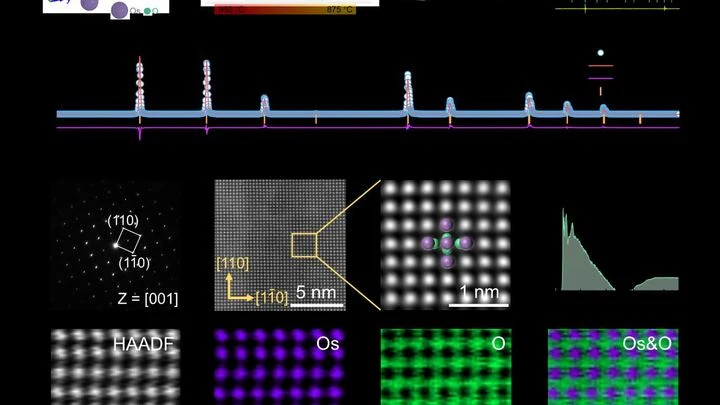
A crystal of osmium dioxide, OsO₂, is like a stubborn teenager: under ordinary conditions it behaves like a typical metal, but press hard enough and its character changes.
A superconductor carries current without loss, like a perfectly smooth road where cars glide with no friction. But what if you scatter rocks and potholes across that road? Scientists decided to find out by adding disorder to a superconducting material just one atom thick.
A thin wire made of a special material, a topological insulator, behaves like a city street: the interior is empty, and all traffic runs along the edges. Electrons in such a wire move only along the surface, like pedestrians on a sidewalk, never stepping onto the roadway.
An ordinary wire heats up when current flows through it. A superconductor doesn't. But almost all known superconductors require either very low temperatures or enormous pressures, like those deep inside planets. Scientists have long searched for a material that avoids these extremes.
Deep beneath us, hundreds of kilometers down, lies a layer that can absorb water like a sponge. The minerals there, wadsleyite and ringwoodite, can hold up to 1–2% water by weight within their crystal lattices.
A thin film of the compound of manganese, bismuth, and tellurium resembles a layered cake: each layer is an atomic plane, and the magnetic moments within the layer are aligned like compass needles. At room temperature, these needles hold formation, but just heating the sample to 45°C makes the order start to fall apart.
Physicists built a chain of Rydberg atoms — atoms with electrons in enormous orbits, comparable to planetary paths. These giant atoms feel their neighbors intensely, turning the chain into a quantum analog of a string.