A magneticimpurity is a foreign atom with its own intrinsic magnetic moment (like iron or cobalt) embedded in a non-magnetic metallic host, such as copper or gold. This seemingly simple defect has profound consequences: it disrupts the orderly flow of electrons, causing anomalous electrical resistance that rises to a minimum at low temperatures — a puzzle that resisted explanation for decades. The presence of such impurities is the key to understanding the Kondo effect, a many-body quantum phenomenon where conduction electrons form a correlated cloud around the impurity, screening its magnetic moment.
History
The anomalous resistance minimum was observed experimentally in the 1930s, but it was Jun Kondo who in 1964 provided the theoretical explanation for the scattering mechanism, giving the effect its name. The full non-perturbative solution came later with the Bethe ansatz and renormalization group approaches in the 1970s and 1980s.
How it works
In a normal metal, conduction electrons move freely, and resistance decreases as temperature drops. But a magneticimpurity acts as a localized spin that can flip-flop, scattering electrons in a way that becomes more effective as thermal motion slows down. At low temperatures, the electrons and the impurity spin become entangled into a collective singlet state, which effectively increases the scattering cross-section and causes resistance to level off or even increase. This is a purely quantum many-body effect, requiring the simultaneous interaction of many electrons with the impurity.
In practice
Magneticimpurities are central to spintronics and quantum dot research, and understanding their behavior is crucial for designing nanoscale electronic devices where even a single impurity can dominate transport properties.
Fun fact
The Kondo effect, caused by magneticimpurities, can be used to 'weigh' a single electron spin: the size of the resistance change reveals the spin's magnitude, a technique now used in scanning tunneling microscopy to probe individual atoms.
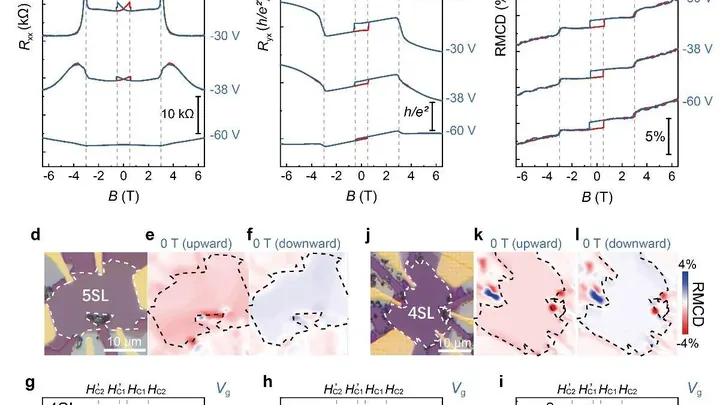
Current in an ordinary metal flows like a crowd of people down a straight street: each electron is on its own, and if you turn on a magnetic field, the whole crowd shifts slightly sideways. This shift is called the Hall effect.
In a distant galaxy, light from hot gas should reveal its composition. The James Webb Telescope split that light into a spectrum, and astronomers saw: oxygen lines too weak.
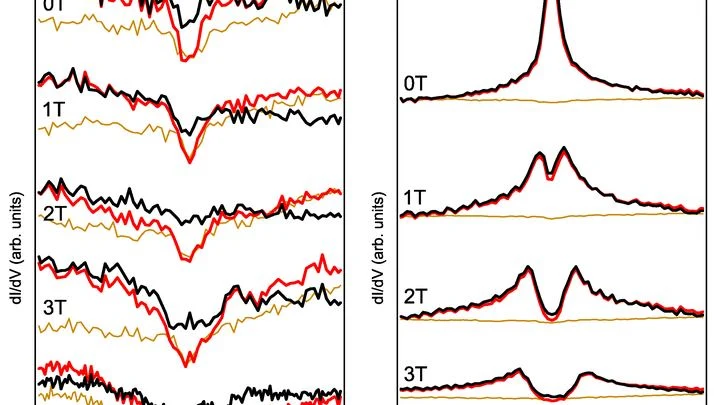
Two tiny magnets sit in a piece of metal. Around them is a sea of conduction electrons. Usually, electrons try to "shield" the magnetism of the impurities: they line up around them and quench it. This phenomenon is called the Kondo effect.
Quantum matter rarely treats us to the spectacle of self-motion. Where the classical world teems with starling murmurations, fish schools, and bustling bacteria, quantum thermodynamics long remained serene.
A pebble falls into a pond, and ripples spread across the water. In the quantum world, the pond is not made of water but of many identical particles, and the pebble is also a particle, just a foreign one. Such a foreign particle is called a Fermi polaron.
Electrons and muons are tiny magnets. Their magnetism is slightly more than two (in special units), and this 'excess fraction' (anomalous magnetic moment) arises from constant ripples in the vacuum: particle pairs momentarily pop into existence and vanish.
A superconductor is like a perfect electron dance: electrons move in pairs without losing energy, like dancers who never miss a beat. But add a few magnetic impurities, and strangers crash into the dance, disrupting the synchronized motion. The temperature at which this dance begins drops.
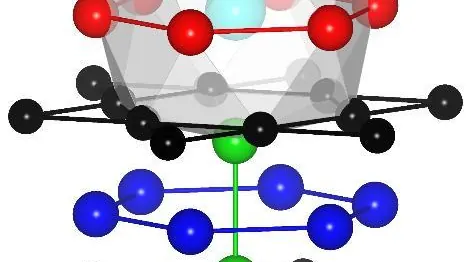
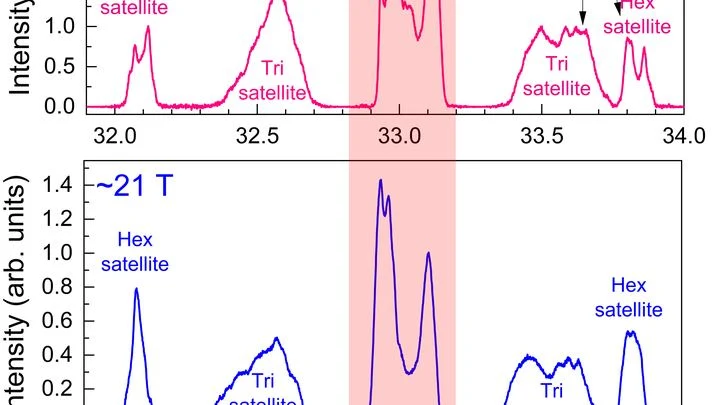
If you toss a handful of coins onto a table, they land in a jumble. But in some crystals, atoms arrange themselves into a pattern reminiscent of a woven basket — the kagome lattice. In the metal MgMn₆Sn₆, manganese atoms form such a lattice, and at room temperature they act like tiny magnetic needles.
A handful of copper coins scattered on a triangular grid freezes into a strange order when a current is passed through them. That's roughly how tiny magnetic arrows, electron spins, behave in a crystal with the rare name Y-capellasite.
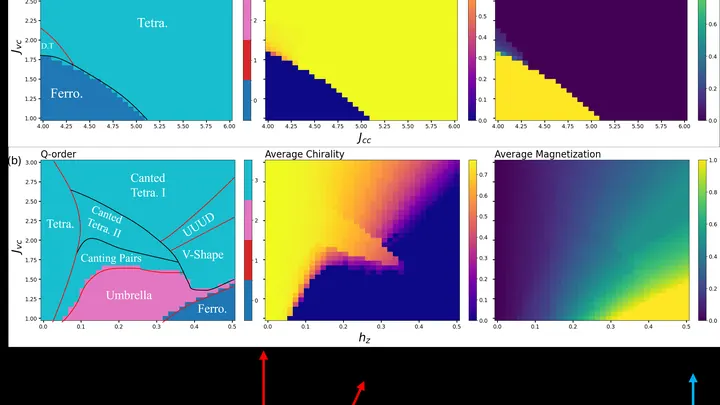
Imagine a triangular grid with tiny magnetic arrows at each node. Electrons, the charge carriers, run across this grid. Usually, the arrows align simply: all pointing the same way (ferromagnet) or alternating in the plane.
A tiny magnet, made from just two molecules, was placed on a metal surface, and it behaved like a temperamental conductor. Normally, electrons in a metal move in a coordinated way, like a crowd on an escalator. But when cooled significantly, this order breaks down, and the motion becomes unpredictable.
A crystal of calcium ions in a trap, illuminated by a laser, is a tiny model of the matter inside a white dwarf. There, in the depths of a dying star, atomic nuclei arrange into a rigid lattice as the temperature drops.
A semiconductor diode normally conducts current in only one direction, like a spring-loaded door: it opens easily one way but pushes back the other. But if you dope the crystal heavily, the door starts behaving strangely: under reverse bias, the current doesn't just flow: it shoots up.
A thin film of the compound of manganese, bismuth, and tellurium resembles a layered cake: each layer is an atomic plane, and the magnetic moments within the layer are aligned like compass needles. At room temperature, these needles hold formation, but just heating the sample to 45°C makes the order start to fall apart.
Fourteen rubidium atoms lined up like beads on a string. Each atom is a tiny magnet that can point up or down. Together they follow strict rules, similar to a train schedule: everything is predictable, everything repeats. But introduce a barely noticeable change, and the schedule goes off the rails.
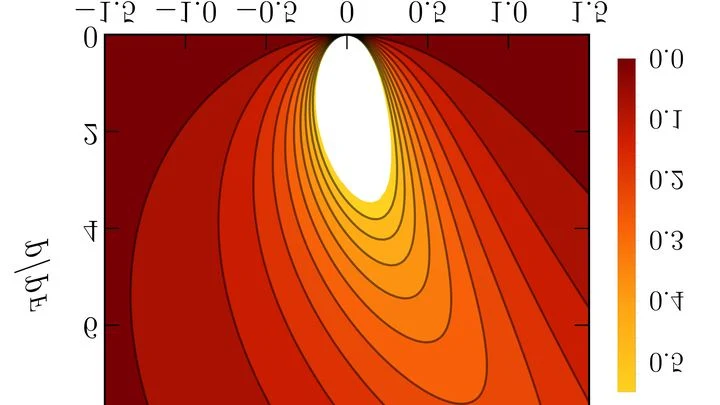
A stone falls into water, and ripples spread outward. In the quantum world, a magnetic impurity (that pebble) in a metal perturbs the surrounding electrons, and they form a special cloud around it. This is called the Kondo cloud. Like ripples on water in the dark, it long remained elusive.
A drop of ink in a glass of water quickly spreads, tinting the whole liquid. Similarly, electrons in a metal move freely, like molecules in a gas. But when a magnetic impurity, an atom with its own magnetic moment, enters this medium, something strange happens.