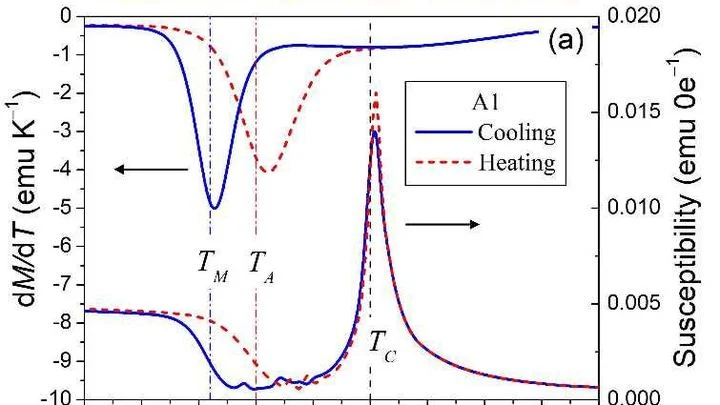
A magnetic transition is a change in the magnetic ordering of a material, typically occurring at a specific temperature called the Curie or Néel temperature. Above this temperature, thermal fluctuations destroy the ordered alignment of atomic magnetic moments, turning a ferromagnet into a paramagnet. These transitions are fundamental to understanding magnetism and are critical for many technologies, from data storage to magnetic refrigeration.
History
Pierre Curie discovered the Curie law in 1895, describing the magnetic susceptibility of paramagnets. The concept of a critical temperature for ferromagnetism was established by Pierre Weiss in 1907 with his mean-field theory.
How it works
In a magnetic material, atomic spins interact via exchange interactions that favor parallel (ferromagnetic) or antiparallel (antiferromagnetic) alignment. At low temperatures, these interactions dominate, and the material exhibits a net magnetization. As temperature rises, thermal energy disrupts the alignment, and at the transition temperature, the ordered state collapses, and the material becomes paramagnetic, with randomly oriented spins.
In practice
Magnetic transitions are exploited in magnetic refrigeration, where the magnetocaloric effect near the transition temperature is used for cooling, and in heat-assisted magnetic recording, where a laser heats a magnetic medium to lower its coercivity for writing data.
Fun fact
Some materials exhibit a 'magnetocaloric effect' so strong near their magnetic transition that they can be used to build refrigerators that are more energy-efficient and environmentally friendly than conventional gas-compression ones.
Picture an orchestra in which violins and trumpets play different parts but together create a powerful sound. In a crystal of the layered magnet Fe5GeTe2 doped with nickel, tiny regions of a different phase, Fe6GeTe2 nanoprecipitates, take on the role of those instruments. It is they, not the nickel itself, that keep the material magnetic at 478 kelvin, that is, at 205 degrees Celsius.
A frozen orchestra where musicians swap seats when the conductor, magnetism, sets a new score. In a spinel crystal, iron and magnesium atoms sit in two types of seats: some surrounded by four neighbors, others by six. At room temperature, they barely stir, but cool the material to 5 K and a mass migration begins.
The neutron is a particle that usually sits in the atomic nucleus and doesn't disappear. But some theories suggest that occasionally it might transform into its invisible twin — a particle that ordinary detectors can't catch.
In the layered crystal CrSBr, the magnetic moments of atoms are arranged like notes in a score: within each layer they point in the same direction, but between layers they point in opposite directions. This antiferromagnetic melody plays up to 132 kelvin, beyond which thermal motion destroys the order.
The magnetic framework of the EuMnSb2 crystal resembles scaffolding: manganese atoms form rigid vertical pillars, while europium atoms act as movable crossbars. Until now, there was no consensus on the angle at which these crossbars rest and how they rotate when a magnetic field presses on the scaffold.
A metal bar suddenly becomes stiff when heated, and at the same time loses or gains magnetic properties. In alloys based on nickel and manganese, such transformations occur not smoothly but abruptly — atoms rearrange into a new order, and the material changes its behavior.
A pot of water on the stove: the hotter the burner, the faster ice turns to water, and water to steam. Heat destroys order. But sometimes nature pulls a trick, and heating makes a liquid freeze, like a puddle turning to ice on a frosty morning.
A crystal is like a city: if the streets are crooked, traffic jams. In a crystal, the streets are atomic rows, and the traffic is the flow of electrons. Any tiny imperfection, impurity, or atomic displacement makes electrons scatter. Scientists from several labs have learned to grow crystals so that the "streets" are almost perfectly straight.
The method is called horizontal vapor transport.
A piece of magnetite, an ordinary iron stone, behaves strangely. At room temperature, it conducts electricity, but cool it below minus 150 degrees, and its resistance jumps sharply. This jump, discovered back in 1939, physicists could not explain for nearly a century.
A new study offers a solution.
Hundreds of people on a dance floor stand at equal distances from each other — strict order, like in a crystal lattice. Slow music is thermal vibrations, making dancers sway slightly. If the music gets louder and faster, order collapses: everyone mixes. That's how thermal motion destroys ordered states of electrons in solids.
In the crystal Rb1-xV2Te2O, the spins of vanadium atoms arrange in a checkerboard pattern: each spin is surrounded by opposite spins. This pattern is called G-type antiferromagnetism. Neutrons passing through the sample scatter off this pattern and reveal its geometry, like light from a flashlight shining through blinds casting stripes on a wall.
Gas falls onto a neutron star — the ultra-dense remnant of an exploded star. This gas accumulates at the magnetic poles and forms a mountain. But a mountain on a neutron star is not like one on Earth: it is held not by rock but by magnetic field lines, like iron filings on a magnet.
When there is too much gas, the mountain begins to break apart.
The strontium ferrite crystal is like a multi-story building where each floor hosts iron atoms. Some floors "look" up, others down, and their magnetic fields partially cancel each other out. But if some of the residents are replaced with aluminum, which doesn't play the magnetic game, the balance of forces shifts.
A compass needle turns slowly, but inside some materials, tiny magnetic moments can flip over timescales that are hard to imagine. A team of physicists has calculated how to make them change direction in a quadrillionth of a second — faster than a lightbulb blinks.
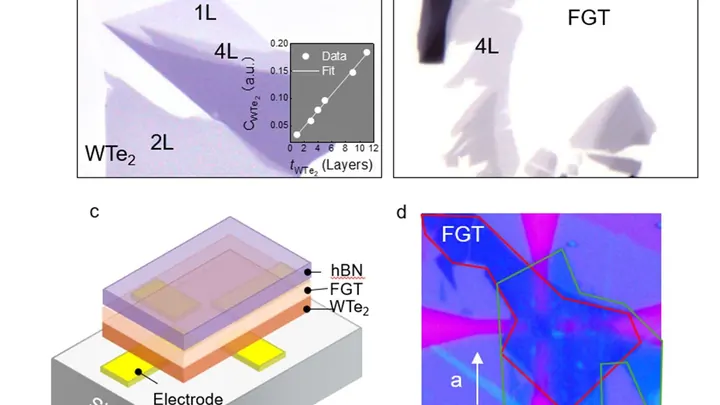
Usually, current in a metal acts like boiling water on ice: it heats the material and destroys magnetic order. But in a layered structure of tungsten ditelluride and the ferromagnet Fe3GeTe2, current behaves differently.
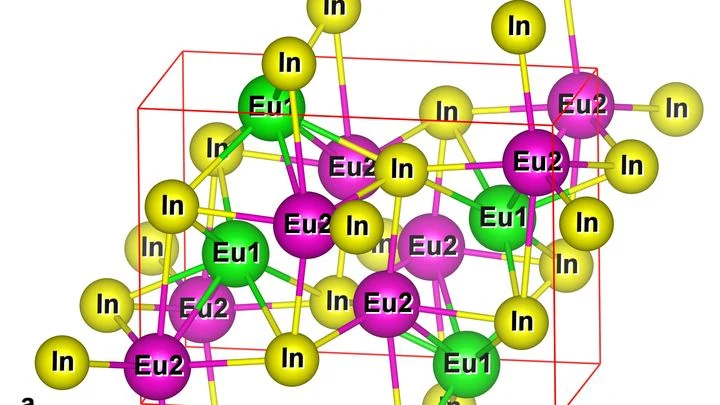
A piece of europium-indium alloy, when cooled in a magnetic field, behaves like water that does not freeze all at once but first in one corner of the glass, then in another.
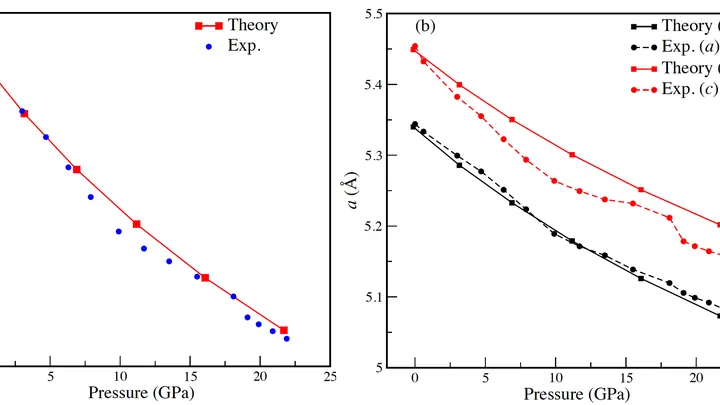
The Fe₃Sn₂ crystal looks like a patterned lattice where iron atoms sit at the corners of hexagons. Under normal conditions, their magnetic arrows are aligned neatly, like soldiers in a row. But squeeze the crystal, and the alignment breaks.
Under a pressure of about 20 gigapascals (imagine twenty elephants standing on your thumbnail), the lattice slightly rearranges.
The magnetic refrigerator of the future won't hum with a compressor. Instead, it will cool your groceries by exploiting a special material that heats up in a magnetic field and cools down when the field is removed. This cycle resembles the compression and expansion of gas in a conventional fridge, but here a magnet does the work of a piston.
The crystal changes its internal geometry like a building frame that slightly twists during an earthquake. In the manganese-gallium alloy (Mn₃Ga), at around 485 Kelvin (about 212°C), a magnetic transition occurs: the atoms align into an antiferromagnetic order, where neighboring magnetic…
The crystal Pr₄Ni₃O₁₀ is like a three-layer sandwich: nickel oxide layers separated by praseodymium spacers. As it cools, three magnetic regimes switch on in sequence, as if, inside the sandwich, the nickel spins first align, then slightly rearrange, and finally the praseodymium spins join in.
Muons, heavy cousins of electrons, penetrate the crystal and sense internal magnetic fields.
A chunk of nuclear fuel inside a reactor is not just a solid. When heated, the uranium atoms in it start to 'wiggle' their magnetic moments, and this motion changes thermal conductivity and other properties.
A magnet that stacks up like a pile of pancakes: that's how the material CrSBr is structured. At low temperatures, each layer is magnetized, but neighboring layers point in opposite directions, and their magnetic fields cancel each other out. This order is called antiferromagnetic, and it's fragile: just a slight warming demagnetizes the layers.
If you stick an ordinary piece of metal into a strong magnetic field, it warms up slightly. But some materials do the opposite: they cool down. This is called the magnetocaloric effect, and it's already being used to build future refrigerators without Freon.
Heat one end of a conductor and keep the other cold, and electrons start flowing from hot to cold. Usually, this creates a voltage along the conductor, like water running down a tilted trough. But in some materials, electrons veer sideways, and the voltage appears across the conductor.
A thin film of the compound of manganese, bismuth, and tellurium resembles a layered cake: each layer is an atomic plane, and the magnetic moments within the layer are aligned like compass needles. At room temperature, these needles hold formation, but just heating the sample to 45°C makes the order start to fall apart.
Tiny particles, smaller than a hundredth of the thickness of a human hair, can be magnets that don't lose their strength even at 600 degrees Celsius. These particular particles were made from a nickel-iron-aluminum alloy. The alloy has been known for a long time, but in nanoparticle form it was produced without templates — simply by mixing solutions of metal salts.
When cooled to -272°C, the Fe₄Nb₂O₉ crystal turns into a magnetic pattern where atomic arrows don't line up in a single row but fan out. It's like a crowd frozen in place, but each person looks in their own direction rather than at the back of the neighbor's head.
The crystal was cooled to minus 228 degrees Celsius, and a pattern emerged on its surface, like frost on a window. But it's not moisture that draws it; it's the magnetic field: tiny iron particles suspended in a liquid settle on magnetized regions, revealing their location. That's the method the researchers used.
The pattern turned out to be two-tiered.
Graphene is a sheet of carbon one atom thick. If you cut it into narrow strips, you get graphene nanoribbons. Their properties depend on how the strip is cut: just as from a single piece of fabric you can sew both a smooth tablecloth and a pleated skirt.
In the new work, chemists assembled a ribbon of asymmetric shape.
Uranus and Neptune have long puzzled scientists: their magnetic fields are heavily tilted and tangled, nothing like Earth's. The answer lay in an exotic form of water — superionic ice, which fills their interiors.
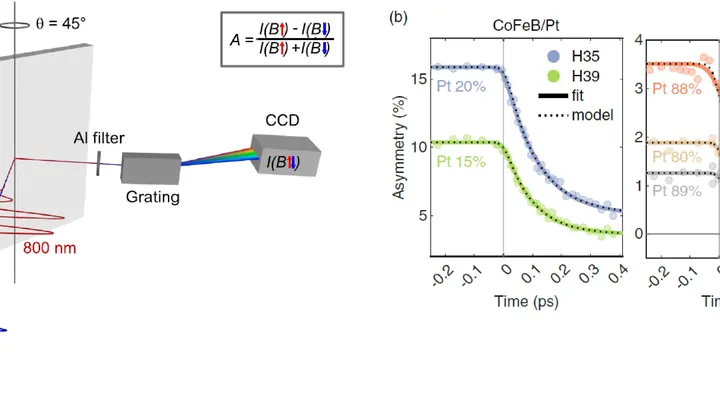
A fridge magnet holds on thanks to tiny internal arrows: each one like a miniature compass. If you hit the metal with an ultrashort flash of light, these arrows start to jitter chaotically, and magnetism melts away in a millionth of a billionth of a second. Previously, such 'melting' was too fast to observe.
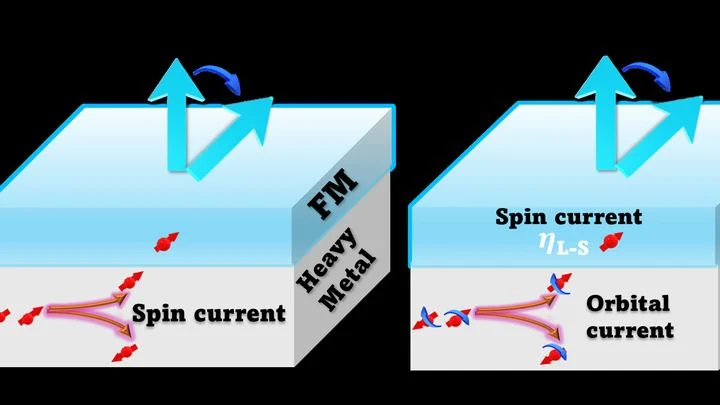
Usually, to flip a magnet in a memory device, heavy metals like platinum or tungsten are used. When current flows, their electrons are deflected sideways, like a crowd on an escalator, and this deflection imparts a rotational torque to the magnetic layer. But heavy metals are expensive and lose a lot of energy as heat.
Niobium diselenide is a layered material that conducts current without resistance at low temperatures. If you weave nickel atoms between its layers, like extra threads in a fabric, superconductivity vanishes.
The temperature in a room drops by a few degrees while the refrigerator runs without a single moving compressor. Inside, there is no Freon, but a piece of metal that is alternately magnetized and demagnetized.