Friction in Faults: How Sand Turns into an Earthquake express
When two tectonic plates grind against each other, a layer of pulverized rock ends up between them, like sand between your palms. This layer, which geologists call fault gouge, behaves not like solid rock but like a thick paste: it can compact, dilate, and slide. Whether a fault ruptures in a devastating earthquake or creeps slowly and safely depends on its whims.
The authors of the new study built a mathematical model of this layer. They described it as a material that is simultaneously viscous (flows under load) and plastic (does not return to its original shape). The model incorporates a key property: such a material changes volume under shear, like wet sand on a beach, which becomes denser when you stomp on it but loosens if you dig into it. This property is critical for faults: compaction or dilation of the gouge directly affects the friction force and how fast the plates slide past each other.
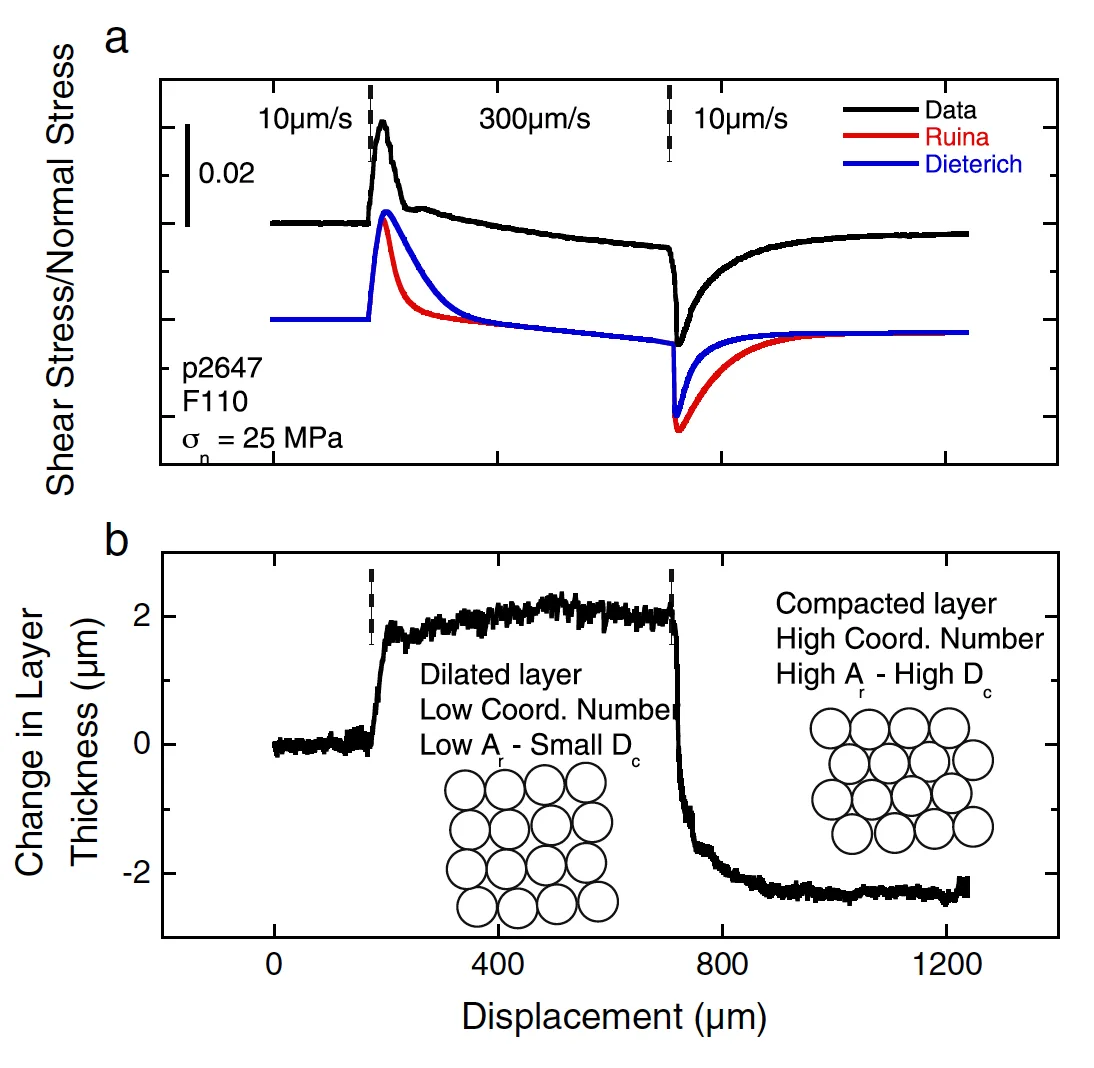
The model was validated against standard experiments: numerical calculations matched the laboratory data. This means we can now more accurately assess when and how a fault will accumulate enough stress for a sudden slip. In the long run, such models could improve earthquake forecasting — at least at the level of the physics of the process, not just statistics.
Original abstract
as written by the authors arXiv:2602.12427
Friction plays a fundamental role in many natural processes, including earthquakes, landslides, and volcanic eruptions. Earthquakes occur when highly compressed fault surfaces accumulate large enough shear stresses, causing the faults to move relative to one another, or slip. The slip is accommodated within a thin layer of comminuted granular material -- called fault gouge -- between the fault surfaces. As a result, characterizing the mechanical behavior of fault gouge in response to shear is a major open problem in earthquake source physics. Modeling gouge is complicated by large deformations, inelasticity, rate dependence, and volumetric changes. As such, researchers typically rely on empirical formulations to capture the effective response. Here, we systematically develop a variational, finite-kinematics framework for fault gouge. We first describe a general theory for a rigid-viscoplastic, pressure-sensitive material, where the plasticity evolution follows from the principle of maximum dissipation. Then, we specialize the governing equations for a Cam-Clay material within a shearing and dilating layer. We rely on convexity considerations and experimental observations from consolidation tests of granular layers to calibrate the model and develop explicit solutions for the rate- and state- dependent response of the model to shear tests under constant compressive normal stress and prescribed shearing rate. To validate the model, we select common rate functions and compare numerical material point tests and theoretical solutions to standard laboratory experiments of shearing granular layers. Lastly, we discuss connections of the model to empirical rate-and-state friction laws.
The thickness of the fault gouge layer in an earthquake zone can be just a few millimeters, yet this thin layer controls the movement of entire tectonic plates.