Impactforce is the force exerted by a body when it strikes a surface, and it is typically much larger than the weight of the body. This is because the impact happens over a very short time interval, and the force is inversely proportional to the duration of the collision. A falling glass shatters on concrete because the force spikes to thousands of times its weight, while the same glass dropped on a pillow experiences a gentler deceleration and survives. Understanding impact force is crucial in engineering, biomechanics, and materials science.
History
The concept was formalized by Isaac Newton in his laws of motion, and the impulse-momentum relationship was later refined by Leonhard Euler and others in the 18th century.
How it works
The force is governed by the impulse-momentumtheorem: the change in momentum of the striking body equals the integral of force over time. If the collision lasts a short time, the force must be large to produce the same momentum change. The actual force distribution depends on the materials' stiffness, deformation, and energy dissipation. For a rigid body hitting a rigid surface, the force is a sharp spike; for a deformable body, the force is spread over a longer time and lower peak.
In practice
Used in crash-test engineering for vehicles, designing protective helmets, and analyzing sports injuries.
Fun fact
A typical golf ball experiences an impactforce of about 10,000 newtons when struck by a driver, which is roughly the weight of a small car.
Units by system: SI: newton · CGS: dyne · Planck: planck force · natural: newton
A spotlight with an adjustable beam width sweeps along the shore. Its light is the long ocean waves that are born in the surf zone and spread in both directions: toward the beach and out to the open sea. Previously, this spotlight was considered a point source, but the actual breaking zone, where short waves break, has a finite width, and it changes as the wave front advances and retreats.
A raindrop slides on the wind and hits the ocean not straight down but at an angle. At that moment, its energy splits into two channels: one pushes the water forward along the flight path, the other presses it downward into the depths. Which channel proves stronger determines what happens at the surface: a quiet submergence, a fan of spray to one side, or a crown that shatters in all directions.
A raindrop falls on glass and flattens into a pancake. Add a bit of polymer to the water, and it becomes elastic, like jelly. You'd think such a jelly would spread differently.
Two houses with identical facades. Windows, doors, wall color — everything matches. But inside, one is empty, while the other buzzes with life. How can you tell without stepping inside? In space, there's a similar puzzle: a black hole and a gravastar look the same from the outside, but they are built differently.
Two pieces of sandpaper are pressed tightly together. As you start to slide them, they first catch on the rough spots, then suddenly slip. A fault in the Earth behaves much the same way during an earthquake. But there's a crucial detail: how far do you need to push the edges before the grip gives way? This distance is called the critical slip distance.
A thin crack runs through glass. At first glance, the fracture line simply reflects the material's brittleness. But if you zoom in to the atomic level, the picture gets more complex: glass starts to resist differently when the crack accelerates.
When a raindrop hits a leaf, it flattens for a moment, then gathers itself and bounces off. But what if the drop isn't quite liquid, but jelly-like, like a gummy candy? Scientists took exactly such drops — made of hydrogel, a material that is 90% water but holds its shape thanks to a polymer network.
Vacuum is not silent emptiness, but a boiling cauldron of quantum fluctuations, born from nothing and vanishing in billionths of a second. This invisible symphony acts like a constant wind, pressing an atom against a wall — as if a powerful bass note pushes a light ball.
A raindrop falls into a puddle, and the impact sends up a little fountain of fine spray. Each of those droplets is a new, secondary drop. How many there are, how big they are, and how long they live depend on a host of factors: the fall speed, the drop size, the properties of the water. Scientists set out to make sense of this chaos using computer simulations.
The Mpemba effect is surprising: hot water sometimes freezes faster than cold. Scientists built a simple model: a bead in a thick, honey-like medium, on a landscape with two dips and a wall at the edge. The bead moves viscously, unable to hop over the central bump.
A thin film is like a taut sheet: the thinner it is, the harder it is to push through. Scientists have noticed that films made of very different materials (graphene, graphene oxide, polymers) resist projectile penetration surprisingly well under high-speed impact. And the thinner the film, the more energy it absorbs per unit mass.
The tear film on the eye is an ultrathin layer of fluid that protects the cornea and keeps vision sharp. It’s usually pictured as a perfectly smooth surface, but the real cornea, even a healthy one, is covered in microscopic bumps.
A raindrop falling to the ground strikes with a certain force. But what if the drop isn't round but elongated like a cigar or flattened like a pancake? It turns out that shape is everything: the impact force can vary by more than a factor of ten just because of how the drop looks at the moment of impact.
The Sun drives the water cycle, and rain returns it to the ground. But now, every drop is a tiny hammer striking the surface. Floating plastic particles (microplastics, mostly carbon) upon impact jump up like popcorn kernels on a hot skillet. But instead of popping, they get wrapped in a thin water film and turn into weightless beads.
Ice slips away from under a skate blade like a bar of soap in wet hands. For a hundred years, scientists argued about where this slipperiness comes from. Some said there is already a thin layer of water on top: it acts as a lubricant. Others countered that water only appears when you start moving, due to friction.
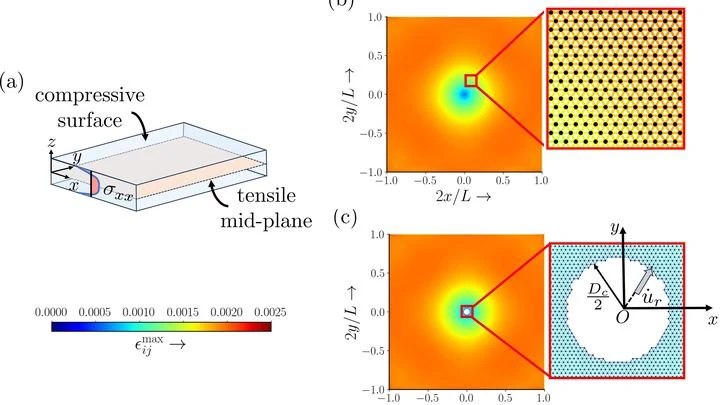
Glass is a material with attitude. It seems fragile, but powerful invisible forces can live inside it. In chemically strengthened glass, the surface is compressed like a stretched rubber band, while the interior is stretched. When a fast object hits such glass, that rubber band snaps in many places at once.
Scientists fired projectiles at glass and watched how it shattered.
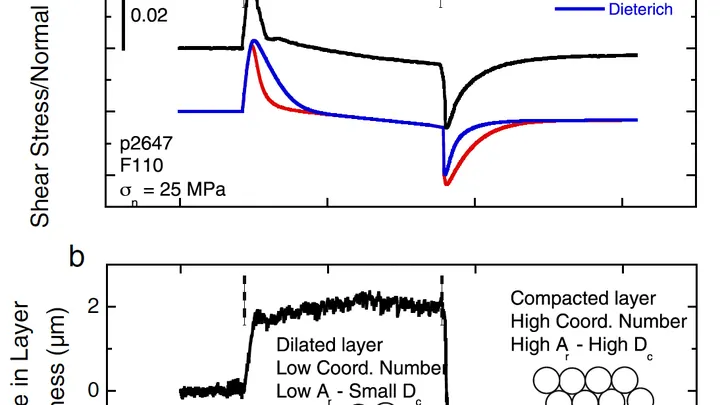
When two tectonic plates grind against each other, a layer of pulverized rock ends up between them, like sand between your palms. This layer, which geologists call fault gouge, behaves not like solid rock but like a thick paste: it can compact, dilate, and slide. Whether a fault ruptures in a devastating earthquake or creeps slowly and safely depends on its whims.
A drop of a thick cornstarch-water mixture falls onto a table. Normally, such a mixture solidifies instantly upon a sharp impact: you can even run across a pool filled with it. But in this experiment, things went differently. The high-speed camera captured that in the first instant after contact, the drop spreads out like an ordinary liquid.
Two particles cling to each other like climbers on the same rope and fly toward a wall. When they hit, will they bounce off together, or will the rope snap? What does it depend on? Physicists considered the simplest case: everything happens on a single line, the particles attract only when they occupy the same point, and the wall is perfectly rigid.
A water droplet falls onto a lotus leaf and bounces off without leaving a trace. Nature has perfected this self-cleaning marvel over millions of years, and engineers have long tried to replicate it. But if the droplet hits too fast, it shatters into splashes, losing mass and leaving wet marks on the surface.