phenomenon

gravitational instability

The process by which a massive, self-gravitating disk fragments into clumps that can collapse to form stars.
49 related articles

Description

Gravitational instability is the process by which a massive, self-gravitating disk of gas and dust fragments into clumps that can collapse to form stars or planets. It occurs when the gravitational pull within a region overcomes the internal pressure and turbulence that would otherwise hold it together. This mechanism is a key pathway for star formation, especially in the early universe and in the disks around young stars.

History

The concept was first formulated by James Jeans in 1902, who derived the condition for gravitational collapse in a uniform medium, now known as the Jeans criterion. The application to rotating disks was developed later in the 20th century.

How it works

In a rotating disk, if a region becomes dense enough, its self-gravity exceeds the local pressure and centrifugal forces. The region then contracts, pulling in more material, and can fragment into a bound clump. If the clump is massive enough, it collapses further to form a star or a giant planet. Magnetic fields and turbulence can either suppress or enhance this instability, depending on their strength and geometry.

In practice

It explains the formation of binary star systems, the birth of giant planets like Jupiter, and the fragmentation of molecular clouds into star clusters.

Fun fact

Gravitational instability can also occur in the disks of galaxies, leading to the formation of globular clusters—dense groups of hundreds of thousands of stars.

Concept graph →

Related articles · 49

Galaxies2026-08-262 minarXiv:2608.25856
A vacuum cleaner at the heart of a dwarf: how a black hole gathers gas from dying stars
At the center of an ultra-compact dwarf galaxy, a very dense stellar system spanning tens of light-years, there is a vacuum cleaner at work. But instead of dust, it sucks in gas shed by dying stars. This gas does not fly off in all directions; instead, it spirals into a funnel, a rotating disk that gradually settles onto the black hole.

HEP Theory2026-08-011 minarXiv:2608.00590express
Black Holes as Bridges to the Dawn of the Universe
A black hole is not just an abyss. It is a seething cauldron whose temperature rises as it evaporates. The authors of the study found that when the heat reaches a critical threshold, the hole seems to boil. It emits superheavy particles — the very ones that exist on a scale where any theory of gravity collapses.
Galaxies2026-07-282 minarXiv:2607.26205
Gravitational Rudder: How a Gas Disk Rips Binary Stars Apart in the Galactic Center
A gas disk with a mass of four hundred thousand suns encircles the black hole at the center of the Milky Way. Its gravity works like a gravitational rudder: slowly but inexorably turning the orbits of binary stars, driving them into the region where tidal forces tear the pair apart.
Cosmic Avalanches: How Vortex Traps Shape Pulsar Glitches
89 milliseconds. That's how long a vortex avalanche lasts that abruptly speeds up the rotation of the Vela pulsar — one of the most famous 'glitching' pulsars. Pulsars are rapidly spinning neutron stars born in the collapse of supernovae.
General Relativity2026-07-211 minarXiv:2607.18764express
A Black Hole with No Bottom: Why Gravastars Can't Hold Up
A campfire burns steadily and long. But when the wind blows, the flame flickers out, leaving only embers. A similar story plays out with the gravastar — a hypothetical object that was supposed to replace the black hole. An ordinary black hole hides a singularity — a point where the laws of physics break down.
Hidden Invariant — Conductor of the Magnetic Dynamo
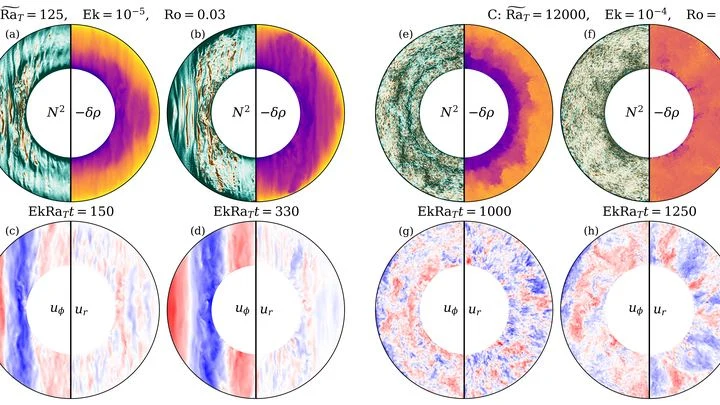
Inside planets and stars, in rotating oceans of plasma, turbulent flows, Coriolis forces, and magnetic tension collide. The central question is how the energy of this chaos crystallizes into a stable magnetic framework that can last billions of years.
Exoplanets2026-06-092 minarXiv:2606.11344express
Young Star Flares Hinder Planet Formation
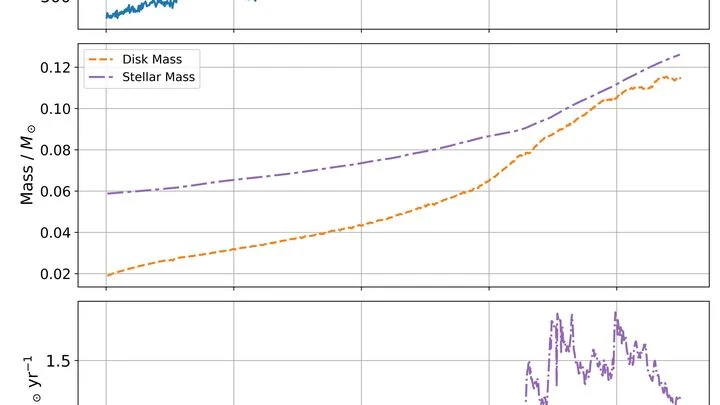
A thick stew slowly cools in a pot. Suddenly, the flame beneath it flares up, and the stew begins to boil, breaking into many small whirlpools. Much the same happens to the disk of gas and dust around a young star when it experiences a flare — a sudden influx of matter from the disk onto the star.
Nuclear Theory2026-05-272 minarXiv:2605.28718express
Invisible Quantum Vortices in Neutron Stars
Imagine a spinning top the size of a city, weighing more than the Sun and making hundreds of revolutions per second. That's a neutron star — the remnant of an exploded star. Occasionally, its rotation suddenly speeds up, as if something inside has switched. Astronomers call these jumps glitches and suspect that invisible vortices in the star's superfluid interior are to blame.
High Energy2026-05-272 minarXiv:2605.28944express
A Spiral at the Heart of a Star
A figure skater pulls their arms in, and their spin suddenly accelerates. When a massive star exhausts its fuel and its core collapses, something similar happens, but on a cosmic scale. The core shrinks to a city-sized sphere, and if it is spinning rapidly, a peculiar instability can arise.
Exoplanets2026-05-252 minarXiv:2605.26216express
Planetary Budget Doesn't Add Up
The cosmic accounting has hit a snag. The bookkeeper is balancing the books: in one column, all the planets astronomers have counted in the galaxy; in the other, the stockpile of building material in the dusty cocoons of newborn stars. The numbers don't line up. Even if you gathered every last grain of dust and molded it into planets, there wouldn't be enough material.
General Relativity2026-05-162 minarXiv:2605.17078express
Cosmic Donuts Around Invisible Stars
At the center of almost every large galaxy lurks something supermassive and dark. Most often, that something is thought to be a black hole — a region where gravity is so strong that even light cannot escape. But what if it's not a black hole, but a dense ball of ultralight particles — a boson star?
Exoplanets2026-05-122 minarXiv:2605.11486express
Dust Rings at the Edge of a Distant System
A huge rotating pancake of gas and dust surrounds a young star. In such a "maternity ward" for planets, rings and gaps are often seen, as if an invisible plow had carved furrows. These are usually attributed to already-formed planets that clear paths with their gravity.
Mesoscale2026-04-301 minarXiv:2604.27860express
Electron Whirlpools in a Semiconductor
River water often swirls into funnels. But in semiconductors, the foundation of microchips, electrons at low temperatures and high purity also turn into a fluid. If you create a circular cavity, vortices appear, just like in a river backwater.
Galaxies2026-04-241 minarXiv:2604.22665express
The Universe Sings: Resonance of Dark and Ordinary Matter
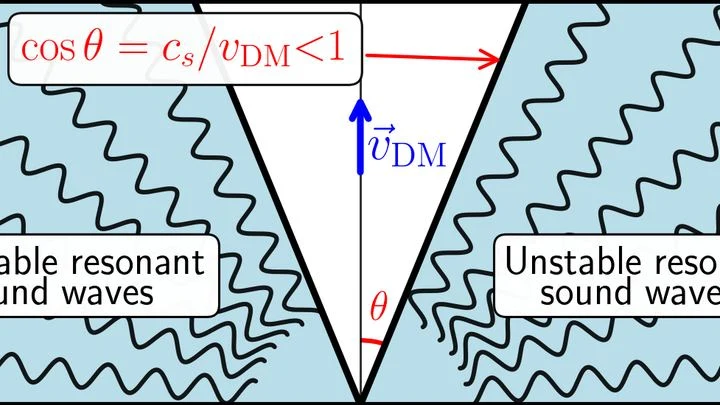
After the Big Bang, dark matter and ordinary matter (mostly hydrogen) went their separate ways in terms of speed. Their gravitational pull acts like a bow gliding across a string: when frequencies match, resonance occurs, and sound waves start to rapidly grow in ordinary matter.
Exoplanets2026-04-232 minarXiv:2604.21322express
Cosmic Remelting of the First Rocks
An old chest of family heirlooms opens, and inside lie jewels that were thought to be as old as great-grandmother. But suddenly it turns out: the gold was remelted, the stones were recut, and this happened much later than thought. A similar story happened to the oldest particles in meteorites — calcium-aluminum inclusions, or CAIs.
General Relativity2026-04-222 minarXiv:2604.20960express
What Holds a Star Together When It Has Two Pressures
A balloon in your hand springs back equally in all directions. But a bottle of soda behaves differently: along the neck it is stiff, while across it is easily squeezed. This is roughly how pressure works inside some stars: it can be unequal in different directions. Such stars are called anisotropic, and their behavior has so far been described by disparate methods.
Chemical Physics2026-04-221 minarXiv:2604.21005express
How Chaos Governs the Chemistry of Giants
A chemical reaction resembles passing through a turnstile: a crowd creates chaos and gets stuck, while an orderly line moves. In the quantum world, however, when the jostling subsides, the barrier can become ghostly — a particle passes through it as if the turnstile has vanished.
Quantum Physics2026-04-172 minarXiv:2604.16144express
Gravity Focuses the Wave
A thrown stone arcs along a clean trajectory, but an electron's position in an atom is smeared out like fog. The transition from one to the other is a puzzle. New work shows that the fuzziness disappears not because of an observer, but because of the particle's own gravity.
High Energy2026-04-151 minarXiv:2604.13557express
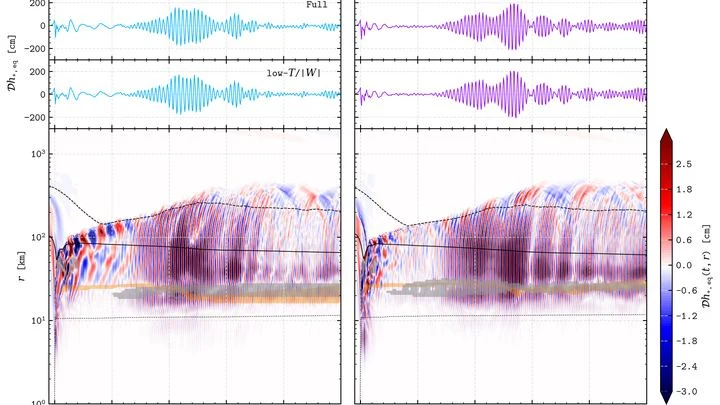
The Invisible Mountain on a Neutron Star
Gas falls onto a neutron star — the ultra-dense remnant of an exploded star. This gas accumulates at the magnetic poles and forms a mountain. But a mountain on a neutron star is not like one on Earth: it is held not by rock but by magnetic field lines, like iron filings on a magnet. When there is too much gas, the mountain begins to break apart.
Exoplanets2026-04-132 minarXiv:2604.11262express
Dust Against the Wind: How Planets Are Born
In a disk of gas and dust around a young star, dust particles behave like sand grains in a stream of water: the gas flows faster, the dust lags behind, and friction arises between them. This friction can rock the magnetic waves that run through the disk. The galaxy is full of such disks: it is precisely in them that planets are born.
Galaxies2026-04-132 minarXiv:2604.12053express
A Galaxy Loses Its Memory in the Blink of an Eye
Drop two identical pebbles from a mountain peak: one lands a centimeter to the left, and a minute later they end up in different valleys. A galaxy is the same mountain, only with billions of pebbles and a slope that stretches over millions of years. The authors of a new study simulated a disk of 40 million point-like stars and tested how quickly it forgets where it started.
Galaxies2026-04-062 minarXiv:2604.04501express
Chaos Reigns in the Thick of Stellar Filaments
In cold clouds of interstellar gas, long, dense filaments stretch out. Inside them, like overcrowded incubators, future stars are maturing. For a long time, it was thought that within such filaments, everything was governed by gravity: matter smoothly flows toward the centers, where density increases and eventually a star ignites.
Exoplanets2026-04-061 minarXiv:2604.05122express
Dust Grains Like Shuttlecocks: How Patterns Emerge in Protoplanetary Disks
Around young stars, disks of gas and dust swirl — the building blocks for future planets. Inside these disks, dust grains don't just fly randomly: they align along invisible lines of gas flow. Recently, astronomers noticed that dust grains in such disks behave like badminton shuttlecocks — always turning their long side into the wind.
Geophysics2026-03-302 minarXiv:2603.28144express
A Snow Avalanche Under the Microscope
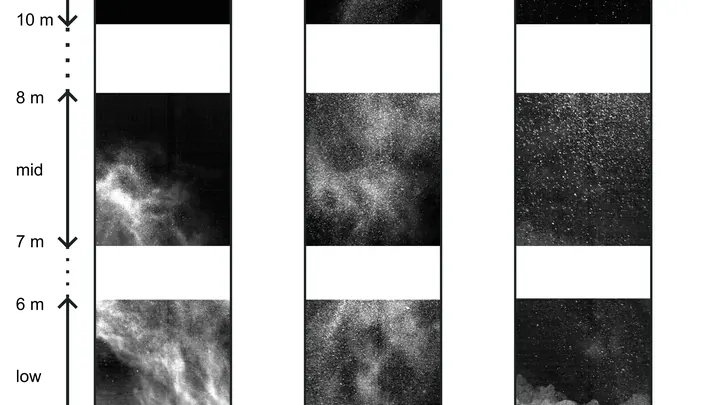
A powder avalanche isn't just a pile of snow sliding down a mountain. It's a cloud racing downhill at car speed. Inside, snow doesn't lie still: it flies: thousands of tiny particles are caught up in air vortices. Until now, no one had seen what actually happens to each snowflake in this chaos. Now scientists have the first footage.
Galaxies2026-03-181 minarXiv:2603.17254express
Turbulence Wins Over Magnetic Fields
In the cold gas clouds where giant stars are born, everything is churning with motion. Gas compresses, swirls, and fragments into clumps — the future stars. For a long time, it was thought that the magnetic field brought order here: like invisible threads, it stretched clumps perpendicular to itself. But new observations showed the opposite.
Exoplanets2026-03-171 minarXiv:2603.17195express
How Dust Gathers into Planets
Planets are born from dust. In a disk around a young star, tiny dust grains collide, stick together, and gradually grow like a snowball rolling down a hill. But there's a catch: the gas in the disk moves faster than the dust and drags on it, preventing it from clumping into large chunks. For dust to stick together, there needs to be enough of it.
Exoplanets2026-03-161 minarXiv:2603.15810express
Dust Grains Dance a Waltz
In a protoplanetary disk, a cloud of gas and dust around a young star, dust grains don't just fly in circles. They are carried by the gas flow, like sand by the wind, and in turn alter that flow. Layers emerge, sliding past each other, and at their boundaries an instability arises — waves and vortices.
Galaxies2026-03-112 minarXiv:2603.10607express
Stars Born from an Interloper Cloud
A gas cloud the size of a small galaxy is falling into the Milky Way at hundreds of kilometers per second. Such clouds are called high-velocity clouds, and until now no stars had been found in them — only gas. Now, in one of them, named Complex H, astronomers have spotted a pair of young star clusters.
Exoplanets2026-03-111 minarXiv:2603.10952express
A Star Winks: Dust from a Planetary Collision
In a constellation where new stars are born, one of them behaves like a faulty lightbulb: sometimes shining steadily, sometimes dimming by a factor of several. Astronomers have been monitoring the star Gaia-GIC-1 for several years and now understand that its blinking is the shadow of a huge dust cloud that periodically passes in front of it.
Galaxies2026-02-252 minarXiv:2602.21821express
Jellyfish Galaxies: Supersonic Winds Ignite Star Formation
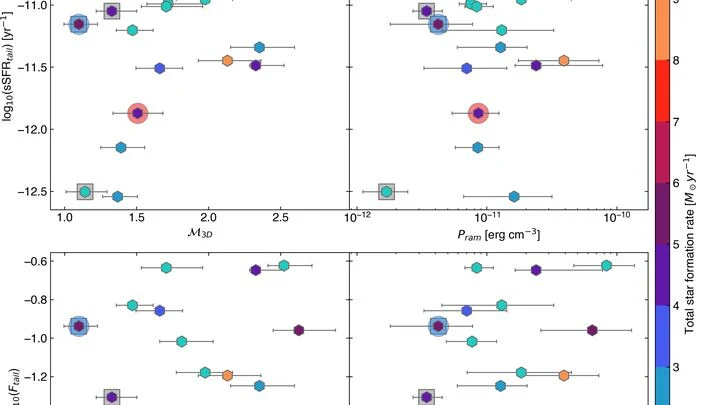
A galaxy plunges into a dense cluster like a runner into a crowd. The oncoming gas, known as the intracluster medium, strips away its own gas, stretching it into a long, glowing tail. Astronomers call these galaxies jellyfish: they have a body and flowing tentacles of stripped material. But only in a few do new stars ignite within those tentacles.
The Glass That Breaks by a Single Law
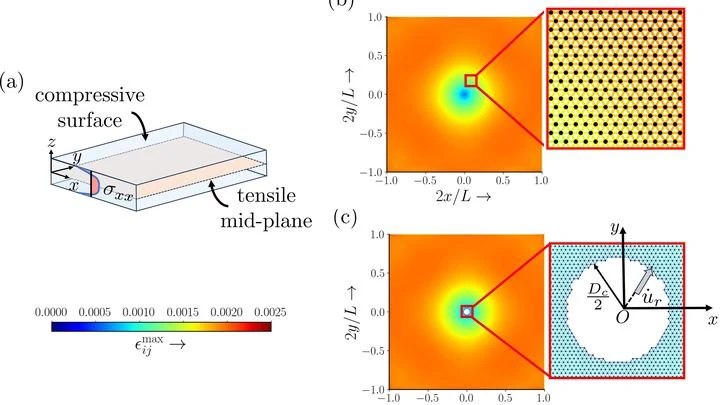
Glass is a material with attitude. It seems fragile, but powerful invisible forces can live inside it. In chemically strengthened glass, the surface is compressed like a stretched rubber band, while the interior is stretched. When a fast object hits such glass, that rubber band snaps in many places at once. Scientists fired projectiles at glass and watched how it shattered.
Exoplanets2026-02-171 minarXiv:2602.15978express
Disk Vortices Keep Planets from Falling In
A young planet in a gas disk is like a swimmer trying to swim against the current: friction with the gas slows it down, and it spirals toward the star. For small rocky planets, this fall can take less time than they need to grow. But the disk also has countercurrents — vortices that can push the planet outward. Scientists built a computer model of a disk around a young star.
Materials2026-02-121 minarXiv:2602.12427express
Friction in Faults: How Sand Turns into an Earthquake
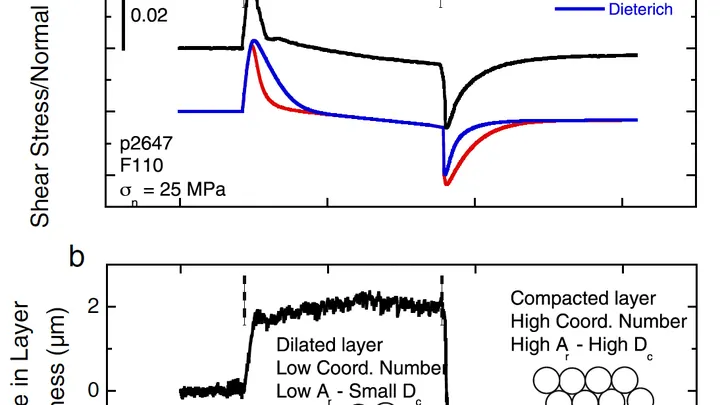
When two tectonic plates grind against each other, a layer of pulverized rock ends up between them, like sand between your palms. This layer, which geologists call fault gouge, behaves not like solid rock but like a thick paste: it can compact, dilate, and slide. Whether a fault ruptures in a devastating earthquake or creeps slowly and safely depends on its whims.
Plasma Physics2026-02-072 minarXiv:2602.07329express
Why Stellarators Don't Blow Up
In a tokamak, plasma is like a crowd on a narrow street: once someone starts running, everyone takes off at once. In a stellarator with a non-circular cross-section, the street is winding, with dead ends and pockets. The crowd can't gather into a single wave — people get stuck in different corners.
Galaxies2026-02-051 minarXiv:2602.05296express
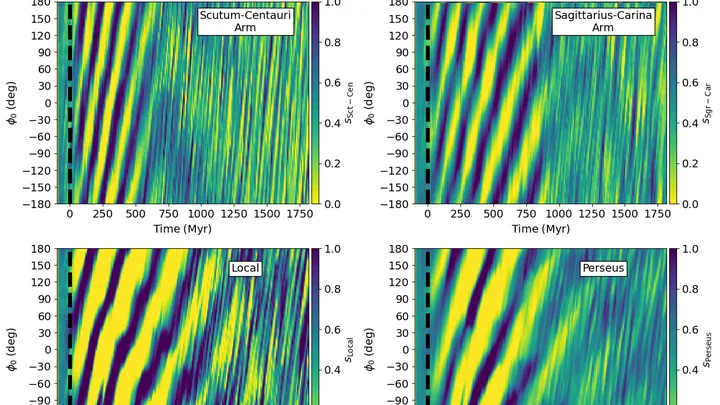
How a Dwarf Galaxy Shook the Milky Way
The Sagittarius galaxy plunged into the disk of the Milky Way and passed through again and again, like a stone thrown into a still pond. Each strike left ripples: waves and warps in the star field.
Exoplanets2026-02-032 minarXiv:2602.03723express
Hot Jupiters Devoured by Their Stars
A giant planet circles too close to its star. With each orbit, it tugs on the star with its gravity, and waves are born deep inside the star, like ripples from a stone dropped into water. These waves damp the planet's orbit, and it spirals into the star. The star swallows the planet and starts spinning faster. Stellar rotation is the key clue.
Galaxies2026-02-012 minarXiv:2602.01333express
Dust Grains Put the Brakes on an Invisible Wind
In the cold clouds of gas and dust where stars will one day ignite, some atoms have lost electrons and become charged. Charged particles feel the magnetic field, while neutral ones do not, so the charged ones slip through the neutral ones like water through a sieve. Astronomers have measured this drift speed: about a hundred meters per second.
Exoplanets2026-01-192 minarXiv:2601.13200express
Cosmic nurseries under fire
A young star is surrounded by a flat, rotating disk of gas and dust — the construction site for future planets. The disk lives its own life: gas flows toward the star, dust clumps together, and from outside, harsh ultraviolet light from neighboring hot stars presses down on it all, like wind blowing leaves off a path.
Exoplanets2026-01-191 minarXiv:2601.13391express
How Planets Are Born: Turbulence in the Gas Disk
Around young stars, flat clouds of gas and dust swirl: these are the birthplaces of planets. For matter in such a disk to clump together, it must be constantly stirred. But what makes the gas move chaotically when it would otherwise be calm? Part of the answer lies in the fact that the gas in the disk barely conducts electricity: it is weakly ionized.
Fluid Dynamics2026-01-141 minarXiv:2601.09358express
How Saturn Hides Its Magnetic Field
Inside giant planets like Jupiter and Saturn, heat doesn't always rise freely. Heavy elements, which are more abundant in some layers than others, prevent hot fluid from floating up. This creates semiconvection — a type of mixing where heat and composition spread at different rates.