Fracture is the process by which a material separates into two or more pieces under applied stress, typically initiated by the growth of a crack. It is a fundamental failure mode in all solid materials, from metals and ceramics to polymers and biological tissues. Understanding fracture is critical for engineering safe structures, predicting earthquakes, and even explaining natural patterns like the cracking of mud or the breaking of ice. The study of fracture bridges materials science, mechanics, and geophysics.
History
The modern scientific understanding of fracture began with Alan Arnold Griffith's 1921 paper, which introduced the energy criterion for crack propagation in brittle materials. This was later extended to ductile materials by George Irwin in the 1950s with the concept of stress intensity factors.
How it works
Fracture begins when stress concentrates at a flaw or defect in the material, such as a microcrack or inclusion. When the stress intensity at the crack tip exceeds a critical value (the fracture toughness), the crack propagates. The process is governed by the balance between the energy released as the crack grows and the energy required to create new surfaces. In ductile materials, plastic deformation ahead of the crack tip blunts it and absorbs energy, making fracture slower; in brittle materials, cracks propagate rapidly with little deformation. Recent research shows that even the way a material is manufactured, like 3D-printed metals, can introduce defects that lower fracture resistance, and that hydrogen can embrittle steel in novel ways.
In practice
Fracture mechanics is used to design aircraft fuselages, pipelines, and bridges, to predict earthquake rupture along faults, and to improve the durability of manufactured components, including 3D-printed parts.
Fun fact
Glass, despite being brittle, can be made stronger by rapidly cooling it, a process called tempering, which puts the surface in compression and makes it much more resistant to crack propagation.
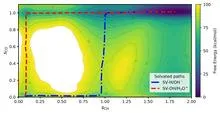
Picture a tiny hole in a sheet of graphene: a single missing carbon atom. It used to be thought that a water molecule splits apart at this defect only on its own, in dry gas. But if liquid water is sloshing all around, everything changes.
A drying puddle of mud becomes covered with cracks, like an old painting with craquelure. At first the cracks meet at nearly right angles, forming a rough grid. But if the mud is wetted again and allowed to dry, the pattern changes: cracks begin to meet in threes, at an angle of 120 degrees, like a honeycomb.
Why this happens remained a mystery for a long time.
A sheet of paper tears where tension exceeds strength. Epithelium, the cell sheet lining our organs, behaves similarly, but until recently models could not show how tears appear in it. The classical vertex model describes tissue as a network of polygons tightly packed together and forbids cells from detaching.
Two pieces of sandpaper are pressed tightly together. As you start to slide them, they first catch on the rough spots, then suddenly slip. A fault in the Earth behaves much the same way during an earthquake. But there's a crucial detail: how far do you need to push the edges before the grip gives way? This distance is called the critical slip distance.
Modular satellites are built from cube-shaped blocks, like a construction toy. When struck by space debris, some blocks are destroyed, leaving a puncture. Engineers took inspiration from the way living tissue heals wounds. Surviving blocks detect disorder and trigger an alarm signal that travels at the speed of light through the entire structure.
A black hole is like a spinning drop of viscous liquid. Normally, such a drop tends to stay whole: splitting would reduce its surface area, which contradicts the law of non-decrease of entropy (a measure of disorder, like a broken cup doesn't glue itself back together).
A steel cylinder that has held hydrogen for a long time sometimes breaks not along the usual grain boundaries but right through the crystal grains, leaving a strange pattern, as if the crack chose the wrong road. For a long time, people looked at this and wondered: why?
A torn telephone wire is a nuisance, but a torn DNA is a catastrophe. A double-strand break, when both strands of the helix snap at the same spot, threatens the cell with death or transformation into cancer. Fortunately, the cell has its own 'glue': special proteins that gather into a droplet right at the accident site.
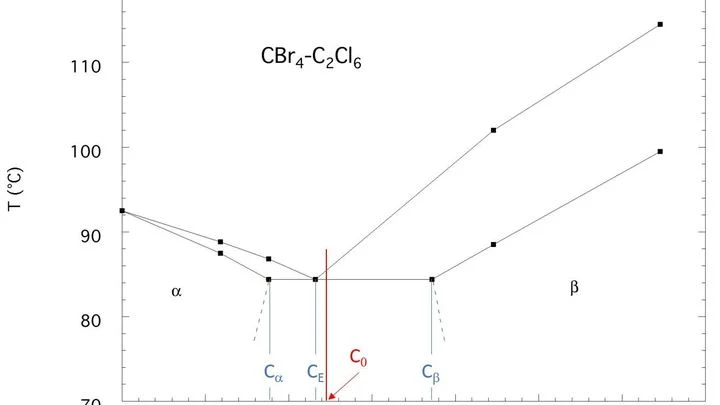
A chef pours hot sugar syrup onto a cold table, and it sets into crystals. That's roughly how engineers pictured metal solidification: the liquid instantly becomes a scatter of crystalline grains. But close-up imaging revealed an extra stage wedged between liquid and solid.
A thin crack runs through glass. At first glance, the fracture line simply reflects the material's brittleness. But if you zoom in to the atomic level, the picture gets more complex: glass starts to resist differently when the crack accelerates.
In a solid piece of tin-lead alloy, the layers of the two metals lie like pages in a book. When heated from one side, the layers don't melt uniformly but in whimsical tongues and fingers. Scientists studied this process using a transparent alloy that can be seen through under a microscope and compared it with a computer model.
When you pull on a piece of metal, it changes shape and simultaneously becomes stronger. The secret lies in tiny defects in the crystal lattice called dislocations. They are like wrinkles in a rug: moving a wrinkle shifts the rug more easily than dragging the whole rug.
A landscape cut by roads or rivers into isolated patches resembles a shared apartment after partitions are installed: residents no longer bump into each other in the common hallway. Species that once competed for the same food or space now live apart. Competition weakens, and those that would have lost to pushier neighbors in a continuous landscape now survive.
A transparent sheet of acrylic with hundreds of laser-burned holes: that's what the test material looks like. When stretched, it loses stiffness almost linearly: the more holes, the easier it bends. But the rate of this softening is surprising: it's noticeably higher than classical formulas for materials with voids predict.
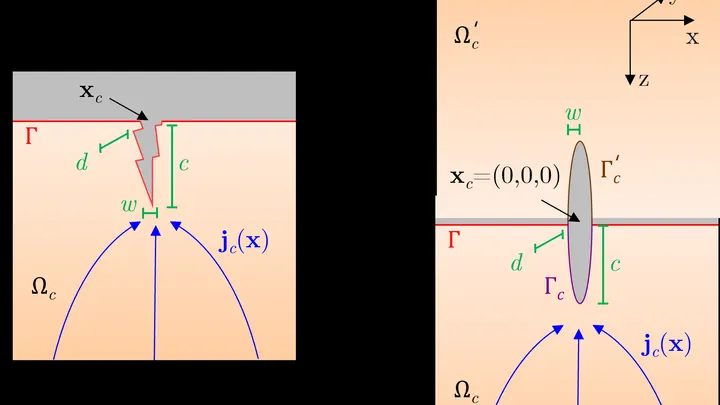
A metal filament as thin as a hair grows through the ceramic like a root through asphalt. In solid-state batteries, such filaments are called dendrites, and they appear when the charging current exceeds a critical threshold. The ceramic electrolyte is solid but brittle, like glass.
A piece of dough, when pulled from the sides, doesn't stretch evenly: in one spot it thins and tears. Living tissue behaves similarly, but instead of a tear, shear bands appear — narrow zones where cells begin to slide past each other, like cards in a deck when cut.
In a metal crystal, atoms line up in neat rows like bricks in a wall. Knock out a single brick, and you're left with a void — what scientists call a vacancy. Under irradiation, these voids multiply and start merging into large holes, sapping the metal's strength. It's like holes in a brick wall joining up into a gaping breach.
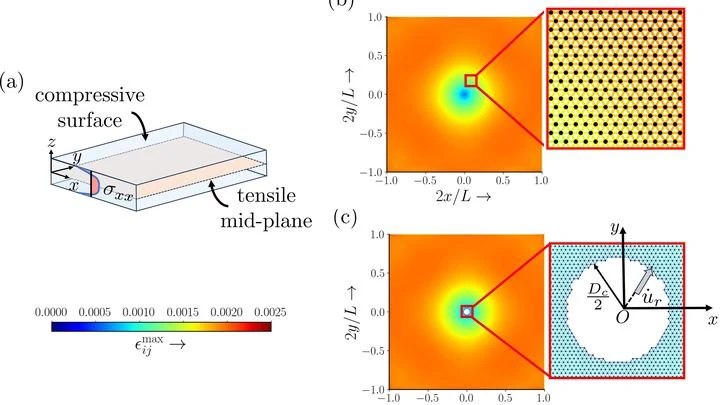
Glass is a material with attitude. It seems fragile, but powerful invisible forces can live inside it. In chemically strengthened glass, the surface is compressed like a stretched rubber band, while the interior is stretched. When a fast object hits such glass, that rubber band snaps in many places at once.
Scientists fired projectiles at glass and watched how it shattered.
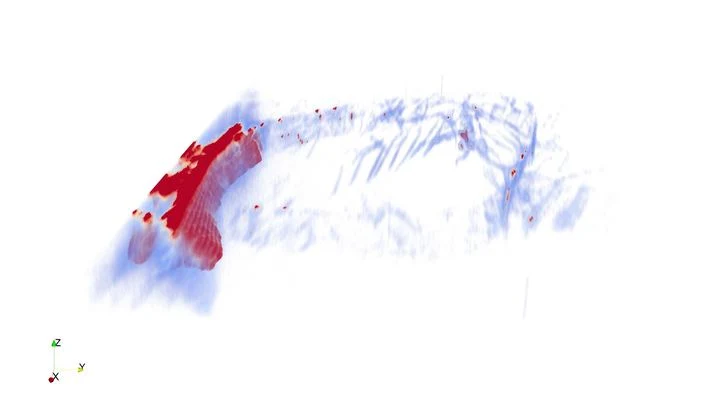
A metal part grown on a 3D printer looks indistinguishable from a forged one. But when load is applied, a very different story unfolds inside. A synchrotron X-ray beam is like a microscope that sees through steel and reveals what's happening right at the crack tip.
In ordinary forged steel, a crack blunts before it can propagate further.
A magnetic film divided into tiny arrow-shaped cells behaves like a crowd in a square. While it's cold, all arrows point in the same direction — perfect order. Heat the film, and the arrows start darting around like pedestrians who have lost their purpose. Somewhere between these extremes, there is a moment when the system stops being uniform but hasn't yet dissolved into random noise.
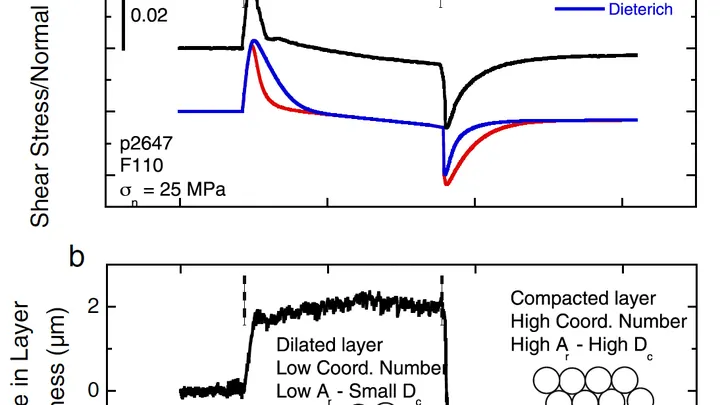
When two tectonic plates grind against each other, a layer of pulverized rock ends up between them, like sand between your palms. This layer, which geologists call fault gouge, behaves not like solid rock but like a thick paste: it can compact, dilate, and slide. Whether a fault ruptures in a devastating earthquake or creeps slowly and safely depends on its whims.
A rubber band is stretched, and suddenly snaps. In the atomic world, a similar picture emerges: the string binding particles can break. In a new study, physicists took a chain of Rydberg atoms and tracked how such a string breaks.
Under weak tension, the string breaks completely, and the system splits into several independent pieces, as if a rubber band shattered into segments.
A thin rubber film lies on a table. Someone grabs it by the middle and slowly pulls upward. The film doesn't just rise: it arches into a dome, then wrinkles run along the dome's edge, like pleats on a skirt. Pull higher — the wrinkles gather into large folds that cross the entire film. And if you start lowering it, the folds don't disappear but collapse into new shapes.