Solar eruption forecasting is a branch of space weatherprediction. It relies on monitoring the Sun's magnetic field, sunspot activity, and historical patterns to estimate the likelihood of an eruption. Accurate forecasts are crucial because a major solar storm can induce currents in power lines, damage satellite electronics, and interfere with GPS and radio signals. The field has grown in importance as society depends more on space-based technology.
History
The systematic study of solar activity began in the 19th century with the discovery of the sunspot cycle, but modern forecasting emerged in the mid-20th century with the advent of space-based observatories. The first operational space weatherprediction center was established by the U.S. in the 1960s, following the recognition of solar storms' impact on radio communications.
How it works
Forecasters analyze solar images and magnetic field maps to identify active regions where magnetic energy is building up. They use statistical models trained on past eruptions to estimate the probability of a flare or CME within a given time window. When an eruption occurs, they track the resulting cloud of plasma using coronagraphs and model its trajectory to predict when it will arrive at Earth, using real-time data from spacecraft like SOHO and SDO.
In practice
Solar eruption forecasts are used by satellite operators, power grid managers, and aviation authorities to take protective actions, such as switching satellites to safe mode or rerouting flights over polar regions to avoid communication blackouts.
Fun fact
The most powerful solar storm on record, the Carrington Event of 1859, caused auroras visible near the equator and set telegraph equipment on fire—a storm of that magnitude today could cause trillions of dollars in damage to modern infrastructure.
A sunspot, a dark island on the fiery surface, lives its own turbulent life. Beneath it, in invisible depths, giant magnetic loops drift like twisted cables. When such a loop emerges, it can discharge as a flare, and hurl clouds of charged particles into space.
Scientists have long tried to understand what determines the strength and suddenness of these events.
The Sun continuously scribbles magnetic fields across its surface. These patterns are not mere ripples but a handwriting in which nature has encoded warnings of flares. A flare is an explosion that releases the energy of billions of nuclear bombs in minutes, ejecting streams of plasma and radiation into space.
Solar flares are powerful explosions on the Sun that can knock out satellites and blackout cities. Predicting them is complicated by the tangled magnetic fields in sunspots.
In 5 billion years, the Sun, having exhausted its fuel, will start to swell, turning into a red giant. Like a balloon losing air, the star will weaken its gravitational grip, and Earth — a grain of sand on an invisible thread — will drift to a more distant orbit.
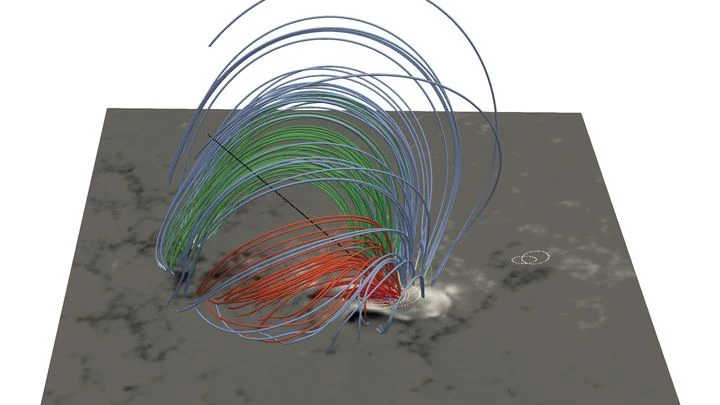
A sunspot cools, and above it a dark filament, a prominence, hangs for weeks. Inside it, like a compressed spring, hides the magnetic field. It can be laid out in neat arches, or it can be twisted into a tight rope.
Perth residents know: when the daytime heat becomes unbearable, relief arrives from the ocean — a fresh breeze affectionately called the Freo Doctor. The same wind, only on a global scale, decides the fate of cosmic visitors plunging into the atmosphere. A meteorite fall is a two-act spectacle.
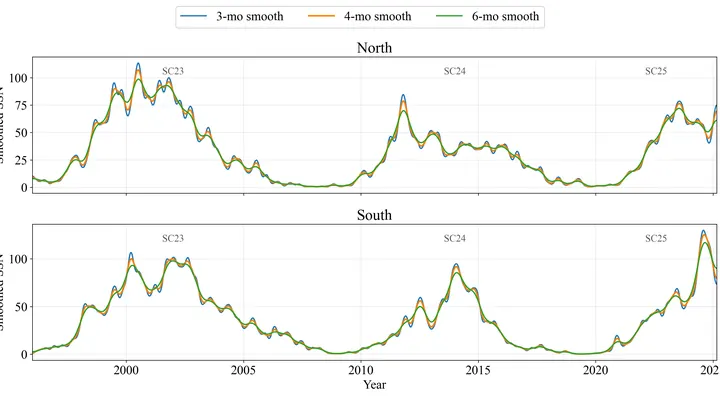
The Sun doesn't burn steadily: it erupts in series. Like a campfire that dies down and then suddenly throws out showers of sparks, these "fiery seasons" last from six months to a year and a half, and during them the star shows an unusually high number of sunspots.
The aurora borealis is like a distant theater: the show may be on, but whether the audience sees it depends on the curtain. Here, the curtain is clouds and moonlight. Earlier forecasts tried to predict both the occurrence of auroras and viewing conditions at once, mixing everything together.
The solar wind, a stream of charged particles from the Sun, slams into the tenuous gas that fills the space between the stars. The collision produces a faint X-ray glow. For astronomers, this is like fog in front of headlights: it obscures distant objects.
Magnetic fields on the surface of the Sun appear as dark spots and bright faculae. But they are born deep inside, where flows of hot gas act like a giant dynamo. The question is whether sunspots on the surface can predict what will happen inside the star years from now.
The authors applied a mathematical theorem similar to the rule linking the area of a shape to its boundary.
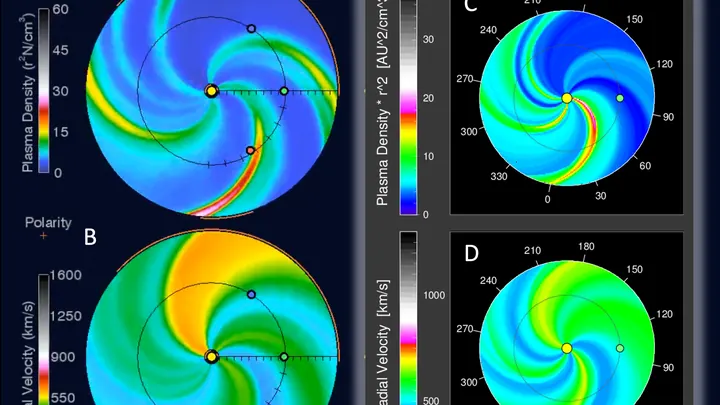
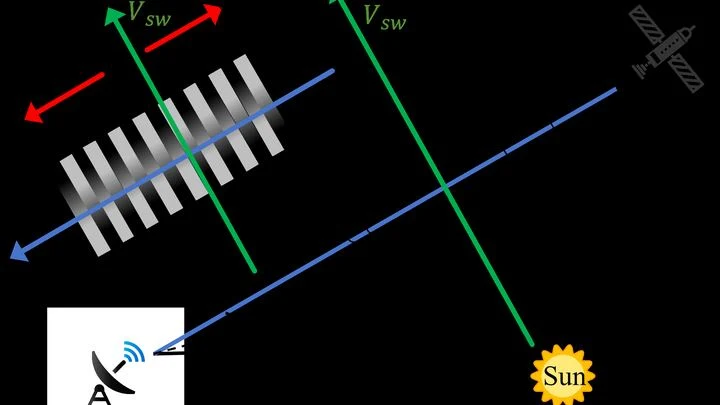
A radio signal travels from Mars to Earth, but on the way it has to push through the invisible "wind" of charged particles blowing from the Sun. This wind, like ripples on water, slightly distorts radio waves.
By day in Chile's Atacama Desert, the air shimmers with heat like the haze above a hot skillet. Sunlight passing through this shimmer begins to dance and flicker. Astronomers call this airy trembling "seeing" — and it keeps telescopes from getting a sharp view of the stars.
To fight this nuisance, engineers have built a special instrument — a solar seeing monitor.
The Sun constantly flares up like a campfire when you toss in more kindling. Big flares are obvious at once, but weak ones easily get lost in the overall glow. The neural network was taught to pick out even barely noticeable bursts from the stream of data that satellites send every second.
From 2018 to August 2025, the algorithm found 111,580 flares.
The Sun sometimes produces giant clouds of plasma that try to escape into space. But often they fail: an invisible magnetic cage keeps them near the surface. Such failed eruptions are called "trapped."
Scientists built a computer model to understand exactly how this cage works.
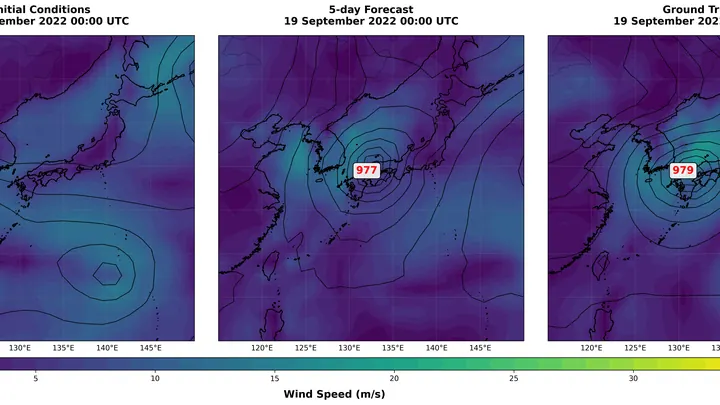
Weather forecasting is like trying to predict where a rock will roll down a slope, knowing the shape of every bump and the force of the wind. Make a mistake at the start, and a week later that error grows into a full-blown storm. In the past, accurate forecasts required massive computers and days of computation.
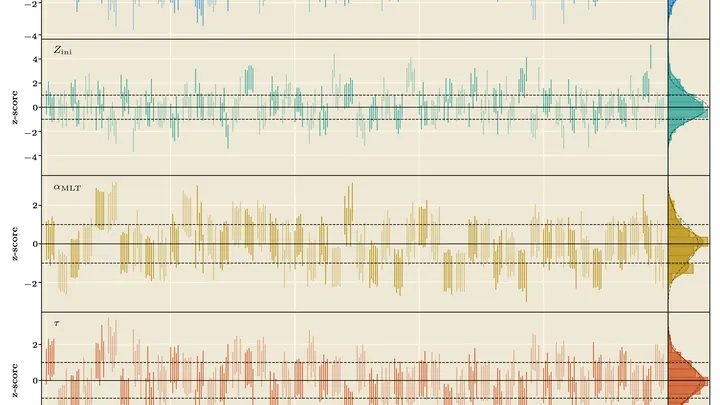
Scientists search for planets around distant stars by detecting a slight wobble in the star's motion: the planet tugs on the star, making its light shift slightly toward the blue and then toward the red. But stars have their own ripples — dark spots and bright faculae on their surfaces. These also shift the light, making it hard to tell them apart from a planet.
A star like the Sun doesn't just shine: it hums quietly. Inside, plasma churns, and these motions make the surface rise and fall rhythmically. Catching such a tremor from Earth is nearly impossible: it gets lost in the noise of the atmosphere and the instrument itself. That's why astronomers listen to stars from space, where it's quieter.
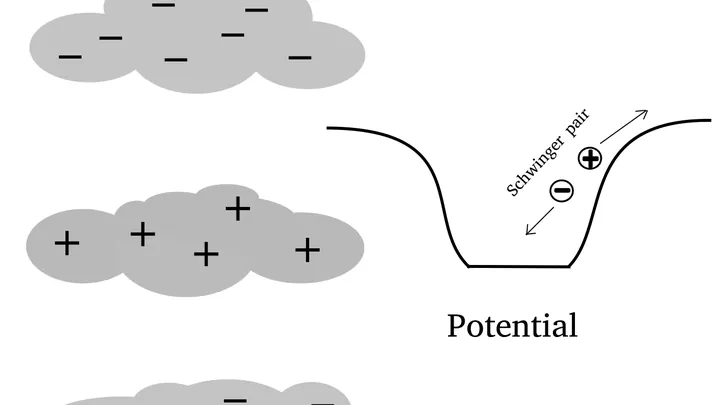
A thundercloud stores electricity like a battery before a flash. It can discharge in two ways: by lightning or by producing particles with a tiny charge: these are called millicharged particles. Such particles are nearly invisible to detectors, but their trace can be caught by how often lightning strikes.
The authors compared thunderstorms on different planets in the Solar System.
Solar flares — sudden energy releases on the Sun — can knock out satellites and power grids. Previous models often either cried wolf or missed a real blow. The fix: attach a reliability estimate to every prediction.
The Sun is not a calm sphere. Waves constantly ripple through its interior, like a bell after being struck. These oscillations reach the surface and reveal what's happening on the far, invisible side. Astronomers have long been able to 'listen' to this ringing and find large sunspot groups there.
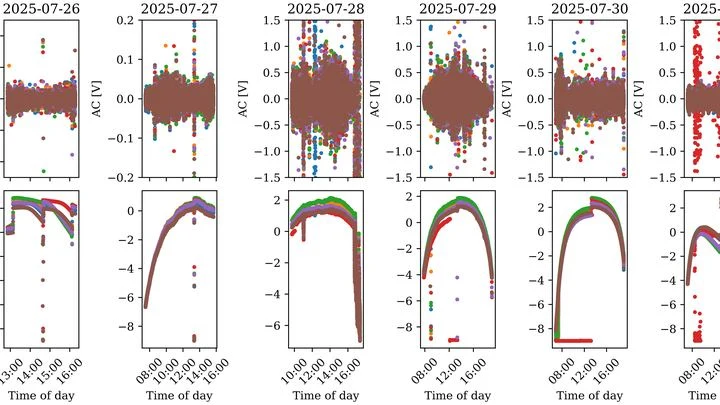
A solar panel on a roof produces little current in the morning, a lot at noon, and stays silent at night. Wind doesn't blow randomly either: it's often stronger in the morning and evening than during the day. Energy providers need to know in advance how much energy will be available in an hour or three, so they can switch on backup plants or store electricity in batteries in time.
The Sun constantly emits a stream of charged particles — the solar wind. Among them are many electrons, some of which fly back toward the Sun. But observations show that fewer electrons return than expected.
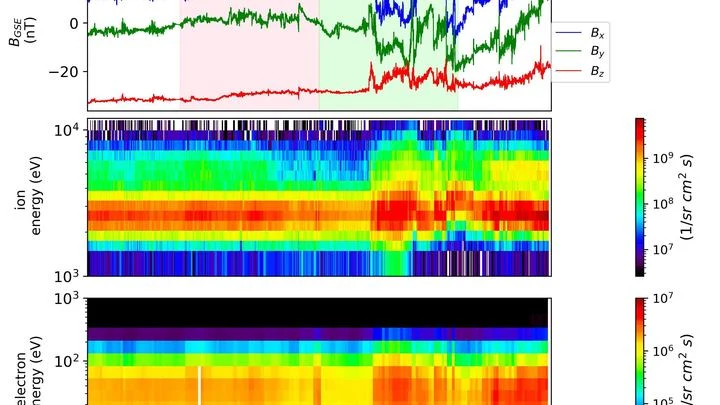
October 10, 2024. The Sun hurled a cloud of magnetized plasma toward Earth, and four spacecraft, stationed at a single point between the Sun and Earth, simultaneously recorded how that cloud churned. The distance between the outermost probes was just 80 Earth radii, about half a million kilometers.
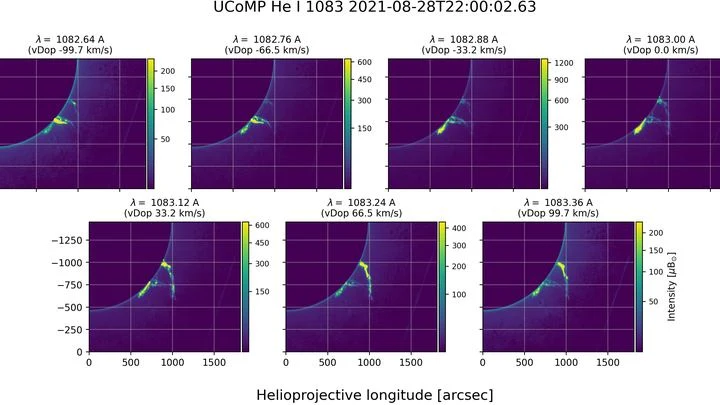
The Sun occasionally hurls enormous clouds of plasma into space — coronal mass ejections. Often tangled within these clouds are prominences: cooler, denser clumps of material. These contain plenty of neutral atoms that shine brightly in specific spectral lines.
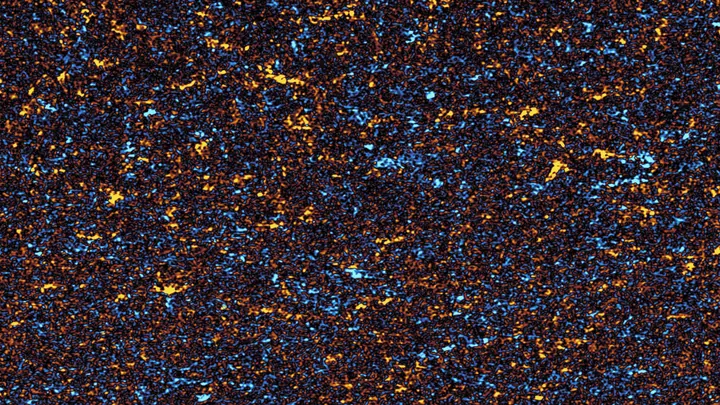
A solar flare is like thunder on a clear day: a short but powerful burst of energy. The MeerKAT radio telescope in South Africa caught one such M1.3-class flare and examined it with unprecedented clarity. Ordinary instruments see either bright details or faint ones, but not both at once.
A star trembles like a bell after being struck. These tremors, tiny fluctuations in brightness and surface, can be caught by a telescope. From the frequencies of these 'stellar notes,' astronomers infer what's happening inside: how old the star is, how it's structured.
In 1992, Hurricane Andrew tore through Florida, leaving insurers with $$15.5 billion in losses. Many companies went bankrupt, and the market devised a way to shift disaster risk onto investors: catastrophe bonds. These securities pay generous coupons as long as a specified disaster does not occur, such as a hurricane of a certain strength or an earthquake in a particular region.
The Sun is not just a ball — it's a magnetic mansion. Its invisible force lines, like electrical wiring, thread through space and control space weather. But until now, we've only seen this wiring from the landing — the plane of Earth's orbit. The attic and basement, the magnetic poles, remained a mystery.
Imagine an orchestra playing without a conductor. Each section takes its turn: first the winds introduce the theme, then the strings join in, and sometimes an unexpected percussionist solos.
A meteorologist looks at a map where clouds gather in flocks, like birds before a storm. Each spot on the radar could be a future downpour or just noise. Earth system forecasting is like trying to assemble a puzzle with thousands of pieces that keep changing shape.
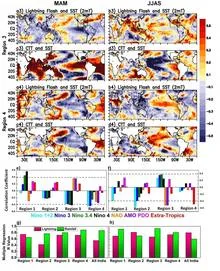
Every year, lightning kills thousands of people, especially in the tropics, where thunderstorms are most intense. In India, the share of lightning deaths among all victims of natural disasters is rising, despite an overall decline in fatalities from cyclones and floods. One might think that lightning is too fast and too local to predict months ahead.
Two people are talking at once, and by the loudness of their voices you can't tell who is answering whom. That's how climatologists have for decades searched for a link between warm water off the coast of Peru and droughts in Australia: they compared how synchronously ocean temperature and rainfall change in different parts of the planet.
A translator who learned a language from thousands of books can interpret a conversation without being distracted by noise in the hall. Similarly, a neural network trained on 127,137 years of model climate produces a winter forecast in a fraction of a second, faster and more accurately than bulky dynamical systems.
Over the Pacific Ocean, giant seesaws swing back and forth. Warm water pushes against the coasts of South America, and El Niño begins; a few years later, the ocean surface cools, and the seesaw tips the other way, into La Niña. These oscillations last for years and reshape cloud cover, rainfall, and wind across an entire continent.
A farmer in Iowa looks at the calendar: plant now or wait? In a month, a heat wave might strike, or rain might set in. Forecasters throw up their hands: the two-week forecast still holds, the seasonal one is out of reach, and in between lies a gap. The atmosphere changes too quickly to remember yesterday, and the ocean is too slow to come to the rescue.
Every June, the sky over India fills with moisture, and how much falls determines rice harvests, water reserves, and food prices for a billion people. But predicting the monsoon's strength in advance was like guessing someone's mood from a single photo: too many hidden springs.
The Indian summer monsoon feeds a fifth of humanity, but its seasonal forecast has been considered nearly hopeless for decades: the potential predictability limit was estimated at only 45% of explained variability.
An orchestra falls out of tune before a storm, then plays in unison again. In the equatorial Pacific, within a rectangle stretching from 5°S to 5°N and from 120°W to 170°W, water temperatures usually change in concert, like musicians playing the same part. This area is called the Niño 3.4 region.
Picture a map of China with sparse green patches scattered across a yellow desert. Those patches are where the GloSea5 climate model can genuinely look three months ahead, while the desert is everything else, where its forecasts are no better than a coin toss.