The Galaxy That Forgot How to Make Stars express
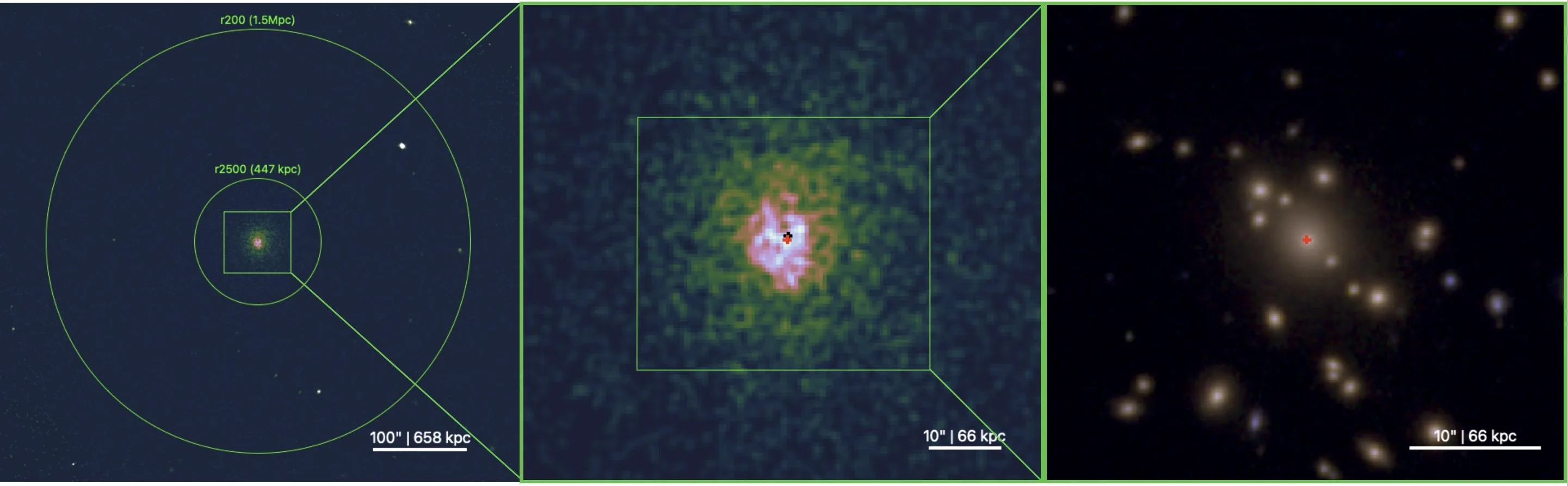
At the center of a vast city of galaxies hangs a thick cloud of gas. It has cooled to the point where, by all the rules, it should be collapsing into new stars, like steam turning to droplets on a cold window. But the window stays dry. Astronomers aimed the Chandra X-ray telescope at this cloud and watched it for nearly three straight days.
The cluster is named SPT J0417 and lies so far away that its light has taken more than seven billion years to reach us. The gas at its core is dense: each cubic centimeter holds about one-tenth of an atom. That's like a single speck of dust floating in a kitchen-sized room, but for space, it's thick. The gas temperature is about thirty million degrees, and it is slowly cooling. Every five hundred million years, the gas loses half its heat. For a star, that's a blink; for a galaxy cluster, it's an entire era.
And yet, no stars are born. Telescopes in Chile and Australia see not a single newborn sun. Spectra show that the last stars ignited here when the universe was half its current age. Since then — silence. Something is preventing the cloud from collapsing. It seems there's an invisible heater at the cluster's center: a black hole that pumps energy into the surrounding gas. It won't let the gas cool completely, so the stellar fuel remains just a hot fog.
Thus SPT J0417 has become an example of how a black hole can 'switch off' an entire galaxy. The gas that could have become billions of suns just hangs there in weightlessness — cooled, dense, but barren.
The gas at the center of SPT J0417 has been cooling for three billion years, yet not a single star has been born in that time, the black hole acts like a cosmic space heater.
In 'Star Wars,' the Death Star destroyed planets, but here a black hole at a galaxy's center quietly snuffs out star formation — silent and subtle.