Galaxy clusters are gravitationally bound systems containing hundreds to thousands of galaxies. They are immersed in a vast halo of hot plasma with a temperature of 10–100 million degrees, emitting in the X-ray range. Approximately 85% of the total mass is dark matter, 10–12% is hot gas, and only a few percent are stars. Clusters form at the nodes of the cosmic web—the large-scale structure of matter distribution in the Universe.
History
The Coma cluster was catalogued by Charles Messier in 1781 as a nebulous object. In 1933, Fritz Zwicky, applying the virial theorem to the velocity dispersion of galaxies in this cluster, showed that the dynamical mass far exceeds the visible mass and proposed the term 'dark matter'. In the 1970s, X-ray satellites (Uhuru, Einstein) discovered the hot intergalactic gas, which became an important tool for studying clusters. By the 1980s, it was clear that the baryonic component (stars and gas) is only a fraction of the total mass, with dark matter dominating. Vera Rubin earlier confirmed the need for dark matter on galactic scales.
How it works
The cluster is held together by gravity, described by Newton's law of universal gravitation and Einstein's general relativity. The velocity dispersion of galaxies (about 800 km/s) and the temperature of hot gas measure the depth of the gravitational potential: kinetic energy of gas particles ~ kT is comparable to potential, kT ~ μ m_p σ², where μ is the mean molecular mass, m_p the proton mass. The gas radiates via bremsstrahlung and spectral lines of highly ionized ions (e.g., iron Fe XXV–XXVI), allowing determination of temperature and chemical composition. Gravitational lensing of background galaxies provides an independent method to map the mass distribution. Cosmological simulations (Illustris, Millennium) within the cold dark matter model (ΛCDM) reproduce cluster formation.
In practice
Studying clusters helps to 'weigh' invisible dark matter, test theories of gravity, and understand how the large-scale structure of the cosmos formed.
Fun fact
The galaxy cluster El Gordo (ACT-CL J0102-4915) is the most massive known, with a mass exceeding 3 quadrillion solar masses.
At night in fog, a searchlight works worse than in daylight: tiny droplets scatter the beam, and distant objects drown in the murky haze. Much the same way, radio waves from pulsars get lost in the interstellar medium when there are many free electrons between us and the star.
A resident of a bustling city center one day packs a suitcase and moves to a quiet suburb. The same happens to galactic clusters, except instead of a suitcase, they have stars, and instead of a move, they have billions of years of drifting across the disk.
Berkeley 36 is an open cluster, that is, a group of stars born together from a single cloud.
A census by body shape: that's one way to describe what astronomers did with 6348 massive galaxies. Instead of height and weight, they measured how concentrated the light is toward the center, how flattened the galaxy is, and how asymmetric its shape is. Then they ran the same measurements on galaxies from three computer models of the universe and compared the results.
In the stellar family of the Phoenix galaxy, there are five old globular clusters, and the sixth child was long considered a foundling. The object Fornax 6, located just 270 parsecs from the galaxy's center, looked like a random clump of field stars or a compact group of distant galaxies. Astronomers argued over whether it deserved to be called a cluster.
The night forest is full of fireflies, but before, we only saw those that happened to be in the beam of a flashlight. That was the case with ultraluminous X-ray sources: points in other galaxies that shine in X-rays more brightly than a stellar-mass black hole can steadily emit. Telescopes looked at galaxies chosen for other purposes, missing most of the fireflies.
An old city gains new suburbs. In the center, narrow streets where life has nearly stopped, while on the outskirts construction is booming. That is what a spiral galaxy looks like when its core stars have long aged and new stars are still being born in the outer disk.
Around every galaxy lies an invisible corona of cold gas. It extends far beyond the stellar disk and serves both as a fuel depot for new stars and as a graveyard for ejected material.
In a distant galaxy, light from hot gas should reveal its composition. The James Webb Telescope split that light into a spectrum, and astronomers saw: oxygen lines too weak.
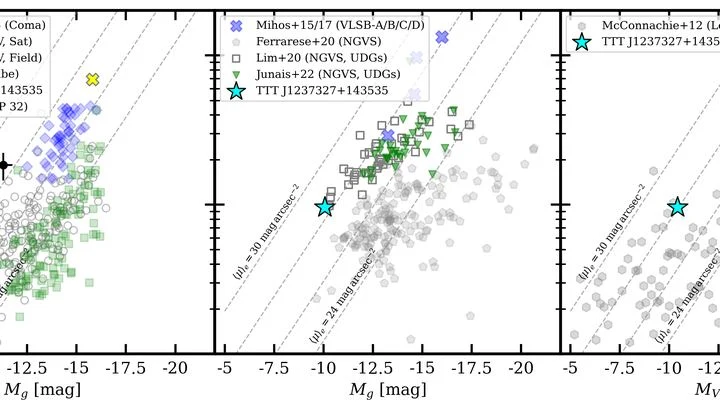
The night sky only looks black: telescopes reveal millions of galaxies, but some are so dim they blend into the background. Astronomers caught just such a "nearly invisible" one by chance while observing the Virgo Cluster with the two-meter telescope at Teide Observatory.
The galaxy is named TTT J1237327+143535.
Faint galaxies scattered across the Perseus cluster are like ghosts among their bright neighbors. They are so diffuse that distant objects shine through them, and they contain hundreds of times fewer stars than our Milky Way.
Light from a distant galaxy reaches us through its own dust. This dust is not a smooth haze but ragged clouds, like wisps of cotton. Old models treated it as a uniform mist, and then the galaxy didn't add up energetically: too much light disappeared in the ultraviolet and too little came back in the infrared.
Astronomers did what a cook does when they dice a potato instead of tossing it in whole.
The night sky looks black, but if you remove the stars and accumulate light for a long time, a faint glow emerges — the summed light of all galaxies born over 13.8 billion years. Astronomers call it the extragalactic background light.
The night sky looks black, but if you remove the stars and accumulate light for a long time, a faint glow emerges — the summed light of all galaxies born over 13.8 billion years. Astronomers call it the extragalactic background light.
The night sky looks smooth, but it's actually clumpy — vast communities of galaxies that bend light from distant objects like lenses. When a short, powerful radio burst goes off somewhere in the universe, its path to an Earth telescope can pass near such a clump.
The night sky looks smooth, but it's actually clumpy — vast communities of galaxies that bend light from distant objects like lenses. When a short, powerful radio burst goes off somewhere in the universe, its path to an Earth telescope can pass near such a clump.
An accountant tallies up all the factories, warehouses, and shops, but the balance doesn't add up — half the inventory seems to have evaporated. That's roughly how astronomers have spent decades searching for ordinary matter in the present-day Universe.
The Andromeda galaxy is our nearest large neighbor, and like the Milky Way, it has an invisible gaseous shroud. This shroud of extremely hot, rarefied gas extends for hundreds of thousands of light-years. Seeing it directly is nearly impossible — the gas is too faint.
In the first moments after the Big Bang, matter and antimatter should have been created in equal amounts. But today, everything around us is ordinary matter, and antimatter is almost nowhere to be found. Where did it all go? The standard answer: a tiny imbalance in favor of matter wiped out almost all antimatter.
A galaxy is like a city: bright lights and dense buildings at the center, sparse lights and emptiness toward the outskirts. But if you watch how gas rotates in a galaxy's disk, you see that its speed barely drops at the edges. As if invisible neighborhoods keep the motion going. Astronomers have found a way to map this invisible city.
A radio telescope, like a sensitive ear, picks up the whispers of distant galaxies. Hidden among that noise are giants — giant radio sources. These are clouds of charged particles ejected from the vicinity of supermassive black holes.
The hot gas in galaxy clusters shines in X-rays, and a significant portion of that light comes from iron atoms that have lost many electrons. These atoms leave characteristic bright lines in the spectrum, like fingerprints. Astronomers use them to determine the temperature, density, and motion of the gas.
A red giant in a globular cluster is a star in retirement. It has burned up the hydrogen in its core and now lives off fusion in a thin shell around a helium ash core.
The night sky looks like a random scattering of stars. But zoom out to enormous distances, and the chaos disappears. Galaxies gather into long filaments and flat walls, with colossal voids gaping between them — cosmic voids. This structure is called the cosmic web.
A translator gets distracted by every rustle in the hall, and a one-hour meeting stretches into two. A single wrong intonation changes the meaning beyond recognition. That's roughly how a particle with spin 3/2—the gravitino — behaves. It cannot exist in isolation: its "speech" must be perfectly coordinated with its surroundings, or the whole structure falls apart.
A globular cluster, a dense swarm of hundreds of thousands of stars, plows through a galaxy like a bullet through water. In ordinary dark matter (the invisible mass that holds galaxies together), it should quickly lose speed due to dynamical friction.
Galaxy NGC 4254 lies 1.5 million light-years from the center of the Virgo cluster. It drags a long stream of cooling hydrogen — a sign that it's plowing headlong into the hot gas. Losing cold fuel quenches the birth of new stars.
In the spiral galaxy Fireworks Galaxy — 6410 stellar nurseries. That's how many regions where massive stars are being born right now were identified by an algorithm on old ultraviolet radiation images from the Edwin Hubble. These aren't just blobs in a picture — each has a clear boundary, like a country on a contour map.
The universe is like a vast invisible scaffold. We don't see it directly, but we know it's there: galaxies and clusters hold together thanks to it. This scaffold is dark matter. The most popular version says it is "cold," made of heavy, slow-moving particles.
Galaxy NGC 4254 lies 1.5 million light-years from the center of the Virgo cluster. It drags a long stream of cooling hydrogen — a sign that it's plowing headlong into the hot gas. Losing cold fuel quenches the birth of new stars.
In the spiral galaxy Fireworks Galaxy — 6410 stellar nurseries. That's how many regions where massive stars are being born right now were identified by an algorithm on old ultraviolet radiation images from the Edwin Hubble. These aren't just blobs in a picture — each has a clear boundary, like a country on a contour map.
In 1,433 pairs of galaxies scattered across the sky, astronomers noticed an unusual pattern. Neighbors located 'above' or 'below' a massive stellar system contain up to a quarter more oxygen than those lying in the plane of its disk.
In the galaxy NGC 1052 DF2, stars move at only 8 kilometers per second, as if there were no invisible mass around. For comparison: in our Milky Way, outlying stars accelerate to 200 kilometers per second, held by a massive dark matter halo.
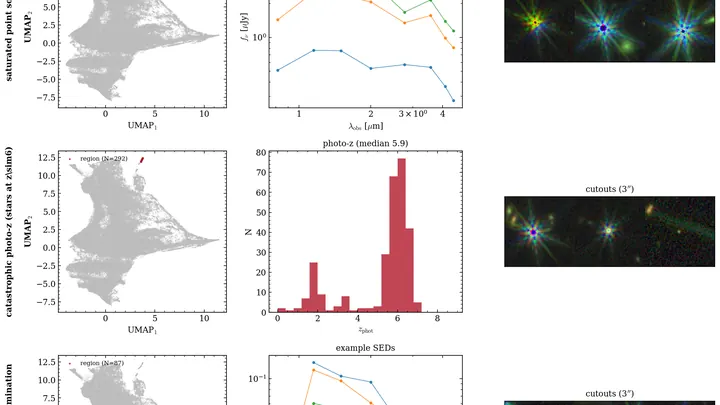
Two hundred forty-two thousand three hundred twenty-seven galaxies — like grains of sand on a beach. But astronomers turned this chaos into a map: the UMAP algorithm (a machine learning method) took from each galaxy eleven parameters — seven colors from optical to mid-infrared (that's photometry), magnitude…
The temperature at the center of a galaxy cluster reaches a hundred million degrees. These largest gravitationally bound systems are natural laboratories where nature hides 85% of its mass in invisible dark matter.
The cosmos resembles silk fabric with threads of the dark web showing through. We only glimpse tiny swatches of the real tapestry — through telescopes, in actual galaxy catalogs. To separate the fundamental signal from astrophysical noise in the cosmic pattern, statistical analysis demands thousands of plausible sketches — synthetic sky maps.
The JWST spectrograph caught a barely perceptible dip in the spectrum of a distant galaxy — two lines, like shadows cast by cold gas. These are the sodium lines, the very yellow light of streetlamps. Here, at the edge of the visible Universe, they betray the slow exhalation of a galaxy returning matter to space.
The temperature at the center of a galaxy cluster reaches a hundred million degrees. These largest gravitationally bound systems are natural laboratories where nature hides 85% of its mass in invisible dark matter.
Two cities endure a series of fires. In one, the wind carries ash far beyond the outskirts, leaving the sky clear. In the other, ash settles as a dense veil, painting sunsets crimson. Roughly the same thing, just on a galactic scale, happens with supernova explosions, the final flares of massive stars.
A galactic disk is like a frozen ripple on water: every disturbance leaves a trace that can be read billions of years later. When a dwarf satellite galaxy flies past or a head-on merger occurs, stars in the disk start to oscillate, like bobbers rocked by a wave.
At the centers of many galaxies, not only supermassive black holes lurk, but also vast clouds of invisible matter. If this matter consists of ultralight particles, it can gather into dense clumps — a kind of 'star' made of dark matter.