Spectra refer to the distribution of electromagnetic radiation (such as light) emitted, absorbed, or scattered by matter, as a function of wavelength or frequency. Each element and molecule has a unique spectral fingerprint, like a barcode, that reveals its composition, temperature, density, and motion. Spectra are the primary tool astronomers use to understand the universe, from the composition of distant stars to the expansion of galaxies.
History
The foundation of spectroscopy was laid in the 19th century by Joseph von Fraunhofer, who mapped dark lines in the solar spectrum, and later by Gustav Kirchhoff and Robert Bunsen, who established that each element has a unique spectral signature. The quantum mechanical explanation of spectral lines was developed by Niels Bohr in 1913.
How it works
When atoms or molecules absorb or emit energy, they do so at specific wavelengths corresponding to transitions between quantized energy levels. The resulting spectrum consists of discrete lines (emission or absorption lines) or continuous bands, depending on the material and conditions. By analyzing the positions, intensities, and widths of these lines, scientists can deduce the chemical composition, temperature, pressure, and velocity (via the Doppler effect) of the source.
In practice
Spectra are used in astronomy to determine the chemical composition of stars and exoplanets, in chemistry for material analysis, and in medicine for non-invasive diagnostics such as pulse oximetry.
Fun fact
The element helium was discovered in 1868 in the spectrum of the Sun's corona before it was ever found on Earth — its name comes from the Greek word 'helios', meaning sun.
Light born when a fast electron enters a material is usually assumed to be the same in all directions. But in crystals where optical properties depend on direction, that's not the case. Run your hand over velvet: one way it's smooth and shiny, the other — dark and rough. Similarly, a crystal responds differently to light depending on how it's oriented.
The night sky looks calm, but in reality, invisible particles, cosmic rays, are constantly flying through us. Among them are electrons and their antimatter counterparts, positrons. When they collide with detectors on satellites or balloons, the instruments record their energy.
When two black holes merge, ripples spread across the fabric of spacetime — gravitational waves. But what if one of them isn't a run-of-the-mill black hole but something else — an exotic compact object?
2,41 hours. That's exactly how long a day lasts on SIMP 0136 — a lonely planet-like object 6,1 parsecs away. That's twice as far as Proxima Centauri. Its mass ranges from 12,7 to 17,8 Jupiter masses, placing it on the boundary between planet and star.
For decades, the search for extraterrestrial intelligence has waited for quiet, coherent signals from space — a kind of 'whistle' in the radio silence. However, our own technosphere has created a continuous radio background — the hum of a vast metropolis, emitted by all communications, radars, and broadcasting stations.
A squad of soldiers marches across a parade ground. As long as everyone keeps in step, the movement remains sharp and coordinated. But if someone falls out of line, the order is lost. In the microworld, electrons play the role of such a squad: when their oscillations are synchronized, the substance emits a narrow, sharp line.
Gravitational wave detectors work like sensitive microphones, picking up the trembling of space from distant cosmic catastrophes. When two black holes merge into one, the newborn object rings like a bell, and that ringing is a unique 'voice' of gravity.
Hot massive stars are the kitchens of the Universe, where heavy elements are cooked up. They end their lives in supernova explosions. To understand their recipe, astronomers use spectroscopy — the analysis of the rainbow band of light passed through a prism. Previously, deciphering such a 'menu' took hours.
An ordinary comb parts hair into even strands. A laser 'comb' does the same to light: it emits not one color but thousands, spaced at exactly equal frequency steps. Such a tool has already helped measure time to billionths of a second and peer inside atoms.
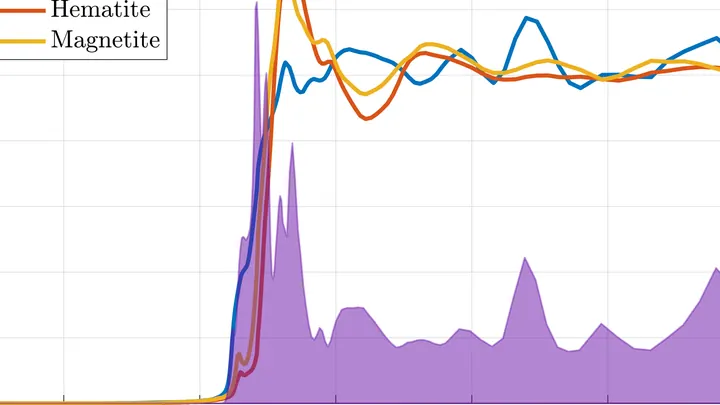
A chemical map of a sample is like a mosaic: each point has its own color, its own chemical composition. To assemble such a mosaic, a spectromicroscope scans the sample point by point, recording a spectrum at each location — a "fingerprint" of how the material absorbs or emits light.
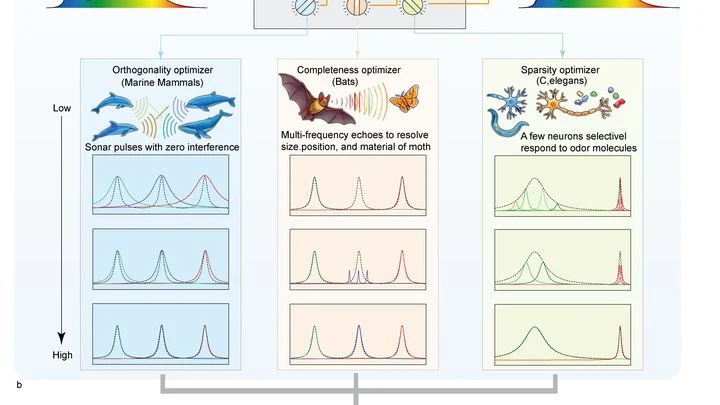
A conventional spectrometer is like a comb that untangles light and sorts it by wavelength. But a comb is rigid: one type of light needs one comb, another needs a different one. The new device works differently. It asks light a series of questions, changing its shape each time to glean more meaning from the answers.
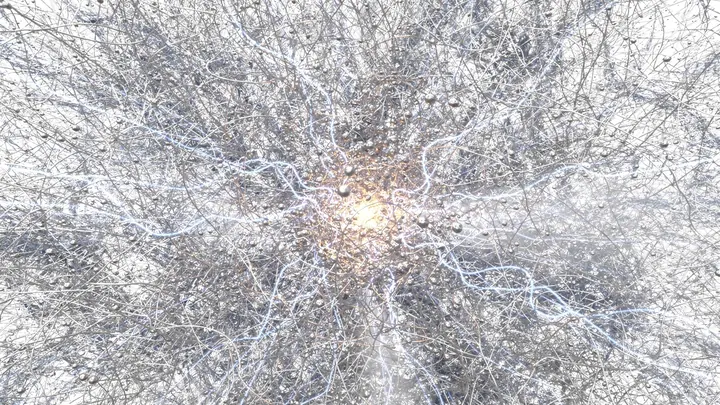
At night over the Siberian taiga, a faint blue light sometimes flickers. It's not the aurora borealis but a cosmic-ray shower: a single particle from deep space slams into the atmosphere and shatters into millions of secondary particles. They race toward the ground in a broad front, like a ripple from a stone dropped into water, and make the air glow.