Tokamak with Inverted Geometry express
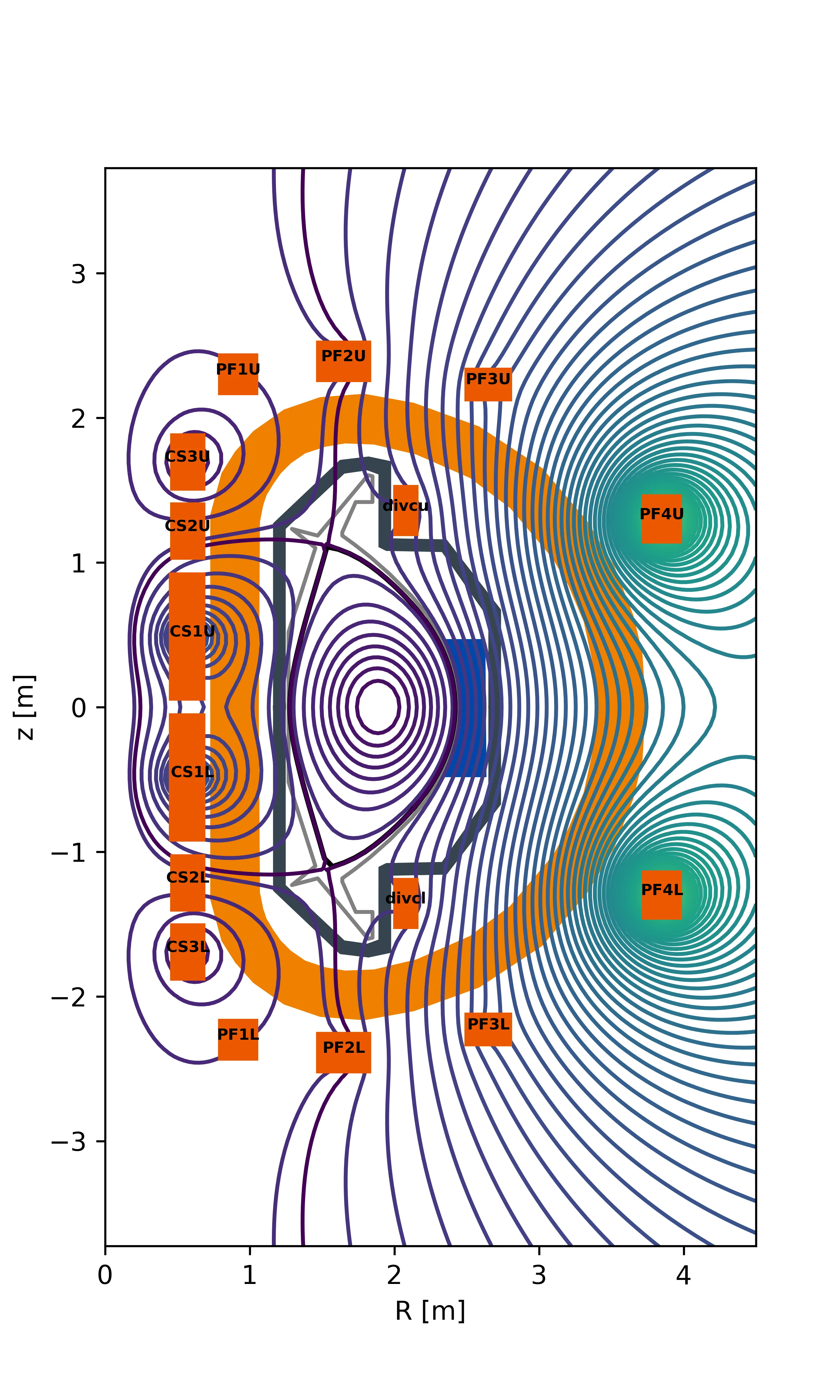
A soup pot is usually round, and a frying pan is flat. The shape of the cookware determines how the boiling water sloshes around. In a tokamak, a device where superheated gas is confined by magnetic fields, the shape of the plasma is also chosen deliberately. Typically, the cross-section of the plasma column resembles the letter D: the straight side faces outward. This is called positive triangularity. But you can turn the D inside out, and get negative triangularity. This shape promises fewer energy bursts onto the walls, but so far it has only been tested in small machines.
The authors of the study took the design of the compact high-field reactor SPARC and asked: what if we ignite plasma with negative triangularity in it? They sifted through hundreds of shape variations, tweaking elongation and curvature, and found a working regime at a lower magnetic field—8 tesla instead of 12. The plasma turned out to be as stable as a chair on four legs, but cramped: the volume dropped by 43% because the chamber walls were designed for the usual D-shape. One of the coils that squeezes the plasma from below would need to carry 5.5 times more current than originally planned.
Why bother with an awkward shape? In experiments on small tokamaks, plasma with negative triangularity behaved more calmly: no sudden disruptions and less contamination. SPARC, even in a reduced mode, will provide conditions close to a real reactor. If the advantages hold up: this could change the designs of future power plants.
For now, the calculations show that the bridge between a laboratory toy and an industrial giant can be built. The pot is awkward, but the soup in it cooks just fine.
Negative triangularity plasma resembles the shape of an hourglass: the top and bottom are wide, and the middle is pinched. This geometry naturally occurs in some astrophysical objects, such as planetary magnetospheres.
In Dan Simmons' novel 'The Fall of Hyperion', future fusion reactors use complex magnetic fields to confine plasma — an idea that resonates with the search for optimal geometry in tokamaks.