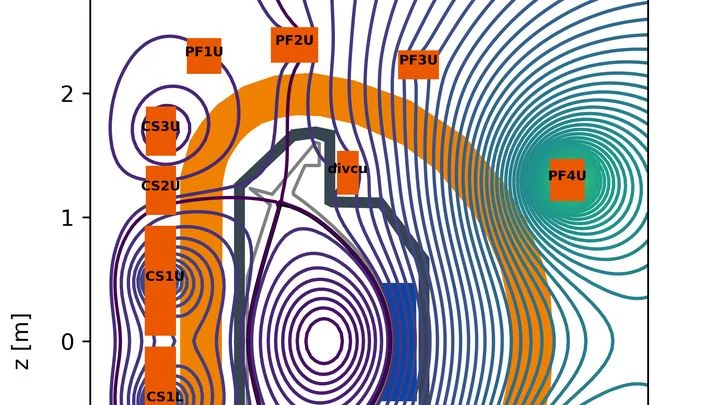
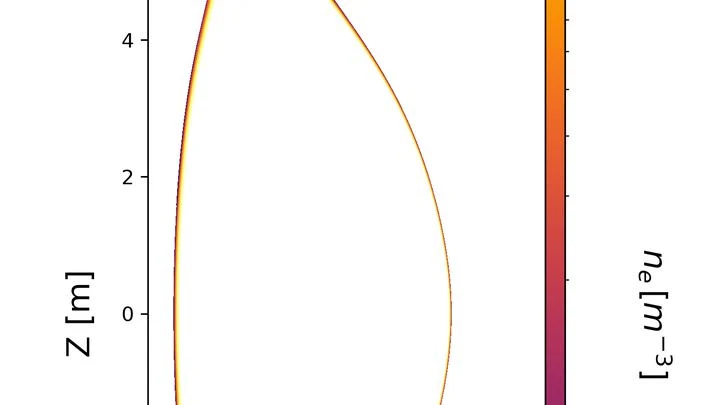
Plasma confinement is the challenge of holding a hot, ionized gas—plasma—in a controlled volume long enough for nuclear fusion to occur, without letting it touch the walls of the reactor. In a fusion device like a tokamak, the plasma must be heated to over 100 million degrees Celsius, a temperature at which any physical container would vaporize. The solution is to use magnetic fields, which exert forces on the charged particles in the plasma, guiding them along field lines and keeping them away from the material walls.
History
The idea of magnetic confinement dates back to the 1950s, with the invention of the tokamak by Igor Tamm and Andrei Sakharov in the Soviet Union. The first tokamak, T-1, was built in 1958, and the concept has dominated fusion research since.
How it works
The most common approach is magnetic confinement, where a toroidal (doughnut-shaped) magnetic field traps the plasma in a closed loop. The field lines are twisted to prevent particles from drifting outward, creating a stable 'magnetic cage'. However, plasma is turbulent, and instabilities can cause it to leak out or touch the walls, so researchers study turbulence and use techniques like shaping the magnetic field or adding external control systems to maintain confinement. Another method, inertial confinement, uses lasers to compress a fuel pellet so rapidly that fusion occurs before the plasma can expand.
In practice
Plasma confinement is the core technology for developing fusion power reactors, such as ITER, which aim to produce clean, abundant energy. It is also used in plasma processing for semiconductor manufacturing and in experimental astrophysics to study space plasmas.
Fun fact
The word 'tokamak' is a Russian acronym for 'toroidal chamber with magnetic coils', and the first working device was so small it fit on a tabletop.
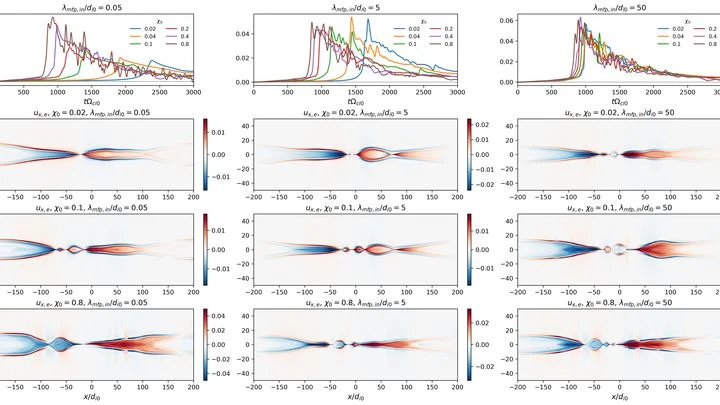
Inside a solar flare, magnetic field lines snap like stretched rubber bands and reconnect — releasing in minutes enough energy to power humanity for millions of years. In the lab, this process, magnetic reconnection, could long be triggered but not stopped. Now physicists have a switch.
A fusion reactor is like a super-hot furnace where plasma reaches millions of degrees. The walls are made of tungsten, the most refractory metal there is. But even tungsten needs protection: fast particles from the plasma bombard the surface and knock atoms loose. These ejected atoms enter the plasma and cool it down, like a spoonful of cold milk in hot tea.
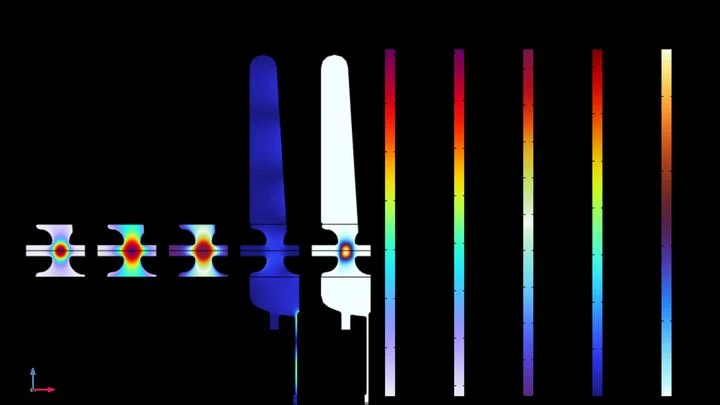
Microwave plasma in a vortex is like a kitchen mixer that simultaneously heats and stirs the gas. In the reactor, the gas is swirled, and microwaves heat it to thousands of degrees, tearing carbon dioxide molecules apart. Scientists created a computer model of such a reactor to understand how pressure affects the process.
In a pot of boiling soup, light fat droplets rise to the top, while heavy vegetable chunks sink to the bottom. Particles in the tenuous hot gas around the Sun and other stars behave much the same way — except instead of broth, there's a mixture of charged particles: electrons, protons, and alpha particles.
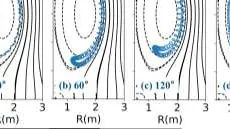
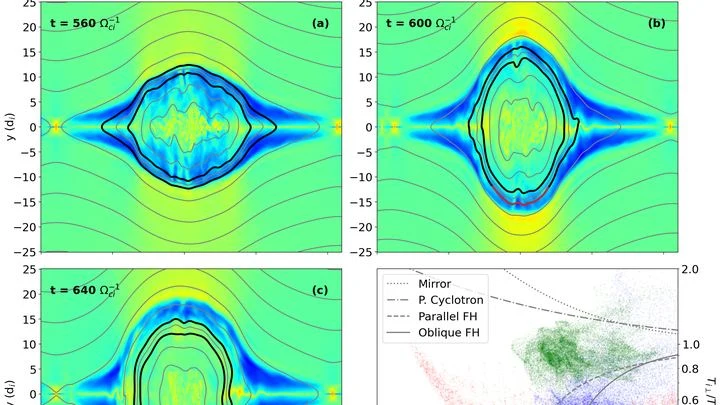
A magnetic mirror is a tube open at both ends. The magnetic field inside is arranged so that hot plasma doesn't leak out: at the ends, the field lines bunch up like a cork in a bottle. Plasma particles flying toward the exit are repelled by these "corks" and bounce back. But some still escape: that's the classic "loss cone" argument.
The race for fusion energy is like trying to bottle a lightning bolt. For decades, physicists have struggled to recreate on Earth the processes that power the Sun. The main challenge is getting light nuclei to fuse despite their mutual repulsion, while extracting more energy than was spent heating and confining the plasma.
Hot tea cools down, and ice cream melts — heat always flows from warm to cold, and this law seemed unbreakable. But in the quantum world, even familiar rules can be rewritten. Physicists placed a tiny mechanical resonator (a vibrating bridge the size of a microbe) in an optical cavity between two mirrors.
The Sun is a giant cauldron where light struggles through a thick layer of scorching matter. On its way out, photons (light particles) constantly bump into atoms and lose energy. How strongly matter holds back light is called "opacity," and it determines how quickly heat escapes.
Iron is one of the main culprits for opacity in the Sun's interior.
In a world locked in a crystal lattice and cooled nearly to absolute zero, matter knows how to hide its deepest secrets. A quantum spin liquid is a state where electron spins never freeze, even at zero temperature, remaining in an eternally flickering superposition.
Inside a fusion reactor, plasma rages — a gas heated to millions of degrees. There are no direct windows, and cameras and sensors quickly fail. Engineers see only fragments of information: a few sensors at scattered points. It's like trying to grasp a symphony from the sound of three microphones in a vast hall.
Water boils in a pot: bubbles churn, heat quickly escapes into the air. In the center of the ARC fusion reactor, plasma behaves similarly — except instead of bubbles, there are turbulent eddies, and instead of air, there's a magnetic field that must hold the heat.
On a sound mixing console, there are hundreds of volume knobs, and each one affects its neighbors. Turn one, and the whole picture changes, but you can only check the result by listening to the entire chord, which takes hours. Designing a laser pulse for inertial confinement fusion is much the same.
Imagine a powerful hair dryer that blows not warm air but white-hot plasma, such devices are called plasma wind tunnels. They are used to test on Earth how a spacecraft will enter the atmosphere.
Quantum laws reign supreme in the microworld, but macroscopic objects usually behave classically: the thermal motion of atoms drowns out quantum effects.
If you stick two identical thermometers into a pot of hot water, they'll both read the same, and we relax, thinking the temperature is measured correctly. But in a rarefied gas heated to millions of degrees, this trick stops working.
A clap of the hands compresses the air, and it flies outward — the simplest shock. In space, exploding stars play the role of hands: their shock waves sharply compress gas and trigger chaotic mixing — turbulence.
In a pot of boiling soup, tiny droplets of fat occasionally flare up — a hundred times hotter than the broth. That's roughly how future fusion plasma works: the bulk of ions heats to hundreds of millions of degrees, while a small admixture of "fast" particles (born from nuclear fusion) is accelerated even further.
Physicists are trying to hear a whisper in a noisy room. They build a soundproof booth, but even inside, their own breathing and heartbeat create interference. That's roughly how the search for quantum gravity goes: they want to see gravity bind two particles into a single whole — entangle them.
A stream of electrons enters plasma like a jet of water hitting a calm pond. The jet disturbs the surface, giving rise to waves that grow quickly and mix the water. In plasma, this process is called the Buneman instability: the electron beam excites oscillations that then scatter its energy.
A stream of scorching gas races away from a star, and suddenly stalls, as if it hit an invisible wall. That's exactly what researchers saw when they tried to reproduce a stellar eruption on a laboratory scale. They used a laser to create a plasma jet and shot it through a magnetic field — first weak, then strong, like that of many stars.
A doughnut-shaped magnetic trap holds plasma made of boron and hydrogen. Inside, the temperature rises above one hundred million degrees — hotter than the center of the Sun. At such heat, nuclei collide and fuse, releasing energy.
Water in a cup cools down in minutes. Gas in a room spreads evenly in seconds. But if you trap atoms in a tube as thin as a laser beam and give them a good kick, they will take several seconds to "cool" toward equilibrium — an eternity by atomic standards.
Space plasma is not a calm gas but a boiling soup of charged particles threaded with magnetic fields. These fields behave like stretched rubber bands: sometimes they snap and immediately reconnect, but in a different configuration. This process, called magnetic reconnection, releases enormous energy.
Inside large particle accelerators, there are hollow metal chambers where beams are accelerated. Over time, grime settles on their walls, like in an old pan. This grime prevents the accelerator from running at full power.
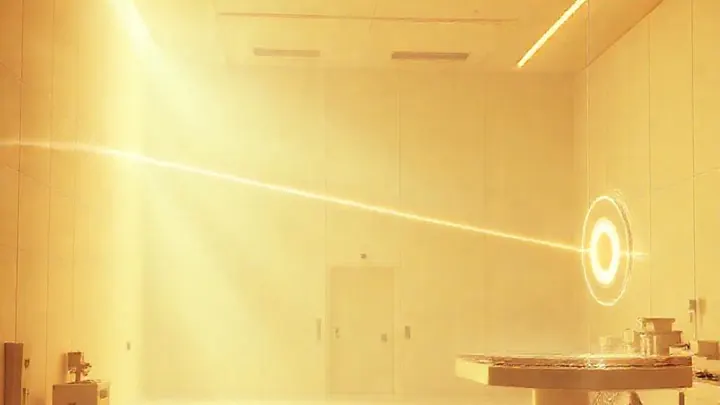
To restore the accelerator's strength, plasma, a glowing gas of argon or neon with a bit of oxygen, is sent into the chamber.
Hot plasma in a tokamak is like a temperamental beast: you need to hold it in, but not let it overheat. In the ASDEX Upgrade reactor, researchers found a regime where plasma eddies solve this problem on their own. Stochastic modeling showed that oscillations at the plasma edge fling out blobs, like bubbles from a boiling pot.
A soup pot is usually round, and a frying pan is flat. The shape of the cookware determines how the boiling water sloshes around. In a tokamak, a device where superheated gas is confined by magnetic fields, the shape of the plasma is also chosen deliberately.
In plasma where some atoms remain neutral, magnetic field lines can rearrange at different speeds. This is like two rubber bands that are initially stuck together, then suddenly snap apart and contract, releasing energy.
Before every tokamak startup, a device where superheated gas is held by magnetic fields, operators spend hours calculating how the plasma will behave. Mistakes are too costly: one wrong parameter can ruin the experiment.
Hot plasma is like a swarm of frantic fireflies darting around in a jar. Keeping it confined in an open magnetic trap is like trying to keep those fireflies from touching the glass. A new computer model shows how to do it more precisely.
Ions and electrons in plasma constantly collide, exchanging energy.
A fusion reactor is an attempt to hold a miniature sun in a magnetic cage. To get more energy out of it, you need to squeeze the plasma denser. But tokamaks have an invisible fence: once the density crosses a certain line, the plasma shudders and falls apart. This disruption is one of the main mysteries on the road to clean energy.
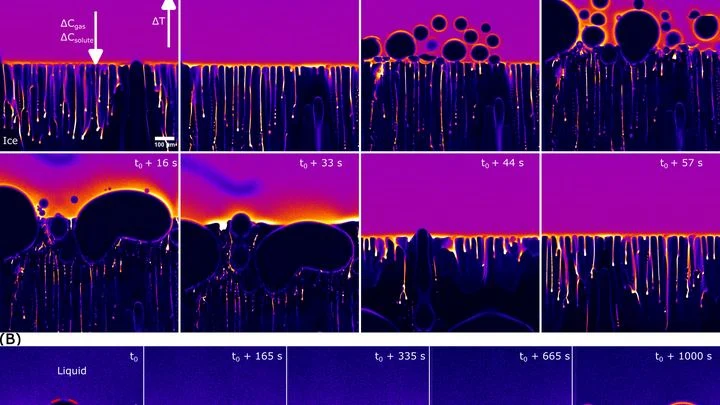
In a glass of soda, bubbles merrily rise to the top. But if you freeze the water, some bubbles end up trapped in the ice. How do they get there? After all, ice grows, pushing gas aside, but it doesn't always manage to.
Light from an ordinary lamp is chaos: photons scatter in all directions with no order. But if you make many atoms emit light simultaneously and in sync, you get a short, powerful flash, like applause that turns individual claps into a single burst. Such coordinated emission is called superradiance.
Igniting a miniature sun is a long-held dream of humanity. Typically, scientists try to confine scorching plasma (a gas of charged particles) at temperatures of hundreds of millions of degrees. But plasma tends to escape magnetic traps, and confinement comes at enormous cost.
Five charged calcium atoms hover in a trap, held by electric fields. Laser cooling saps their excess energy, and they line up into a tiny pyramid with a square base. But this pyramid doesn't stay put: every now and then it flips over, as if someone tosses it into the air and catches it upside down.
A fusion reactor resembles a giant boiler where hydrogen is 'cooked' into helium. The plasma inside is heated to 150 million degrees — ten times hotter than the Sun's core. But like any boiler, scale forms: harmful impurities that settle on the walls and quench the plasma.
Quantum entanglement is a fragile resource. Heat a system, and thermal fluctuations will tear the delicate threads of correlations: at a sufficiently high but finite temperature, the Gibbs state of a local Hamiltonian becomes separable, that is, representable as a probabilistic mixture of products of local states.
Six barium ions lined up in a flat hexagon inside a Paul trap, a device that holds charged particles with oscillating electric fields. But a slight change in the shape of the trapping potential made the crystal rearrange: one ion moved to the center, and the other five formed a ring around it.
A drop of ink in a glass of water quickly spreads, tinting the whole liquid. Similarly, electrons in a metal move freely, like molecules in a gas. But when a magnetic impurity, an atom with its own magnetic moment, enters this medium, something strange happens.