Invisible Solar Flares: How a Sunspot's Magnetic Field Trembles express
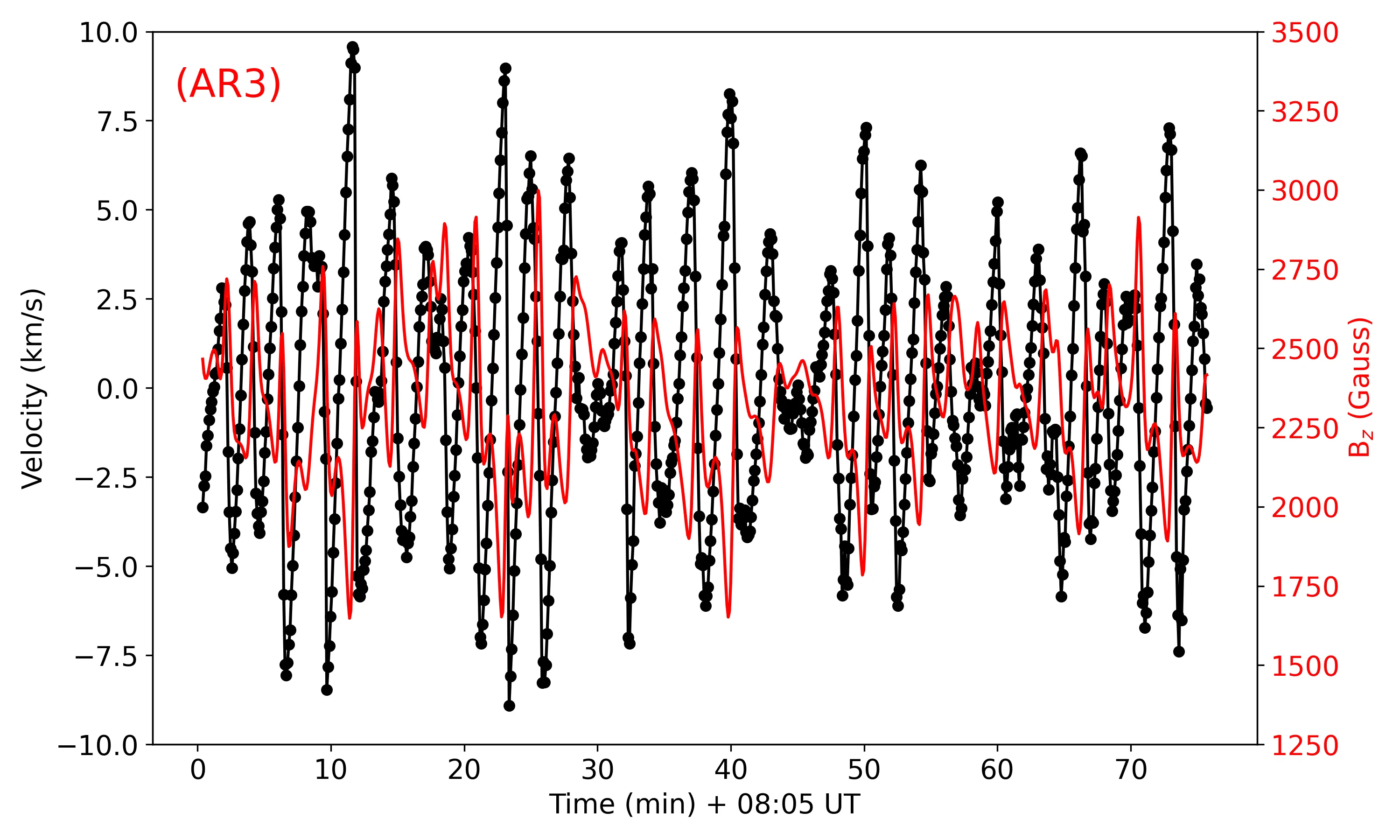
The Sun's surface is dotted with dark spots — regions of extremely strong magnetic fields that restrain the boiling of hot gas. From time to time, shock waves race through a spot's atmosphere, like a gust of wind compressing the air ahead of it. The gas briefly flares brightly, and astronomers call these events umbral flashes.
Scientists observed five different sunspots using the GREGOR telescope and the GRIS instrument. They measured how the gas moves and how the magnetic field changes at the moment of the flash. It turned out that in three spots the field sharply intensified upon impact, while in the other two it weakened. That seemed odd: why would the same wave act differently?
But there's another explanation. When a shock wave passes through gas, it may simply push the gas back and forth rapidly. Then the instrument sees not a change in the magnetic field, but merely a play of velocities. The researchers tested this idea: they allowed the model to assume the field stays constant while only the gas velocity changes. And the model matched the observations perfectly.
So the truth might be that the spot's magnetic field barely changes during a flash: it only appears to change because of the fast gas motion. But the first version, with strong field jumps, hasn't been ruled out either. Now new observations are needed to understand what really happens in the heart of a sunspot.
Original abstract
as written by the authors arXiv:2603.12213
Umbral flashes are manifestations of magnetoacoustic shocks in the solar chromosphere. These phenomena are thought to influence the evolution of chromospheric umbral magnetic fields. However, the impact of these shocks on inferred chromospheric magnetic field oscillations remains unclear. We examined five different sunspots located near the solar disk center, observed with the GRIS instrument installed at the GREGOR telescope. The HAZEL2 Spectropolarimetric inversion code is used to obtain the photospheric and chromospheric line-of-sight velocities and magnetic fields in Si 10827 {\AA} and He 10830 {\AA} spectral lines, respectively, using various inversion strategies. In the inversions with one chromospheric component, three of the sunspots exhibit remarkably stronger magnetic fields accompanying the shocks, while the other two sunspots show striking reductions in the magnetic field. Alternatively, the Stokes profiles can be reproduced by models with two chromospheric slabs, one on top of the other, through two-component inversions. These inversions provide excellent fits even when magnetic field fluctuations are discarded by imposing a constant magnetic field during the whole temporal series. In this scenario, the observed Stokes profiles are interpreted as the result of strong velocity gradients, where the He 10830 {\AA} line is sensitive to both sides of the shock front. Both competing models explaining the spectral profiles during the shocks, either large magnetic field fluctuations or velocity gradients, are critically discussed.
Shock waves in the Sun's atmosphere heat gas to tens of thousands of degrees — hotter than the Sun's surface itself.