The solar magnetic field is the Sun's large-scale magnetic structure, generated by the motion of conductive plasma in its interior. It governs solar activity, including sunspots, flares, and coronal mass ejections, and shapes the heliosphere—the bubble of solar wind that surrounds the solar system. The field's polarity reverses roughly every 11 years in a cycle tied to the solar dynamo, a self-sustaining process that converts kinetic energy of plasma flows into magnetic energy.
History
The cyclic nature of sunspots was discovered by Samuel Heinrich Schwabe in 1843, and the magnetic character of sunspots was established by George Ellery Hale in 1908. The modern dynamo theory was developed in the mid-20th century by Eugene Parker and others.
How it works
The solar dynamo operates through differential rotation (the equator spins faster than the poles) and turbulent convection in the outer layers. These motions stretch, twist, and amplify magnetic field lines, creating the observed patterns of sunspot pairs and the cyclic reversal of the poles. The field extends outward as the solar wind, carrying magnetic flux into interplanetary space and interacting with planetary magnetospheres.
In practice
Understanding the solar magnetic field is crucial for predicting space weather, which can disrupt satellites, power grids, and GPS systems.
Fun fact
The Sun's magnetic field is so strong that it can accelerate charged particles to near-light speeds, producing solar energetic particles that reach Earth in minutes.
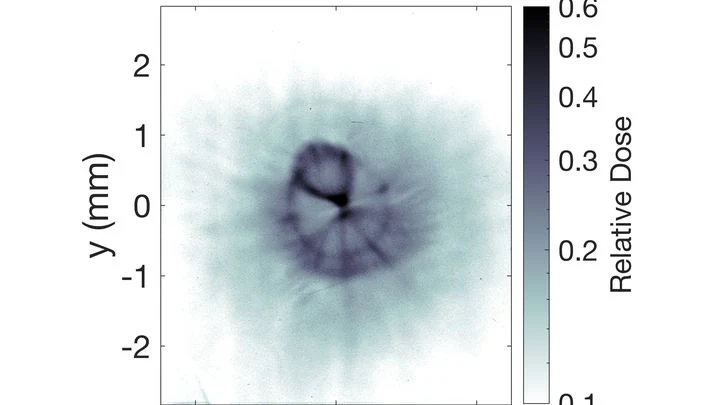
Two caravans travel toward each other along a narrow road. One is wide and slow, carrying a load of density. The other, a string of light carts carrying current, slips between the first. Thus, in a magnetron discharge, two structures rotating in opposite directions coexist: the density spoke and the current filaments.
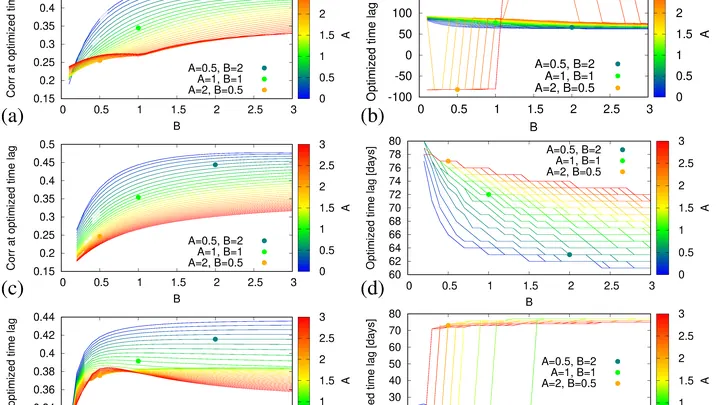
The Sun breathes, and that breath has a magnetic rhythm. Every 27 days, the visible surface of the star makes a full rotation, and with it, its magnetic field, like an invisible ribbon wrapped around the star.
The Sun has a layer called the chromosphere, sitting just above the visible surface. Bright arcs often flare up there, visible through telescopes, but to understand what ignites them, you need to look at invisible magnetic fields.
Inside a solar flare, magnetic field lines snap like stretched rubber bands and reconnect — releasing in minutes enough energy to power humanity for millions of years. In the lab, this process, magnetic reconnection, could long be triggered but not stopped. Now physicists have a switch.
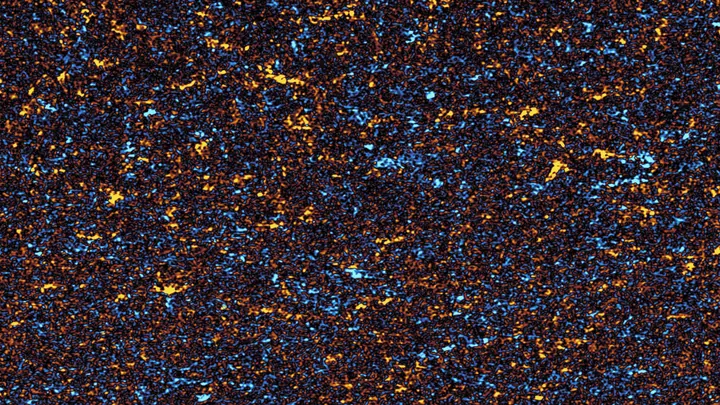
The solar corona lives its own turbulent life. Magnetic fields here are governed by the motions of the dense surface — the Sun's photosphere — but occasionally they rewrite the magnetic pattern themselves.
A sunspot cools, and above it a dark filament, a prominence, hangs for weeks. Inside it, like a compressed spring, hides the magnetic field. It can be laid out in neat arches, or it can be twisted into a tight rope.
The crown of a huge tree sways in the wind, but the roots and trunk are hidden underground. On the Sun, magnetic fields play the role of such invisible roots. They emerge from the depths, thread through the entire atmosphere, and govern the motion of the hot gas — plasma.
A planet's magnetic field is like an invisible shield: it catches charged particles from the solar wind and stretches out behind the planet into a long tail, like a fluttering scarf.
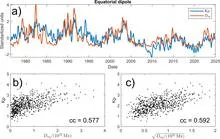
Magnetic fields on the surface of the Sun appear as dark spots and bright faculae. But they are born deep inside, where flows of hot gas act like a giant dynamo. The question is whether sunspots on the surface can predict what will happen inside the star years from now.
The authors applied a mathematical theorem similar to the rule linking the area of a shape to its boundary.
Dark matter is an invisible substance that keeps galaxies from flying apart. If its particles occasionally decay near the Sun, they shoot out streams of fast particles, like invisible hammers striking light. Each impact turns a particle of sunlight into a gamma ray — a super-powerful flash that telescopes can spot.
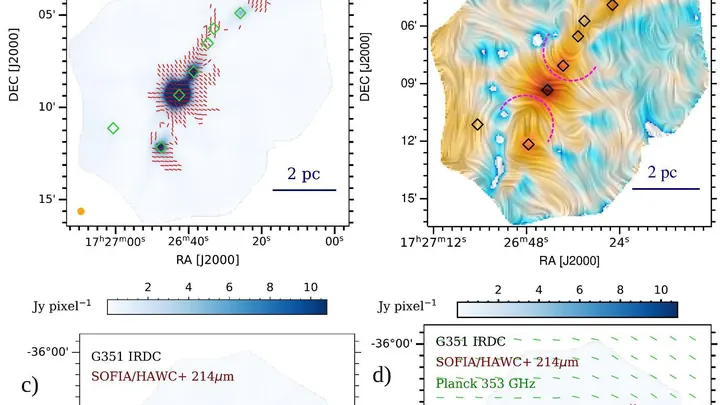
In the dark cloud G351, where new stars are about to emerge from gas and dust, the magnetic field has bent into an hourglass shape. Such a shape is a sign that the field is not just watching star birth from the sidelines but is actively taking part.
Scientists used the SOFIA telescope, mounted on an airplane, to see the dust in the cloud.
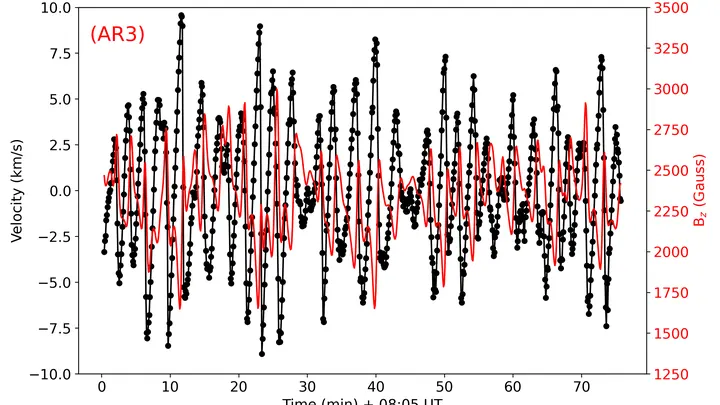
The Sun's surface is dotted with dark spots — regions of extremely strong magnetic fields that restrain the boiling of hot gas. From time to time, shock waves race through a spot's atmosphere, like a gust of wind compressing the air ahead of it. The gas briefly flares brightly, and astronomers call these events umbral flashes.
The Sun is not a calm sphere. Waves constantly ripple through its interior, like a bell after being struck. These oscillations reach the surface and reveal what's happening on the far, invisible side. Astronomers have long been able to 'listen' to this ringing and find large sunspot groups there.
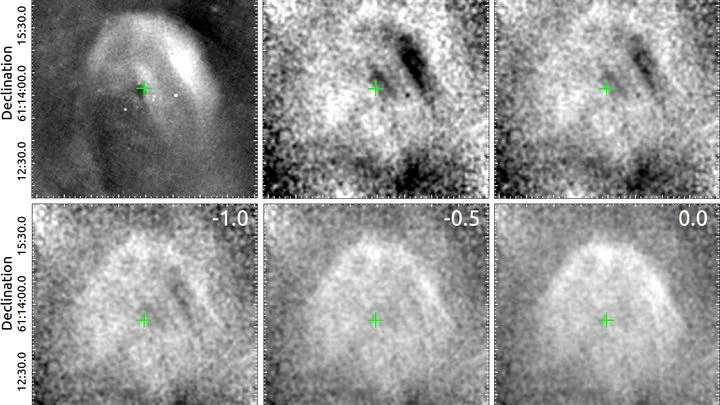
The VLA radio telescope peered into the Boomerang Nebula — a cloud inflated by the wind from a rapidly spinning neutron star. The new images reveal details as small as a lunar disk on the sky: an elongated core around the pulsar and a long arc curving around it from the north.
The Sun constantly emits a stream of charged particles — the solar wind. Among them are many electrons, some of which fly back toward the Sun. But observations show that fewer electrons return than expected.
Sunspots are traces of magnetic fields that emerge on the surface. They live their own lives: spots closer to the equator tilt more, while those farther away tilt less. These two effects, like two knobs on an old radio, control how much magnetic field reaches the Sun's poles and accumulates there for the next cycle.
An ordinary solar cell does one thing: when the sun shines, current flows. Here, when the sun shines, the current flows differently depending on which side you bring the magnet.
The Sun is not a calm sphere but a boiling cauldron that follows its own rhythms. Roughly every 11 years, its activity peaks: more dark spots appear on its surface, and streams of charged particles fly into space. But hidden within this grand cycle is a shorter one — about 1.7 years.
The Sun doesn't rotate as a solid body: its equator spins faster than its poles. This difference in rotation speed creates layers that move at different speeds, like ocean currents at different depths.
The Sun is not just a ball — it's a magnetic mansion. Its invisible force lines, like electrical wiring, thread through space and control space weather. But until now, we've only seen this wiring from the landing — the plane of Earth's orbit. The attic and basement, the magnetic poles, remained a mystery.