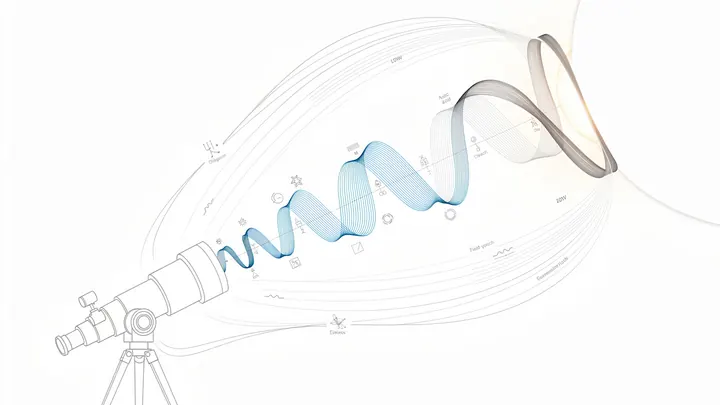
Solar magnetic phenomena encompass the dynamic and often violent magnetic activities on the Sun's surface and atmosphere, including sunspots, solar flares, coronal mass ejections (CMEs), and oscillations of magnetic field lines. These phenomena are driven by the Sun's internal dynamo — the churning of ionized plasma that generates and sustains magnetic fields. The magnetic field's behavior is not static; it undergoes cycles of buildup, stress, and sudden release, leading to the spectacular eruptions we observe.
History
The study of solar magnetism began with Galileo's observations of sunspots in 1610, but the magnetic nature of sunspots was only established in 1908 by George Ellery Hale, who detected their Zeeman splitting. The concept of magnetic reconnection was developed in the 1950s by Eugene Parker and others, and the solar cycle's magnetic periodicity was recognized in the 19th century by Heinrich Schwabe.
How it works
The Sun's magnetic field is generated by the motion of electrically charged plasma in its interior, a process described by magnetohydrodynamics. As the Sun rotates (faster at the equator than at the poles), the magnetic field lines become twisted and tangled over time. When the stress exceeds a critical threshold, the field lines can 'reconnect' — a process that converts magnetic energy into kinetic energy, heat, and particle acceleration. This reconnection triggers solar flares (sudden bursts of radiation) and CMEs (huge expulsions of plasma and magnetic field into space). The released particles and fields travel through the solar system, shaping the solar wind and influencing cosmic ray fluxes.
In practice
Understanding solar magnetic phenomena is crucial for space weather forecasting, which protects satellites, power grids, and astronauts from the harmful effects of solar storms.
Fun fact
The Sun's magnetic field reverses polarity approximately every 11 years, meaning the north and south magnetic poles swap places during each solar cycle.
An avalanche in a sandpile starts with a single grain. No one knows exactly where it will slip or how big the slide will be. But if you keep pouring sand, the pile itself reaches a state where avalanches of all sizes, from tiny trickles to massive collapses, follow the same law.
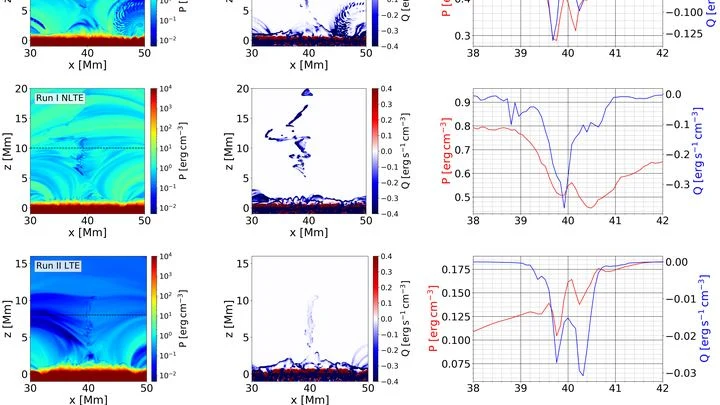
The Sun has quiet regions where the magnetic field is barely visible. But even there, sound waves find loopholes to rise higher. These loopholes are magnetic tubes that expand upward like funnels. Inside them, sound travels more freely.
In the solar corona, it rains from time to time — only not water, but plasma. The hot gas cools, clumps into blobs, and rushes downward along magnetic loops, like drops running down invisible gutters.
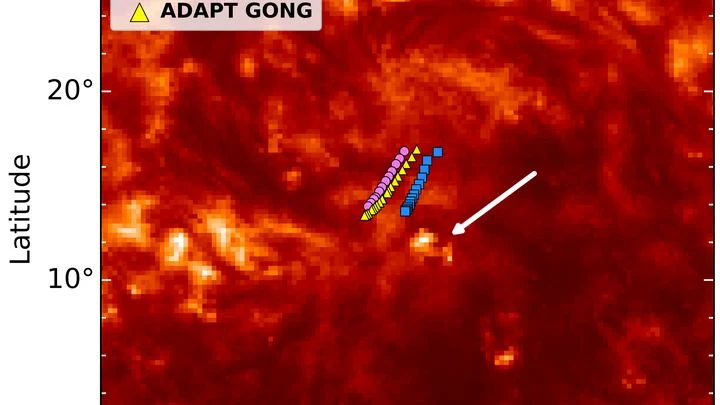
A sunspot, a dark island on the fiery surface, lives its own turbulent life. Beneath it, in invisible depths, giant magnetic loops drift like twisted cables. When such a loop emerges, it can discharge as a flare, and hurl clouds of charged particles into space.
Scientists have long tried to understand what determines the strength and suddenness of these events.
The solar corona lives its own turbulent life. Magnetic fields here are governed by the motions of the dense surface — the Sun's photosphere — but occasionally they rewrite the magnetic pattern themselves.
A waterfall that doesn't heat up from the fall but freezes — that's roughly how gas behaves as it flows onto a neutron star in an X-ray pulsar when the star shines dimly. Usually, infalling matter is heated to a white-hot glow, but new work shows the opposite.
In the vast clouds of rarefied gas that fill the space between stars, something is always churning. Supernova explosions, colliding streams — all of it shakes the plasma. And in this rippling, as it turns out, hides the mechanism that gives birth to magnetic fields.
Plasma is a gas in which electrons are stripped from atoms.
The Sun is not just a blazing ball, but a colossal orchestra, where the strings are solar filaments — giant arches of dense plasma floating in the scorching corona. They tremble, and each oscillation is an encrypted melody of magnetic fields.
Solar flares are powerful explosions on the Sun that can knock out satellites and blackout cities. Predicting them is complicated by the tangled magnetic fields in sunspots.
The Sun is not just a source of light but a giant laboratory where ghostly particles are born. Every second, billions of neutrinos fly through your body, barely noticing you. But inside the Sun, these particles behave differently: they change their type on the fly, like an actor playing three roles in a single play.
A sunspot cools, and above it a dark filament, a prominence, hangs for weeks. Inside it, like a compressed spring, hides the magnetic field. It can be laid out in neat arches, or it can be twisted into a tight rope.
The paradox of the young solar wind has long puzzled heliophysicists. Measurements showed that near the Sun, proton beams aren’t smeared out but sharply compressed, as if someone had neatly hammered them into the shape of a hammerhead.
The Sun is a boiling cauldron of hydrogen and helium, where scorching gas is caught in magnetic snares. When invisible ropes reconnect, energy comparable to billions of thermonuclear explosions is released. Where does it go?
In December 2011, Comet Lovejoy boldly raced through the searing corona of the Sun. Right after — a flare. Scientists checked whether the comet could have caused it. The atmosphere of the Sun is threaded with taut magnetic loops, like a drawn bowstring.
A giant cauldron that barely smolders most of the time, but occasionally spits out showers of sparks. That is roughly how the supermassive black hole at the center of our galaxy — Sagittarius A*—behaves. It weighs four million times as much as the Sun and lies 26,000 light-years away.
A thin layer of oil on the surface of water breaks into separate droplets at the slightest disturbance. Something similar happens in the pulsar wind — a stream of particles ejected by a rapidly rotating neutron star. This stream also contains plasma layers, which can break apart into clumps — magnetic islands.
In the scorching solar corona, where temperatures soar past a million degrees, float cold, dense clouds — solar prominences. They hang for weeks, neither falling nor dissolving, like icebergs in a boiling ocean. How they got there is a question that has puzzled astronomers for decades.
The solar wind, a stream of charged particles from the Sun, slams into the tenuous gas that fills the space between the stars. The collision produces a faint X-ray glow. For astronomers, this is like fog in front of headlights: it obscures distant objects.
Around small, cool, but extremely restless red dwarfs, planets the size of Earth often orbit. Such a star is like a temperamental stove that intermittently erupts flares: powerful streams of light and particles batter the planet's atmosphere, as if someone splashed fire into a simmering soup pot.
A stream of scorching gas races away from a star, and suddenly stalls, as if it hit an invisible wall. That's exactly what researchers saw when they tried to reproduce a stellar eruption on a laboratory scale. They used a laser to create a plasma jet and shot it through a magnetic field — first weak, then strong, like that of many stars.
The solar wind isn't a smooth flow: it's gusty. Inside it, protons and helium nuclei don't all travel at the same speed; they spread out like droplets in a hose stream. Usually, this spread is described by a simple bell-shaped curve.
Dark matter is an invisible substance that keeps galaxies from flying apart. If its particles occasionally decay near the Sun, they shoot out streams of fast particles, like invisible hammers striking light. Each impact turns a particle of sunlight into a gamma ray — a super-powerful flash that telescopes can spot.
During a thunderstorm, the sky acts like a giant battery: charge builds up in the cloud, and a lightning bolt discharges it. That charge is invisible, but cosmic particles (muons, which constantly rain down on Earth from space) can sense it. As a muon flies through a charged cloud, it speeds up or slows down slightly, and these changes reveal the voltage inside the cloud.
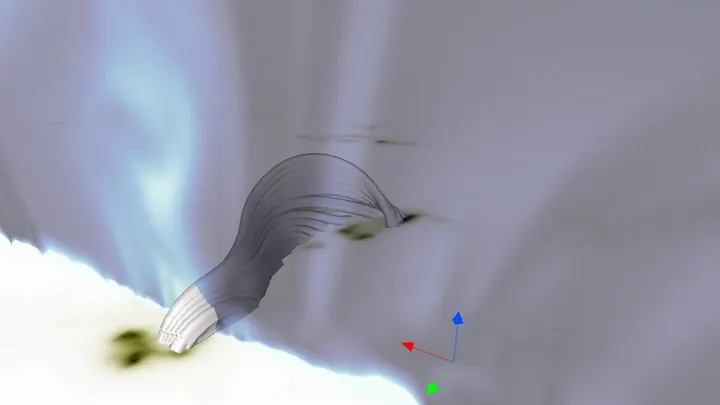
The Sun sometimes produces giant clouds of plasma that try to escape into space. But often they fail: an invisible magnetic cage keeps them near the surface. Such failed eruptions are called "trapped."
Scientists built a computer model to understand exactly how this cage works.
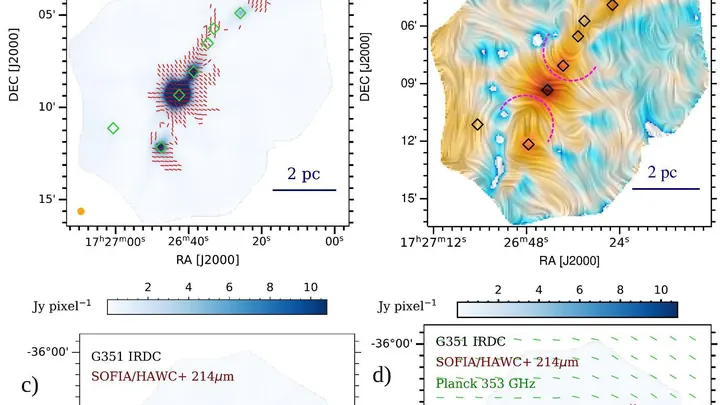
In the dark cloud G351, where new stars are about to emerge from gas and dust, the magnetic field has bent into an hourglass shape. Such a shape is a sign that the field is not just watching star birth from the sidelines but is actively taking part.
Scientists used the SOFIA telescope, mounted on an airplane, to see the dust in the cloud.
The Sun's corona looks like a shaggy dandelion: bright petal-like loops hold hot gas near the surface, while long, tenuous jets escape into space between them. These jets, the heliospheric current sheet, stretch across the entire solar system.
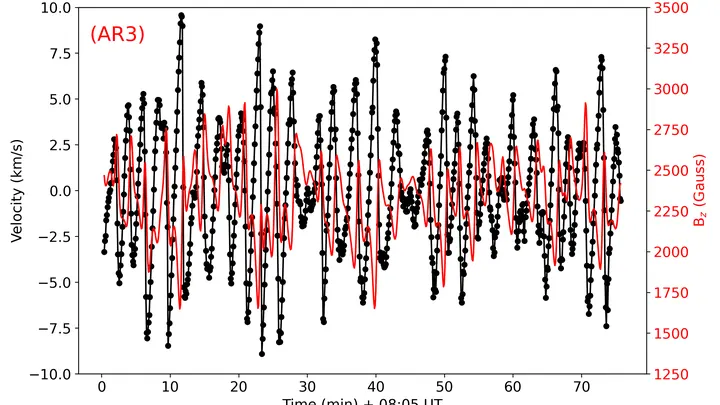
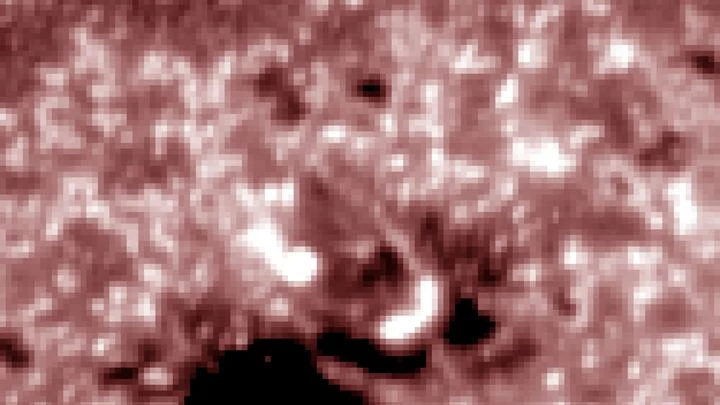
The Sun's surface is dotted with dark spots — regions of extremely strong magnetic fields that restrain the boiling of hot gas. From time to time, shock waves race through a spot's atmosphere, like a gust of wind compressing the air ahead of it. The gas briefly flares brightly, and astronomers call these events umbral flashes.
The X-ray pulsar Centaurus X-3 is a neutron star that spins rapidly and emits pulses of X-ray light like a lighthouse. Scientists pointed three space telescopes at it and studied the polarization of its emission — how the electric field of the light wave oscillates.
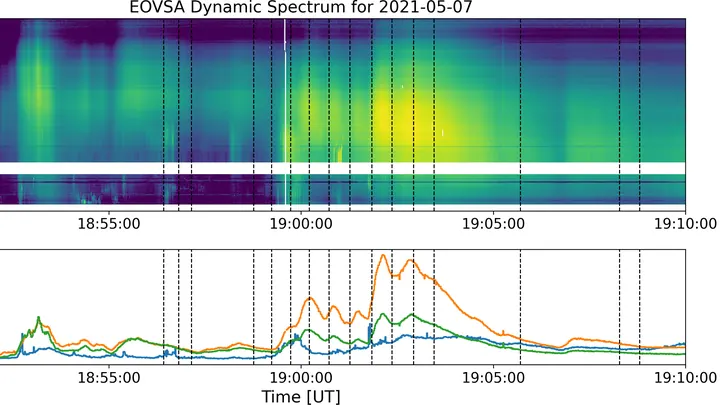
A solar flare is like a short circuit in a giant neon sign. Inside the Sun, magnetic fields twist into loops, like rubber bands, and when they reconnect, energy bursts into space. Part of it goes into hard X-rays, produced by particles accelerated to nearly the speed of light.
Cosmic rays are charged particles that reach us from distant stellar explosions. But before hitting a detector, they must pass through the bubble of the solar wind. The Sun breathes: it inflates this bubble, then contracts it.
If you toss a stone into a pond, ripples spread across the water. Tiny magnetic crystals also host waves — except it's not water that oscillates but the direction of magnetization. These are called spin waves. They travel through the crystal like ripples on a surface and can carry information.
A solar flare is like a giant spring that gets twisted and twisted, and then suddenly snaps. The energy stored in the magnetic field is unleashed into space within minutes, heating plasma to millions of degrees.
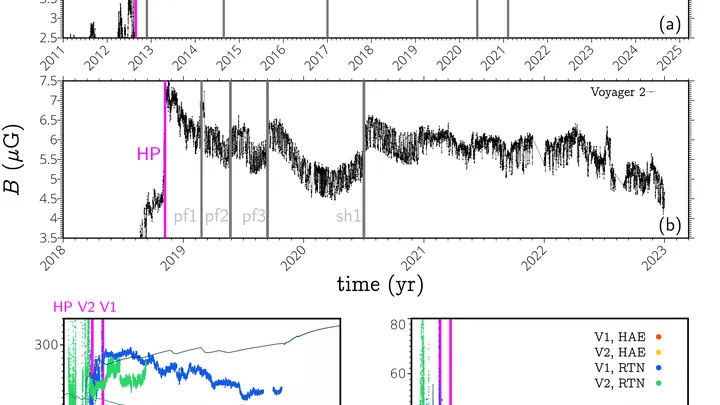
Two aging spacecraft, launched back in 1977, are flying through interstellar space — the region where the Sun's influence fades. The Sun doesn't just shine; it continuously blows a stream of charged particles that forms a giant bubble around our system — the heliosphere.
The Sun regularly produces explosions that hurl huge clouds of charged particles into space. Such a cloud travels toward Earth and can knock out satellites, disrupt radio communications, and even leave cities without electricity.
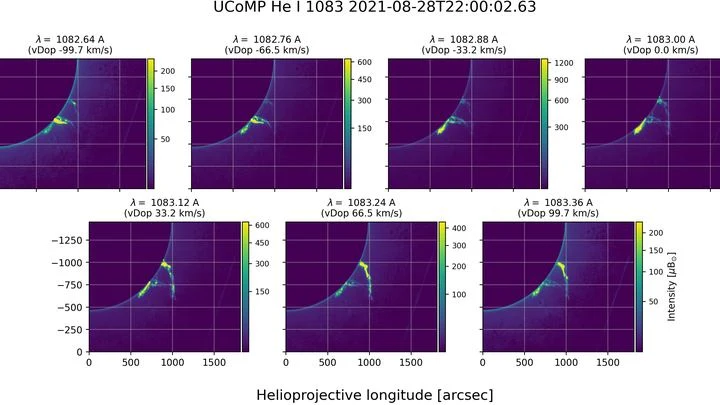
The Sun occasionally hurls enormous clouds of plasma into space — coronal mass ejections. Often tangled within these clouds are prominences: cooler, denser clumps of material. These contain plenty of neutral atoms that shine brightly in specific spectral lines.
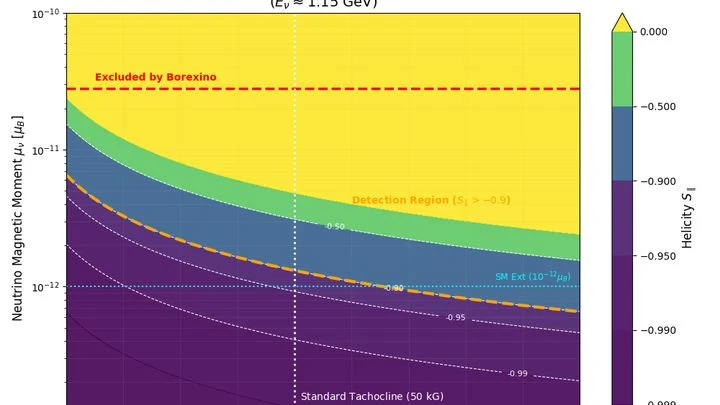
The Sun doesn't just shine: it continuously emits streams of tiny particles, neutrinos. They are born in thermonuclear reactions in the core and pass through the star almost unhindered. But inside the Sun, there are magnetic fields that can influence these particles, like invisible corridors that slightly bend their path.
A solar flare is like a tightly coiled spring suddenly uncoiling. In the Sun's corona, energy accumulates in the twisted magnetic field, and then it is abruptly released, accelerating particles and heating plasma.
On October 1, 2024, a class X7.1 flare erupted on the Sun — one of the most powerful. Two spacecraft, HXI and STIX, watched it from different angles, like two eyes, and together with a computer model helped reconstruct the three-dimensional picture.
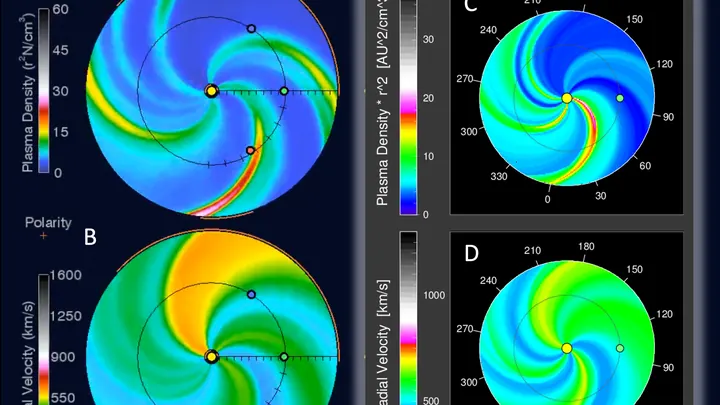
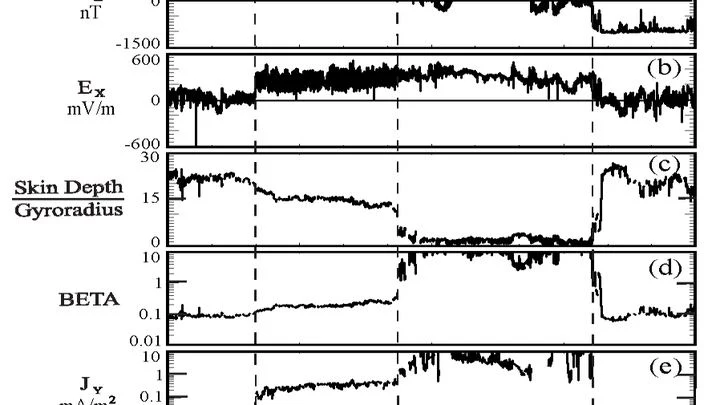
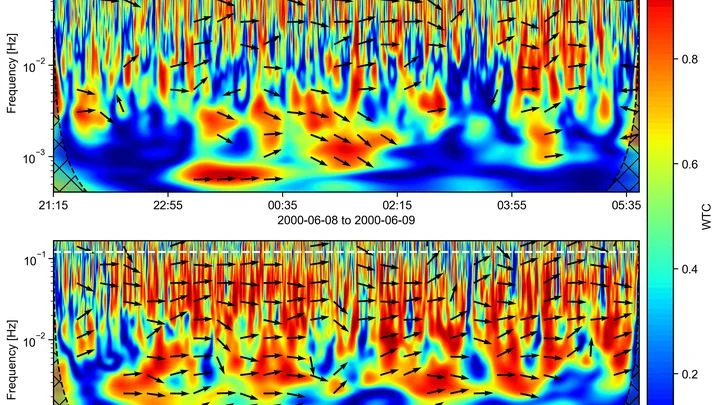
The Sun constantly emits a stream of charged particles, mostly hydrogen — the solar wind. Sometimes the Sun ejects dense blobs of magnetized gas, inside which calm usually reigns. But in 2000, scientists noticed two regions inside one such cloud where the gas was churning.
A young star is like a layered spinning top: its outer layers rotate slower, its inner ones faster. The magnetic field here acts like sturdy threads binding these layers together. When the speeds differ, the threads begin to twist and stretch more and more.