Solar Flare: The Boiling Starts Before the Stove Is Turned On
In a pot on the stove, water starts to churn from the bottom long before the whole thing boils. Bubbles of steam rise from the base even though the burner itself hasn't heated up yet.
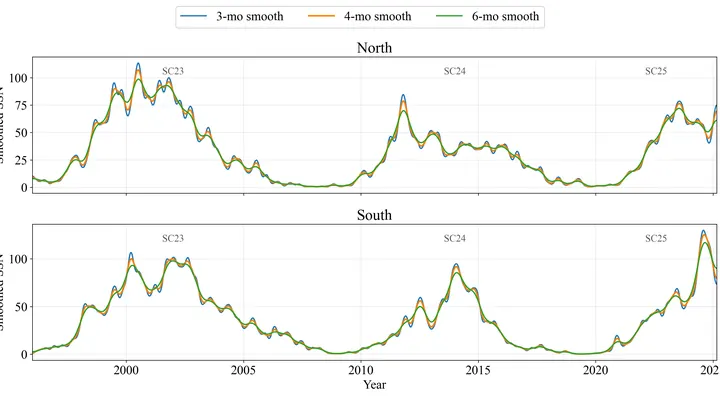
Temporary dark spots on the Sun's surface caused by magnetic activity.Sunspots are temporary dark regions on the Sun's photosphere, appearing darker because they are cooler than their surroundings. They are caused by intense magnetic activity that inhibits convection, reducing the flow of hot plasma from the interior. Sunspots often appear in pairs or groups with opposite magnetic polarities, and their numbers follow an approximately 11-year solar cycle. They are sites of strong magnetic fields, thousands of times stronger than Earth's magnetic field, and are associated with solar flares and coronal mass ejections.
Sunspots have been observed for millennia, but their scientific study began with Galileo Galilei and others in the early 17th century. The 11-year cycle was discovered by Heinrich Schwabe in 1843, and the magnetic nature of sunspots was established by George Ellery Hale in 1908.
The Sun's magnetic field is generated by a dynamo process in its interior, where differential rotation and convection stretch and twist magnetic field lines. When these field lines emerge through the photosphere, they form loops that suppress the upward flow of heat, creating cooler, darker regions. The magnetic field strength in a sunspot can reach several thousand gauss, and the spots evolve over days to weeks, with complex structures including a dark umbra and a lighter penumbra.
Sunspot monitoring is crucial for space weather forecasting, as solar flares and coronal mass ejections associated with sunspots can disrupt satellite communications, power grids, and GPS systems on Earth.
The number of sunspots in a given year correlates with the Sun's overall brightness, but during the Maunder Minimum (1645–1715), sunspots almost disappeared, coinciding with a period of cooler global temperatures known as the Little Ice Age.